

Exploring Lupin III Kabuki: Classical Japanese Theater Meets a Modern Classic
by Ken Iikura-Gross,Arguably one of the greatest action-heist anime and manga franchises is Lupin the Third. With its iconic characters of the master thief Lupin III, marksman Daisuke Jigen, honorable swordsman Goemon Ishikawa XIII, femme fatale Fujiko Mine, and the ever-persistent Interpol Inspector Koishi Zenigata, the franchise has seen the original manga series by Monkey Punch, several animated TV series, films, numerous TV specials, and theater productions. And in 2026, just on the cusp of Lupin the Third's 60th anniversary, the franchise returned to the stage for the new Lupin III: The beautiful azure castle kabuki play. ANN was able to experience the play before its Tokyo finale at the Shimbashi Enbujo theater, and it's a production to remember.
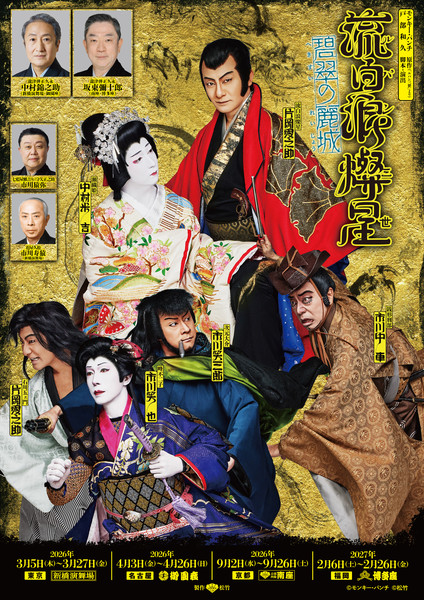
Starring Kataoka Ainosuke (Lupin III and Goemon Ishikawa XIII), Nakamura Yonekichi (Princess Seori), Ichikawa Emisaburō (Jigen Daisuke), Ichikawa Emiya (Fujiko Mine), Ichikawa Chūsha (Inspector Koishi Zenigata), and Nakamura Kinnosuke (Takitsu Danjō Hisanaga), the story follows Lupin, Jigen, and Princess Seori as they uncover the secret of the titular Azure Castle and the mysterious drug spreading across Suwa Province. Over the course of three Acts, the audience is treated to action, comedy, and fusions of modern and classical Japanese kabuki theater. While three acts may seem long, at about three hours total, the play is well-paced and is quite breezy, making it an exceptionally fun watch.
As we entered the theater, we were ushered to our first-floor seats and greeted with a beautiful curtain of the Lupin the Third characters in the style of a classic Japanese scroll art or Ukiyo-e woodblock print. As the final call for the audience was announced, the Lupin the Third curtain was taken back to reveal the green, black, and red kabuki curtain, signaling Lupin III: The beautiful azure castle was about to begin.
As the curtain was pulled back, the first scene set the stage for the kabuki play. Placing the characters in Feudal Japan, we were transported to Hatsuse Temple in Kamakura, where we learned that Princess Seori, the daughter of the now-deceased Lord of Suwa and head of the Harumiya clan, will marry the regent of the Harumiya Clan, Takitsu Danjō. Lupin, Jigen, and Goemon, though, plan to disguise themselves as the Temple's head priest and entourage to steal the dowry donation to the Temple. Fujiko, as always, has her own plans to steal the dowry and infiltrated Princess Seori's entourage as a lady-in-waiting.
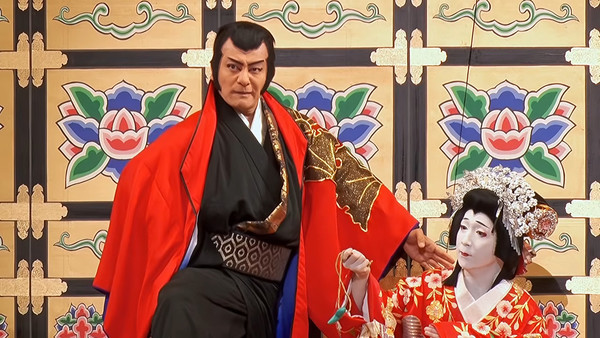
As Lupin puts his plan into motion, in what can only be described as a reference to Lupin III: The Castle of Cagliostro, the Princess, seeing through Lupin's disguise, reveals she wishes to live a free life and “stolen” away, offering her clan heirloom, a magatama, a comma-shaped jade bead as payment. As the back and forth continues, Lupin reveals himself to the Princess, only for Inspector Zenigata to interrupt them and utter his famous word, “Lupin! You're under arrest!”
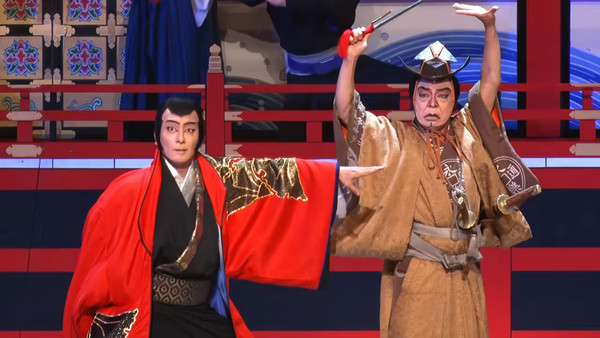
As an action scene began, a kabuki rendition of the Lupin the Third theme began playing. Brimming with shamisen three-string guitars, shakuhachi flutes, and tsuzumi hand drums, the characters engaged in an acrobatic and intense action scene. And, as is common in kabuki theater, each main character performed a mie pose during the height of their respective moment. The action ended with Lupin, Jigen, and Goemon making off with their stolen goods, but not before Goemon split the Temple in twain and uttering his famous words, “Once again, I have cut a worthless object.” And as the cast exited the stage, the classic typewriter clack revealed the title of the story.
A strong opening to Lupin III The beautiful azure castle to say the least, but the back half of the first act was just as strong. Moving to the bay around Enoshima in the Shonan Coast of modern Kanagawa Prefecture, Lupin and Jigen enter the scene via the hanamichi stage path, riding a small boat. Like in Lupin III: The Castle of Cagliostro, but more closely to a separate kabuki play according to the audio guide, the two enjoy their spoils only to discover the donations to the Temple were a new and popular drug. Tossing the booty overboard, the two spot Princess Seori fleeing her retainers by boat.
Not one to leave a lovely lady in trouble, Lupin intervenes in the chase. Rowing in to save the day, another action scene ensues. However, where the first action scene was filled with acrobatics and several mie poses, this action scene was built on the skilled handling of the prop boats by the Kuroko stagehands and the actors traversing between three boats. It was a different sort of fun compared to the acrobatics seen in the first scene, and it was exhilarating. And capping off the end of the first act was the appearance of Takitsu Danjō before Lupin, Jigen, and Princess Seori escape to Suwa Province.
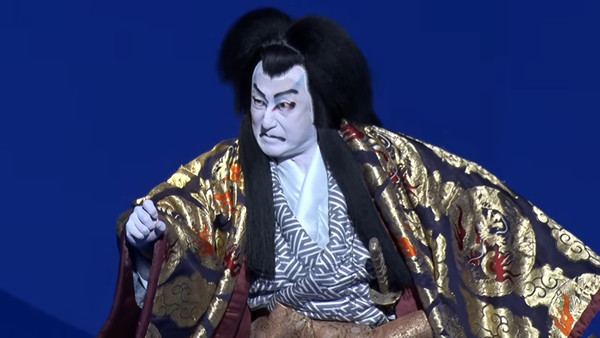
The first act cliffhanger ending wouldn't be resolved until the end of the first 20-minute intermission. However, as the second act opened, the play didn't jump right back into the action. Rather, the unlikeliest of Lupin the Third characters made an appearance on stage. That character was none other than Mamo from Lupin the 3rd: The Mystery of Mamo. A humorous appearance to say the least, Mamo joked about his appearance in Lupin III The beautiful azure castle along with promoting the plays Nogoya, Kyoto, and Hakata dates, the plays' merchandise, and most importantly, providing a recap and preview of the events.
Mamo's preview provided the audience with information about the new and popular drug spreading across Suwa Province. Capped with a villager high on the drug to show the audience its effects, Mamo ushered us into the Second Act with Lupin, Jigen, and Princess Seori, who pretended to be a village girl, entering a town square.
As someone who lived a sheltered temple life, Princess Seori is shown as unaccustomed to a bustling village life. But the disguise is more to hide her identity. While she is almost discovered after she helps a woman with an elixir, the counter to the popular drug, Lupin and Jigen shoo away any onlookers and eavesdroppers so they can explore the village. While one would think, “how are the characters going to explore the village with such limited stage space,” the three characters, in fact, entered the first-floor audience space and treated it as an extension of the village they were in.
What made this exciting was how the actors interacted and ad-libbed with the audience. Stopping once to comment on one person as a Jizo Buddha statue, as the procession made its way around the aisles, they stopped about three or four rows behind where we were sitting, only for Princess Seori to ask an audience member, “What are you doing here?”, as if to treat the audience as villagers rather than spectators. Unfortunately, the audience member was flustered and couldn't quite respond to the Princess's question.
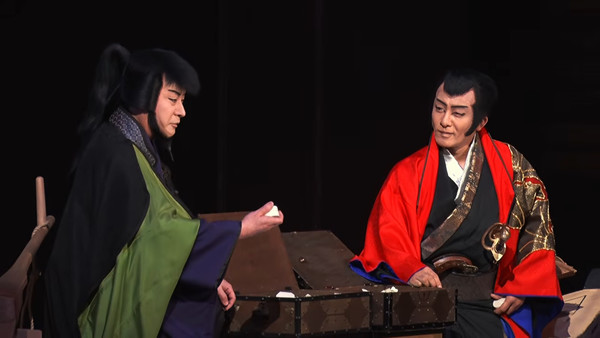
Eventually returning to the village square, Jigen departed to buy some tobacco, leaving Lupin and Princess Seori to get some food at a soba noodle shop. As the two settle in and discuss the drug and elixir, who should eavesdrop on their conversation but none other than Inspector Zenigata. “Arresting” Lupin at the most opportune moment, as the master thief is one to escape handcuffs easily, in a surprise twist, it's revealed that the shop owner was once a retainer to Princess Seori's father. Lamenting the state of Suwa Province, the four characters, although to the dismay of Zenigata, make a pact to stop Takitsu Danjō. Just as the pact is formed, Takitsu Danjō's men assault the soba noodle shop for a rousing end to the opening of the second act. However, Lupin is separated from Princess Seori, but not before he is entrusted with her magatama, a comma-shaped bead.
While Fujiko hasn't played a large role in the play to this point, she has her moment to shine when Lupin and Jigen take a slight detour to Princess Seori's old estate. Revealing Princess Seori has been captured and wants to learn why Lupin is with the Princess, Lupin skirts over the major details, letting his lust for Fujiko win. And in good Lupin the III fashion, Lupin attempts his patented dive, albeit without his clothes magically coming off, only to be slapped by Fujiko. The detour is not without its plot progression, as it is here that Lupin learns the secret of the drug and elixir made in Suwa Province, the water in the now dry well. Postulating where the source of the water is, Lupin heads off to free the captured Princess Seori.
The scene then shifts to Inspector Zenigata and his men as they search for routes into Takitsu Danjō's estate. A comical affair, four of Zenigata's men appear one at a time from the four cardinal directions, only to give a long-winded explanation that they could not find an entrance to the estate. Undeterred, Zenigata and his men use his classic technique to infiltrate Takitsu Danjō's estate, Lupin declaring he will steal Princess Seori.
Lupin III The beautiful azure castle then shifts gears as the scene changes to Takitsu Danjō's estate. Where the play felt closer to a modern production, the scene used classical kabuki narration and storytelling methods. As in, a narrator, accompanied by a shamisen player, narrated the goings-on of the scene. It's much slower than the rest of the play, but it puts on full display the range of a modern kabuki production. And the scene focuses on a tied-up Princess Seori under the moonlight and Sakura trees in full bloom.
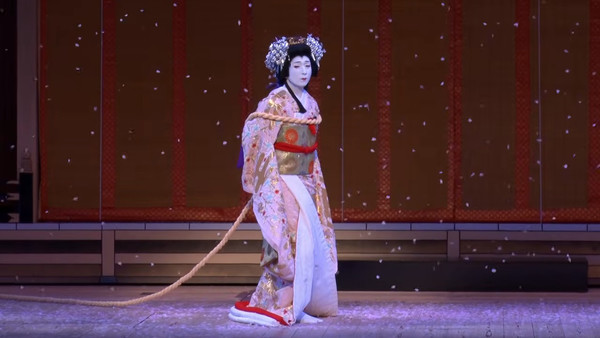
It's not long before Lupin enters to free the Princess and, as if falling into a trap, faces Takitsu Danjō for the first time. While the action begins on the first floor of the estate, with some kabuki stage magic by lowering the stage center, the action moves to the roof. While all seems hopeless for Lupin and Princess Seori, using a magical phoenix ornament on the roof, the two escape to freedom. Thus, bringing the second act to a close.
In classical Japanese storytelling traditions stories follow the kishōtenketsu four-act format, with Ki being the opening, Shō being the development, Ten a twist or different perspective in the story, and Ketsu concluding the story. This is fundamental in many Japanese stories, and Lupin III The beautiful azure castle is no different, as the opening of the third act takes the audience away from Lupin, Princess Seori, and Takitsu Danjō. Instead, the story briefly follows Goemon and Jigen. As part of his training, Goemon enters the mountains of Suwa Province to vanquish a legendary giant centipede. While not connected to the main story, the scene serves more as an introduction to other aspects of kabuki for those unfamiliar with its storytelling traditions. As such, we're treated to a wonderful location change with the center stage physically rotating. Much like the stage lowering at the end of the second act, this is part of Kabuki stagecraft, in which sections of the kabuki stage are purpose-built to rotate, lower, and even rise.
Upon finishing the location change, Goemon and Jigen face the giant centipede in another spectacular action piece. It's difficult to imagine the two characters doing this, as one might expect the centipede to be one giant prop. However, the centipede was composed of several actors working in tandem. The scene was a nice respite from the main story, despite not having much to do with it, and conveyed aspects of traditional kabuki theater engagingly.
As the story moved to the play's final scene, we found Lupin and Princess Seori at a shrine hidden in a rocky cave, where the key to the late Lord of Suwa's elixir and the new drug circulating the Province lay. It's here that Lupin and Princess Seori learn of the full treachery of Takitsu Danjō. Not only does the regent want Suwa Province for himself, but he also aims to take the Emperor of Japan's seat by spreading the drug. And the waters that once flowed from the shrine are the key to his plans.
With a short battle between Takitsu Danjō and Lupin ensuing, as if heightening the drama, Takitsu Danjō bests Lupin and leaves the burglar on his last breath. And as the regent is about to obtain his riches, much like in Lupin III: The Castle of Cagliostro, he is done in by his own greed with the shrine crumbling on him and the pure waters flowing once again. But, as with any good story, Lupin can't be left to die. With the final dose of her father's elixir, Princess Seori administers it to Lupin. Regaining consciousness, Lupin offers his final goodbye to the protests of Princess Seori, who wishes to be taken with him.
And as one can guess, Inspector Zenigata arrives just after the intrepid burglar departed. Despite Princess Seori's insistence that Lupin stole nothing, the play ends with Zenigata's famous line, “No, ma'am. He stole something of no small value… your heart.”
Although the play ends with Inspector Zenigata chasing after Lupin once more, we are treated to one final short scene, a festival celebrating the ascendance of Princess Seori to Lord of Suwa and the prosperity of the Province. A bit on the comical side, there are some fun interactions between all the major characters on stage. But there was one final surprise for the audience, a shower of gold koban coins. While it was only a thin plastic sheet replica of the Japanese gold coin, it was certainly a fun way to send off both the play and the audience.
Despite Lupin III: The beautiful azure castle running three hours, it's a fun experience from start to finish. The play is played straight for the most part, but the few fourth-wall-breaking moments help engage the audience even more with the narrative. While the Tokyo showings ended on March 27, Lupin III The beautiful azure castle is showing at the Mizono-za theater in Nagoya between April 5 and 26, the Minami-za theater in Kyoto between September 2 and 26, and Hakata-za theater in Fukuoka between February 6 and 26, 2027.
discuss this in the forum |
