

Game Review
by Lucas DeRuyter,Pokémon FireRed Game Review
Nintendo Switch 2
| Description: |  |
||
Pokémon FireRed Version and Pokémon LeafGreen Version were originally released for Game Boy Advance in 2004, and this Nintendo Switch release will contain much of the same Kantonian charm. Players will be able to revisit the classic story and Pokémon of Pokémon Red and Pokémon Blue with the updated graphics you know and love, complete with the excitement of the Sevii Islands introduced in Pokémon FireRed Version and Pokémon LeafGreen Version. Players can also look forward to trading Pokémon, battling each other, and more using local communication. Disclaimer: This game was reviewed on the Nintendo Switch 2 system. |
|||
| Review: | |||
Do not spend twenty dollars to play 2004's Pokémon FireRed on the Nintendo Switch family of systems. I really hate having to bring up whether a piece of media is “worth the price” in a review, as this is one of the lowest forms of criticism imaginable, but charging twenty dollars for a largely straightforward port of a game that came out twenty years ago is as egregious as it is insulting. The Nintendo Switch consoles have a collection of Game Boy Advance titles available on the platform through the Nintendo Switch Online service that both FireRed and LeafGreen would be perfect for, and the only reason I can surmise for Nintendo and GAME FREAK charging this much for this port is because Pokémon is popular enough that they think some members of that massive fanbase will shell out for them. Don't buy this game and reward their cynical and disrespectful business practices. The changes between this version of the game and the original are so minimal that you can have virtually the same experience — or, arguably a better one as the the D-pad on the Game Boy Advance, SP, and Micro are all far more pleasant to use than the buttons on the Switch or Switch 2 — by dusting off an old Pokémon FireRed Game Boy Advance cartridge. Maybe if there were features in this game like save states or an increased playback speed, it would be worthwhile to purchase this version of this game, but the differences are too minimal to be worth the spend, even for folks wanting to engage with this in a nostalgic or educational capacity. With all of that being said, I'm a thirty-year-old man who's been playing Pokémon games for just about as long as I've been alive, and I have had to listen to a lot of people express some very wrong opinions about the series, with these first remakes in the franchise regularly being the target of shallow criticism and misinformed commentary. Now that I have any kind of soapbox to stand on, I'm going to use the rest of this review to set the record straight on these remakes, while casting a particular focus on how Pokémon FireRed iterates on past entries in the franchise and what stands out in the twenty-two years of Pokémon evolving beyond this title. 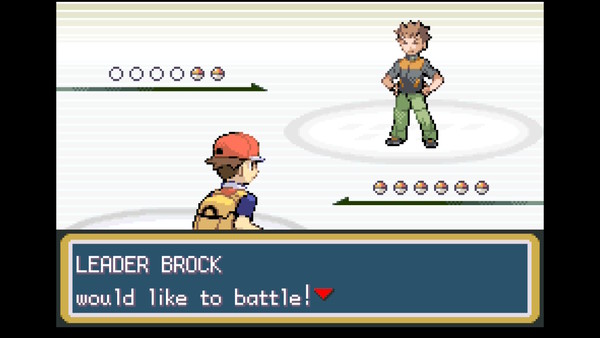 © © 2026 Pokémon. ©1995 - 2026 Nintendo/Creatures Inc./GAME FREAK Inc. TM, ®Nintendo. In 2026, Pokémon FireRed feels like it marks a transitional point in the franchise's history. While this title does run far more smoothly than the notoriously buggy Pokémon Red, it lacks several gameplay and quality of life decisions that GAME FREAK would go on to implement in the franchise in future titles. However, the base of the original games that started this decade-spanning Pokémania trend is so good that I can't help but fawn over how this title iterates on prior role-playing games while also being a masterclass in world-building. While Pokémon Red is less prone to outright breaking than the title it's remaking, there's a lot more moment-to-moment friction and small annoyances in this game than in the original. Most NPCs deploy stall strats to drag out encounters. Status ailments like poison are incredibly common thanks to Poison-type Pokémon being the most common type in the Kanto region and the introduction of the Poison Point ability, and experience not distributing between the entirety of the party makes it difficult to keep six different monsters at a competitive level simultaneously. This clunkiness is especially frustrating when compared to the deeply considered and curated world of Pokémon FireRed, and I struggle to think of a team that made a game this tonally specific and confident could have also made one that's such a grind to actually engage with. More surprising than that, though, is how I still could not put Pokémon Red down after all these years! I remember living in the world of this game during my free time as a kid, and as an adult, I found myself once again staying up later than I should have and mulling over party compositions and strategies during quiet moments throughout the day. There's something so special about this weird, horny, dark, team-building inspired world that resonates with me — and millions of others — deeply, and that quality of this game shines through no matter how dated it may feel by today's standards. 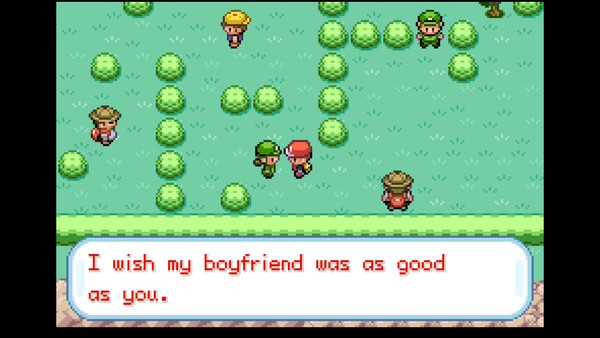 © © 2026 Pokémon. ©1995 - 2026 Nintendo/Creatures Inc./GAME FREAK Inc. TM, ®Nintendo. When I describe Pokémon FireRed as “clunky,” please know that I'm not referencing the third-generation Pokémon mechanics broadly, and am instead referencing specific implementations of these mechanics that feel half-baked in this entry. Broadly, I enjoyed going back to a more simplistic version of the Pokémon battle system and appreciated how some Pokémon were designed specifically around these mechanics. For instance, creatures like Gyarados and Kingler are often ridiculed in these games for having stats that aren't synergistic with their typings. In generations one through three, a move's type determines if it draws from the Attack or Special Attack stats in damage determination, and as Water moves are classified as Special Attacks, that limits the amount of damage that these Attack stat heavy-hitters can dish out. However, the games are aware of this lopsided and seemingly limiting stat distribution and balance around it while dropping hints to clue the player into the correct mindset. While both Gyarados and Kingler can't make much use of the same-type attack bonus (or STAB) from their Water typing, they both have movepools that let them learn plenty of physical attacks that draw on their Attack stats, with Gyarados' Pokédex entry even explicitly mentioning how much damage it can do with the Normal type, physical attack Hyper Beam. Furthermore, Rock type Pokémon are one of the few types to resist Normal type attacks in this game, but are weak to Water type attacks and, as many of the Rock types in this game like Onix, Geodude, Graveler, Golem, Rhydon, and Rhyhorn are all part Ground type; they are actually four times weak to Water attacks which means Gyarados and Kingler can effectively able to use Water type moves against them even with their non-conducive stat spread. Setting up this kind of interplay between these different monsters is a masterclass in turn-based RPG game design, and Pokémon Red is LOADED with these kinds of inspired interactions! This game allows you to use status ailment strategies against Gym Leaders, the functional bosses of this game, which most other RPGs, like the SMT/Persona and Final Fantasy franchises, often block the player from utilizing. Lance and his three Dragon-type Pokémon can be a difficult hurdle to clear as they resist the Fire, Water, and Grass starting Pokémon types, but all have a disadvantage against Ice-type Pokémon, which can be sourced through optional trades or the skippable Seafoam Islands dungeon. Not to mention that Snorlax, a functional mandatory mini-boss, has a borderline competitive setup as an HP tank that can recover health by deliberately taking on the Sleep status condition while also possessing one of the few moves in the game that can deal damage while a creature is asleep. Even if these mechanical interactions aren't always the most thought-out or synergistic, they're some of the best in this genre, often enough that I can overlook most shortcomings…even if I do need to call those shortcomings out. 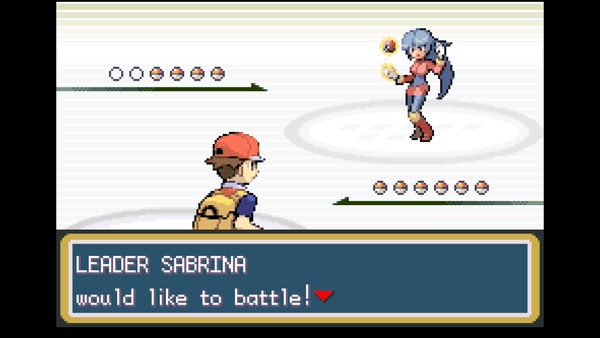 © © 2026 Pokémon. ©1995 - 2026 Nintendo/Creatures Inc./GAME FREAK Inc. TM, ®Nintendo. Unfortunately, a big part of what makes Pokémon FireRed's cleverest moments shine so brightly is that a lot of the minute-to-minute gameplay can be fairly monotonous. While Pokémon FireRed's more grounded depiction of traditional RPG dungeons in routes, caves, buildings, and even a cruise liner that the player traverses through in this campaign are well designed and feel like an exercise in endurance and resource management a la the early Dragon Quest games, many of the battles in these dungeons are underbaked and forgettable. Understandably, wild Pokémon encounters would involve the opposing creature spamming attacks at random to reinforce the trainer-Pokémon at the core of this game's world-building, but it's really frustrating that many trainer battles are interchangeable slogs. A lot of the NPCs in this game don't seem to have much thought put into their strategies or team composition. While I do like that Pokémon FireRed essentially makes more everyday careers into RPG classes by assigning certain kinds of Pokémon to different kinds of trainers — Hikers use Rock and Fighting types, Scientists use artificial Pokémon, more villainess NPCs like Bikers or Rocket Grunts use Poison types, etc — most battles devolve into just spamming a strong attack because NPCs don't have any kind of strategy or cohesion in their teams. For instance, in several battles, an opponent's Horsea used the move Leer against my Pokémon to lower its Defense stat. This is essentially a waste of a turn because, at the level I fought them, the Horsea would only know Water-type moves to deal damage, which uses the opponent's Special Defense stat in damage calculation. While I understand this situation is largely a consequence of the more limited move pool most Pokémon have in the third generation of games, it would be nice if the difficulty in this game came from more regularly challenging encounters instead of just the sheer volume of battles you'll face while trying to get to a new town. The exception to this lack of combat design is, unfortunately, how often dungeon NPCs utilize stall strategies. To keep the above example going, in many of those fights with Horsea, the battle would start with the not-yet-a-dragon seahorse using Smokescreen, a move that makes attacks more likely to miss. While this debuff can be reset by switching out the current Pokémon or using a guaranteed-hit movie like Aerial Ace or Swift, those moves are rare, and having to take an extra turn to switch is still annoying when most of an evenly leveled party can one-shot this opponent. Since accuracy-lowering and similarly annoying evasion-raising moves can be used by commonplace-on-NPCs Pokémon like Grimer, Koffing, and Clefairy, lots of fights turn into spamming whatever attacks have the most power points and hoping that one of them will connect. This loops into another problem with the movesets of this game: most Pokémon in Pokémon FireRed learn an incredibly limited number of moves naturally. The game flags early that a player should use Technical Machines, or TMs, to teach a monster more powerful moves. However, TMs can only be used once — a limitation that would be phased out in future games — and many of the Pokémon encountered early in the game are deliberately underpowered and likely to be phased out of a party later in the game. Collectively, this actually motivates a player to wait until near the end of the game to start utilizing TMs when their preferred party is more finalized. There's an obvious cycle of friction in the creatures in this game, having a limited learnset, TMs having a scarcity element, and early game party options having a lower endgame utility that could be resolved by even just one of these dimensions being improved, and I have a hard time imagining how it took the franchise so long to address this deficiency. There are so many things to love in Pokémon FireRed, and I desperately wish that many of its shortcomings weren't obviously the consequence of many of these decisions being made at the franchise's inception and not reexamined in this game's development process.  © © 2026 Pokémon. ©1995 - 2026 Nintendo/Creatures Inc./GAME FREAK Inc. TM, ®Nintendo. I know this is fairly obvious and applicable to every game in the franchise, but I'd be remiss if I didn't mention how absolutely incredible it is to start Pokémon FireRed with a team of cute little animals and bugs, and finish the game with a party comprised of dinosaurs, dragons, and monsters! The Pokémon games make progress both legible and cool in a way that very few other games can communicate. While there is a satisfaction in seeing various numbers go up in an RPG, by having the creatures you're controlling become visibly stronger makes a player feel like they've overcome challenges and are standing at the top of this world by the time the credits roll. It's also clear after playing Pokémon FireRed that, for as much as broader discourse around Pokémon games can often focus on things like graphics and difficulty, it's the world-building that's turned these games into one of the biggest media franchises in the world. The world of Pokémon FireRed is filled with iconography and experiences that are immediately recognizable to a young person who's beginning to familiarize themselves with the world around them, and makes it infinitely cooler than real life by filling it with monsters and letting kids do cool adult stuff. In this game, you play a child who leaves home on their own, who goes on to stand on equal footing with adults who hold respected positions in society, win big at a casino, and wail on some punks who are mean to Pokémon. Furthermore, much of this game is grounded in references to real-world locations like India and Ayers Rock, features non-Pokémon related fantastical elements like psychic powers, and includes facets of life that young people aren't likely to have much experience with, such as death and people being horny. The world of Pokémon FireRed is stuffed to the brim with societal underpinnings, and that both informs a younger audience to the world around them and creates a surprisingly familiar world that people of all ages want to live in. This incredible feat of writing is further elevated by one of the best localizations in video games. These localization choices are so ubiquitous now that we don't talk about them often, but naming the elemental bird trio “Articuno, Zapdos, and Moltres” is really fun! Similarly, “Elite Four” might be the best translation of “Shitteno” ever written, and so many characters have wacky, weird, or extra dialogue that further makes the world feel even more delightful and elevated. There's an NPC in this game with a team of Meowths that just says “meow” over and over when she challenges you to a battle, and I don't know how anyone can find this game to be anything less than entirely delightful. The Nintendo Switch port of Pokémon FireRed is far from perfect and, in some ways, is worse than both the original release of this remake and the Game Boy game this remake is based on. However, there's something undeniably special about this game that makes it peerlessly charming and impossible to put down. Even if I don't think anyone should pay twenty dollars to experience this game, I'm so glad I had the opportunity to re-play this title and express what made it so affecting and inspiring now that I'm an adult. This port of Pokémon FireRed made me realize why I was destined to become a Pokémon kid, and why I'm going to be a Pokémon adult for the rest of my life. I don't think I can ask for more than that from any video game. |
|
The views and opinions expressed in this article are solely those of the author(s) and do not necessarily represent the views of Anime News Network, its employees, owners, or sponsors.
|
| Grade: | |||
Overall : A
Graphics : A
Sound/Music : A
Gameplay : A
Presentation : A
+ Enchanting world-building, deep systems that reward exploration, and artful localization. |
|||
|
discuss this in the forum (13 posts) |
bookmark/share with:

|
|||