

Spring 2026 Light Novel Guide
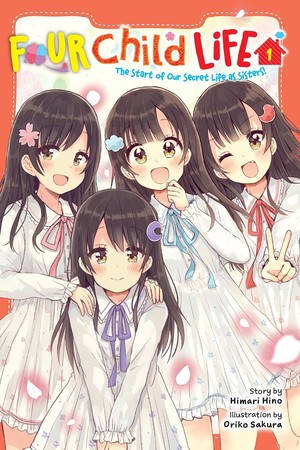
Four Child Life
What's It About?
I THOUGHT I WAS ALL ALONE, BUT I'M ACTUALLY A QUADRUPLET?!
My name is Mifu Miyabi. For the past twelve years, I thought I had no family―no parents, no siblings. Little did I know, my world was about to get turned upside down by not one, not two, but three identical sisters showing up out of nowhere! Sure, we all grew up leading separate lives, but now we have to figure out how to live together under one roof. It may be hard to tell us apart just by looking, but we're much more different than you'd think. This is how our time as a family begins!
Four Child Life has a story by Himari Hino and illustrations by Oriko Sakura. English translation is done by Laura Sitzer. Published by JY (April 14, 2026).
Is It Worth Reading?
Rebecca Silverman
Rating:
Writing good middle grade fiction is a lot harder than many people think. Particularly at the lower grade-level end of the demographic, stories have to balance being age appropriate with not talking down to their readers. Four Child Life almost gets there, but it keeps getting tripped up by its need to make the story feel safe and cozy for its readers. It really would be a stronger book without that.
In large part this comes down to the plot's unbalanced use of what's commonly known as “the orphan fantasy.” In children's literature, this is twofold: one variant is that the adults have to be gone in order for the children to go on their adventures (think The Chronicles of Narnia), and the other is that the child is an orphan who is secretly part of a family who has been looking for them. Four Child Life combines these two variants in what feels like a very contrived way: Mifu, who was abandoned as an infant, is suddenly roped into a new program for middle school orphans that “teaches” them to live independently only to find that the other three girls she'll be living with are her long-lost quadruplet sisters.
If that sounds silly, it absolutely is, and the whole “independence” training positively beggars belief, because what sane government would throw four twelve-year-olds into a paid-for house on their own and expect them to be able to thrive? What saves it, to a degree, is the fact that it seems like it might have been orchestrated specifically for the sisters, which adds a little mystery to the story. The fact that of the four sisters, only two were living in group homes also feels suspicious – it would make sense to have Mifu and Shizuki be part of the program, but Ichika was in a foster home and Nitori had been adopted. Why rip them away from their parents? It's not like they were in danger of aging out of the state-sponsored childcare system.
Then there's the girls' biological mother, who seems to have a weird, sudden stake in the matter. She only shows up after they're ensconced in their new house, and she's plainly a rich and powerful woman. Right now, my best guess is that the girls are all clones or something, and she threw them out into the world separately as some kind of sick experiment. So there really is some plot to be found here. The problem is that it's buried under a lot of nonsensical fluff that talks down to the reader, like an “independence test” that requires the girls to wear something matching or divvying up chores in as cutesy a way as possible.
Four Child Life isn't terrible, and I do think that the author will mature into a good writer (this is her first series), but if you're looking for a good orphan fantasy novel, I'd suggest hunting down Julie Edwards' Mandy instead.
Erica Friedman
Rating:
Little Women this ain't. That said, Four Child Life: The Start of Our Secret Life as Sisters!, somehow manages to be contrived and absurd without being cloying or unpleasant.
Mifu's experience is neutral enough that she is not particularly happy to leave her orphanage, but when she encounters three girls who look identical to her, she feels as if she finally has a family. Lots of warm fuzziness as they work to bond, deal with disagreements and work through the vastly different experiences they had growing up. There are many mysteries presented here, not the least of which is their mother who becomes a shocking problem that leads to as much of a climax this story has. The four characters, despite looking the same, are very much not the same person, which helps not only to differentiate between them, but to create friction that leads to what plot the story contains.
The key to this story Is to read it with good intent, as it was—apparently, based on the author's note—written. The idea of suddenly realizing you're a quadruplet, suddenly gaining family, suddenly being happy after years of just…not having anything to look forward to, could easily feel like a cut-rate A Little Princess, but because it is written to be exactly what it is, it escapes that.
I'm not sure I would recommend this to a middle-grade reader, because it is a bit simple, but an older young reader, with a love for orphan stories, say post-Pippi Longstocking, pre- Anne of Green Gables might find this an easy read.
Disclosure: Kadokawa World Entertainment (KWE), a wholly owned subsidiary of Kadokawa Corporation, is the majority owner of Anime News Network, LLC. Yen Press, BookWalker Global, and J-Novel Club are subsidiaries of KWE.
The views and opinions expressed in this article are solely those of the author(s) and do not necessarily represent the views of Anime News Network, its employees, owners, or sponsors.
discuss this in the forum (4 posts) |

back to Spring 2026 Light Novel Guide
Seasonal homepage / archives