

The Winter 2026 Light Novel Guide
Divine Incursions
What's It About?
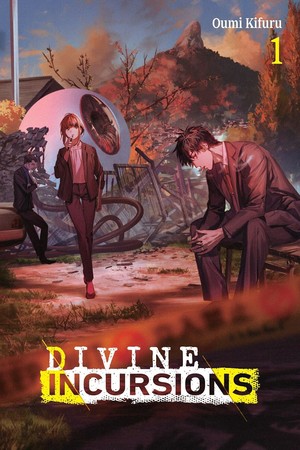
In this world, there exist divine beings beyond mortal comprehension. To them, the concepts of good and evil mean nothing. From destructive physical manifestations to the manipulation of dreams and warps in the very fabric of reality, the gods continuously threaten peace across Japan. And humans are completely at their mercy. Agent Katagishi and his junior partner Miyagi belong to a secret government organization tasked with investigating supernatural incidents. It's their job to handle cases involving deities and the dangerous humans who worship them. And in the midst of it all, Katagishi is determined to track down his missing wife, even if it forces him to confront a terrible truth...
Divine Incursions has story by Oumi Kifuru. English translation is done by James Balzer. Published by Yen On (December 30, 2025).
Is It Worth Reading?
Rebecca Silverman
Rating:
When you forget a god, or simply stop worshipping one, do they simply disappear? According to Divine Incursions's first light novel, they might…but they'll be sure you know that they were there. A folk horror version of Terry Pratchett's Small Gods, Oumi Kifuru's series is told in intersecting, but not quite interconnected, short stories. Each features the same duo of what are basically federal agents going to small towns and investigating paranormal phenomena. In every case, the events are related to local deities who are no longer worshipped, or at least not worshipped as they were accustomed to. From hollowed out bodies devoid of organs to giant body parts dropping from the sky each year on the date of what was once a local festival, the gods are making themselves known, refusing to be forgotten. Each chapter is named after what the god is known for, or what it has become known for, and it is up to Katagishi and Miyaki to sort through the messes they've caused.
It doesn't take them long to realize that almost all of the gods' actions are due to what humans are or aren't doing. This is best seen in both the first chapter, “The God That Descends in Pieces” and the second to last, “The Unknown God.” The former is a crystallization of the book's themes, taking place in a town where not only has worship of the local deity (or deities) has stopped, but they also moved all of the protective stones to make way for “progress.” As a result, every year a different body part falls out of the sky; the villagers simply collect them in an old school building and leave them there – guarded, of course. Although Katagishi tells them that they ought to put protective stones back to stop the rain of body parts, there's a sense that this is an impossible request. Time is marching on, roads must be built, and so on. But that's a very human view of things, isn't it?
The intersection of belief and divine existence is one worth exploring, and if Divine Incursions doesn't always get it right – it gets lost in its own schtick in the middle of the book – it still covers a lot of good ground. Katagishi's missing wife and the politics of memory help to bring the novel to a satisfying close, and while I do feel like it could end here, I'm not sorry there are more volumes, either. Meddling in the realm beyond human ken is a grand old tradition…even if, this book suggests, that may not be the brightest idea.
Erica Friedman
Rating:
Do you like the uncanny? The bizarre? The feeling of cold creeping down your spine at eerie and unknowable things happening? Do you like the intersection of folklore and animism? If you are older, did you like The X-Files, where two government employees of fundamentally different personalities investigated the inexplicable? If any of these describe you, you will like Divine Incursions, which is all of the above at once.
Katagishi is dour chainsmoking misery on two legs. Miyaki is his cheerful, extroverted partner. Together they travel around Japan investigating “Divine Incursions,” inexplicable activities that can only be explained if you accept that the gods of nature and place are as real as the people of that place—sometimes more real.
From a town where giant body parts crash down from the sky once a year, to a festival that happens when a mobile shrine is seen, to places where everyone who learns the truth disappears, Katagishi and Miyaki uncover human and divine behaviors. They don't judge, in fact, most of their investigations close with nothing any different, but they understand why the local god is doing what they do. These gods are not metaphors, although some of them began that way. Local deities in this story are often inexplicable, but rarely unknowable.
Both Katagishi and Miyaki have personal reasons for their interest in these mysteries and, as the story develops, so does our understanding of their personal connections. But the gods work in mysterious ways in all part of the world. There is also an really fascinating leitmotif about the passing of old villages in rural Japan. As they disappear into nothing, the gods that protected them are left with no one. For many of these villages, technology and progress appear to bring prosperity, but not always with the gods' blessings. It's a very specific relationship between genius loci and the people whose adoration keeps them healthy.
There's also a whole conversation about the nature of sacrifice to be had after reading this book. I was just discussing how tiring it is that human writers constantly reach for human sacrifice as a plot contrivance when a population fails to remember the actual mechanisms for their society. Haha on me, because here we are in 2025 and rising fascism tells me tired plot contrivances are in again. This book at least provides some fascinating arguments for different forms and different motivations for those sacrifices.
discuss this in the forum |

back to The Winter 2026 Light Novel Guide
Seasonal homepage / archives