

SHIBOYUGI: Playing Death Games to Put Food on the Table
Episode 11
by James Beckett,
How would you rate episode 11 of
SHIBOYUGI: Playing Death Games to Put Food on the Table ?
Community score: 4.4
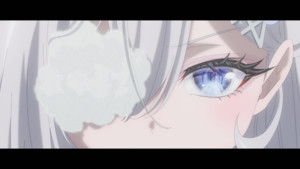
How do you end a series like SHIBOYUGI? In committing to its esoteric sensibilities and its willingness to forego the easy victories that come from more traditional storytelling methods, the show has set up quite the conundrum for itself. It's not really about the plot, for one, since its non-linear structure and purposefully vague and cyclical stories have not primed us to expect some kind of grand narrative payoff in this finale. Yes, the “death” of Hakushi and the buildup of Kyara as Yuki's psychopathic foil has given this last episode a convenient boss battle to structure itself around, but Kyara is simply a means to an end, thematically speaking. We already knew the outcome of the game before it started.
Nor is SHIBOYUGI an intensely character-driven story, at least not in the way that would lend itself to the simple catharsis that comes from a heroine overcoming great odds to win the day. While Yuki does find a meaningful and personal goal to strive towards in the wake of the Candle Woods Massacre, we've seen the aimless and haunted woman that Yuki has become by the time she's stumbling away from the Golden Baths. When Yuki proudly drops the subtitle of the show and announces that she will from now on be Playing Death Games to Put Food on the Table, she is marching confidently into the next act of her own tragedy that remains in progress.
So, in the end, SHIBOYUGI finds the answer to its own end in what has always come first for this superlative adaptation. It makes us feel what it needs us to feel by twisting and blurring the boundaries of Yuki's story, the barriers that divide Yuki's past and present, the thin lines of ink and graphite that separate her from the girls she has killed and the playgrounds that serve as their tombs. This is never more clear than in the showstopping sequence that sees the Yuki of the past confront the ghosts of all the girls who will be cut down along her path to that ninety-ninth victory. Kinko. Aoi. Azuma. Riko. Mishiro. Moegi. They're all there, trapped in the amber of those haunting little death-dreams that seem to be Yuki's way of honoring the people that they once were and could have been. Even Kyara, by the time Yuki is through turning her into another angel of cotton and tattered fabric, is given a final moment of peace in preservation.
What makes this all so compelling is how SHIBOYUGI still refuses to give us simple answers and straightforward payoffs. Yuki may have found meaning in taking on Hakushi's dream, but is that meaning perverted by the revelation that Hakushi faked her death, or does that simply strengthen its symbolic power? Are we meant to empathize with Yuki's spirited resolve in that final moment, or did the show anticipate the stone that would sink to the bottom of my stomach when I remembered that scene of Yuki lying so still in her bed in the fog that fills her world between games? Which Yuki is the one that SHIBOYUGI wants us to empathize with? The victor of Candle Woods who defiantly spits out her intention to live in this world and conquer the death games, or the survivor of the Golden Baths whose one feeble attempt at rebellion was snuffed out before it could do any good?
You could criticize this show as relying on “style over substance” for using its tricks to carve these questions into the brains of its viewers without ever providing anything in the way of concrete resolution, but I say that SHIBOYUGI's style is its substance. Of course, it's good when a powerful work of art can present a searing and direct exploration of complex characters and their fraught stories. There will always be a need for profound treatises on the flaws of human nature and cogent arguments for how they might be corrected, or at least understood. Sometimes, though, we need the kind of medicine offered by works like this one. SHIBOYUGI is an indulgent tonic of equal parts empathy and anger that invites us to luxuriate in an elegy for a world gone insane. Then, once the fever of medicine has broken, the only thing to do is go back to playing the game, even if the rules don't make much more sense than they did before, and the outcome has never been less certain. We've all got to put food on the table, at the end of the day.
Episode Rating:SHIBOYUGI: Playing Death Games to Put Food on the Table is currently streaming on Crunchyroll.
James is a writer with many thoughts and feelings about anime and other pop-culture, which can also be found on BlueSky, his blog, and his podcast.
Disclosure: Kadokawa World Entertainment (KWE), a wholly owned subsidiary of Kadokawa Corporation, is the majority owner of Anime News Network, LLC. One or more of the companies mentioned in this article are part of the Kadokawa Group of Companies.
The views and opinions expressed in this article are solely those of the author(s) and do not necessarily represent the views of Anime News Network, its employees, owners, or sponsors.
discuss this in the forum (84 posts) |

back to SHIBOYUGI: Playing Death Games to Put Food on the Table
Episode Review homepage / archives