

All the News and Reviews from Anime Expo 2026
The Golden Age of Anime is Over, But Industry Veterans Are Betting on ZAN
by Kalai Chik,
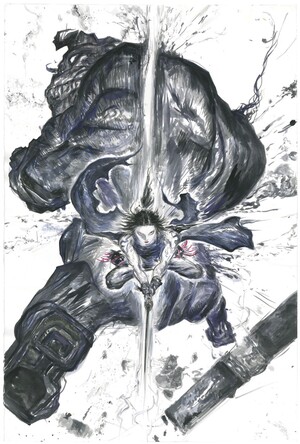
A day after announcing Yoshitaka Amano's newest anime project, ZAN, the "Masters of Anime: Exploring Japanese Animation Production" panel gathered the legends working on the series. Unfortunately, Moriyasu Taniguchi couldn't make it to the panel due to an injury. Instead, the panel featured film producer Hiroaki Ikegami, Armored Trooper Votoms creator Ryōsuke Takahashi, producer Tatsuyoshi Matsumoto, and Mobile Suit Gundam 0083: Stardust Memory mechanical director Tōru Yoshida.

Diving into a brief history of the “Robot Revolution,” the panel took a broad look at anime in the past, present, and future. Given the panelists' résumés, the discussion began with a brief conversation about Armored Trooper Votoms and Fang of the Sun Dougram. Right off the bat, Takahashi shared his admiration for Gundam, which led to Dougram. One of the challenges was making “sweaty military uniforms look cool” as there weren't many examples. “I think I was able to create my own uniqueness to it.”
Yoshida then added some behind-the-scenes stories about him and Takahashi, dating back to when he made his “Robot Works” debut with Dougram. For a while, he only drew what he was told to do for Dougram, which is why he wanted to focus on Blue Comet SPT Layzner.
“I would help with the mecha designs, and when it came time for the draft of the first episode, we talked about the movement.” Since there weren't many examples, it was challenging to imagine how pieces such as the wings would move. “When I was making VOTOMS, I was 22 and had a lot of creative freedom,” Yoshida said. He then described his back-and-forth experiences between the strict expectations and artistic flexibility.
Matsumoto described Yoshida and Takahashi's lasting influence on Japanese animation. He complimented Takahashi's eye, saying the “robots were flushed with realism,” which greatly impacted him as a teenager. Dougram and VOTOMS inspired young animators who wanted to join Taniguchi's company, Anime R.
These “students” of Taniguchi include: Hiroyuki Okiura (Ghost in the Shell), Kazuchika Kise (Patlabor), Takahiro Kimura (Code Geass), Kazuaki Mōri (Pokémon), Masahide Yanagisawa (Rurouni Kenshin), Seichi Nakatani (Gundam), and Asako Nishida (Love Live! School idol project).
“The fact that they were all under Taniguchi-san is unknown to much of the U.S. and Europe. But it's a popular fact in Japan,” Matsumoto said.
He stressed the impact that the panelists and Taniguchi had on shaping the current anime landscape. “Shinya Ōhira of Studio Ghibli is also a fan of Anime R's works, Layzner and VOTOMS.”
Takahashi took a moment to reflect on anime's past with his time alongside Osamu Tezuka. During the intense work schedules of the “Golden Age” of anime in the 1980s, they would pull all-nighters and work so closely that “it wasn't so much work but forced labor,” Takahashi said with a smile. Tezuka was at the forefront of the 30-minute animation revolution in Japan, and Takahashi shared that the legend wasn't the kind to “hold your hand.” Described as a “genius but a weirdo,” the director claimed Tezuka would be a rarity in the U.S. as he had no interest in accumulating wealth.
However, Takahashi warned of working oneself into an early grave. “[Tezuka, Shōtarō Ishinomori, and Fujiko Fujio] passed away at the age of 60, and I'm 83 now. If you work too much, you're going to pass early, so be careful.”
As for the present, Takahashi commented that the production environment for Japanese anime hasn't changed compared to the past. When Astro Boy aired in 1963, there were about four animated series by the end of that year. Afterward, it would expand exponentially to about 370 anime series broadcasting on Japanese TV.
“But the staff members working on anime haven't increased. There are still only around 10,000 animators.” Even though Japan's population has increased since the 1960s, Takahashi stressed the number of animation staff hasn't changed.
“80% are average animators and probably only 5% are at the top. This has been the case for the last 60 years in Japan.”
At the same time, digitalization has made certain processes more efficient and faster. Yet, the animation veteran said animators are “spending just the same amount of time” drawing. “With ZAN, we're going back to making everything by hand and showing what we can create from there.”
Yoshida added that it's a matter of scheduling and time constraints. “When I was in my 30s, I was working on 14 different works simultaneously. Right now, I'm working on eight at the same time.” He emphasized that there simply is not enough time. “In terms of those who draw, regardless of whether you draw traditionally or digitally, you'll have to draw for multiple projects at the same time.”
Since the panel was running out of time, the speakers each gave their thoughts on the future of the anime industry. Takahashi teaches animation at a college in Osaka and sees plenty of students interested in animation. However, they hesitate to pursue it as a career because it's a tough job.
“There's a Japanese proverb that says you'll become better at it the more you love it. Love it, then you can pursue it.”
From an artist's perspective, Yoshida sees more 3D prospects. “I want someone somewhere to focus on the drawing, whether it's hand drawing or digital.” He believes in simply putting into paper what's inside one's head, no matter the medium.
Matsumoto believes the Golden Age of Japanese animation was around 1985-1992, with the 1988 movie Akira as a defining work. “I don't think that's something that could be recreated right now.” In his eyes, the all-star animators, who were in their 20s, are now in their 40s and 50s, at the head of the animation world. Matsumoto, like Yoshida, works on multiple titles at once and is thankful they were able to complete ZAN.
“ZAN was finished when I was on the airplane at 5 AM. Thank goodness, or else I wouldn't have made it here,” he laughed.
He confessed he doesn't “have the capacity” to think about the future of the anime industry right now. “I'm focusing on the last time to showcase the Golden Age of Anime, where everyone who worked with Taniguchi-san and his students came together to work on this project.” Matsumoto interrupted himself to add that Cowboy Bebop's Takahiro Komori is the youngest member of this team.
“This is potentially the last opportunity to share the era of the Golden Age of Anime. I concentrated on it as the last opportunity. I'm looking forward to this moment right now.”
discuss this in the forum (2 posts) |

back to All the News and Reviews from Anime Expo 2026
Convention homepage / archives