

Spring 2026 Manga Guide
Drawing From Your Memory
What's It About?
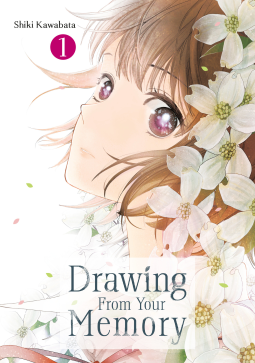
Mahoro Haruta is a manga artist whose first series became a huge bestseller. Her publisher expects her sophomore effort to be even better. There's just one problem: Mahoro has no idea what to draw next, because she plagiarized the story that skyrocketed her to stardom from a high school classmate named Yukishima, who shared a few precious months with Mahoro in the school's manga club before passing away and leaving her his notebook.
When, after a strange encounter, Mahoro wakes up ten years in the past—around the time of her first meeting with Yukishima—she realizes this could be her chance to redeem herself, erase her regrets, and maybe even save Yukishima's life...
Drawing From Your Memory has a story and art by Shiki Kawabata. English translation is done by Sawa Matsueda Savage and lettering by Madeleine Jose. Published by Kodansha USA (April 14, 2026). Rated T.
Is It Worth Reading?
Erica Friedman
Rating:
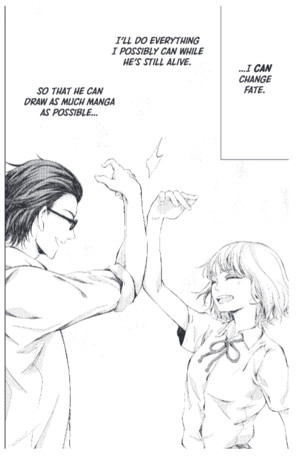
The one thing that has struck me, quite forcefully, since I began reviewing for ANN is how good so much of what I am reading is. No, it's not all for me, I don't want to continue reading all of it, but more often than not, I find myself deeply impressed at the originality, even within the relatively strict confines of subgenre work. It's not easy to be original, as Mahoro Haruta points out right at the opening of this book.
What follows is as much a story about regrets as it is a battle of wills, with time to get to a place where Mahoro can finally move forward. In doing so, this is a really good manga, with a story and characters that hold up throughout.
It's a cliché that when artists of all kinds have a breakthrough hit, their next work is a frustrated look at the industry, their own artist blocks, and the pressure of being a hit creator. And so often, in doing so, artists lance that wound and move on to create more amazing work. Here, Kawabata uses that pressure and the repetition and regret of a time loop to create another, even a more pressing situation, that holds our attention and keeps us glued to the page. Art and story work beautifully here to tell the full tale, beyond the dialogue.
I genuinely loved this story, from beginning to end. I want Mahoro to complete her loop, to resolve the issues that keep her from moving forward, and of course, I want her to save her friend. Good stuff.
Rebecca Silverman
Rating:
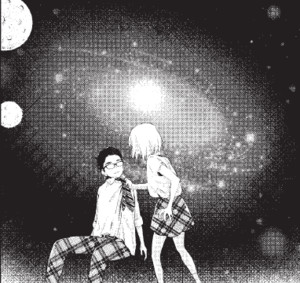
The entire point of time loop stories is, in my opinion, to go back and get things right. For Mahoro, that means making sure her tragically deceased manga club senpai gets credit for the work he left her. As an adult, she used his manga ideas notebook to become successful, but that eats at her, and she wishes she'd done things differently. And through the magic of time travel, she can – but is Yukishima's fate set in stone, or can she save him?
I know what I want to be the answer, and I will be very unhappy if it doesn't turn out to be the case. But Mahoro's loops feel more akin to Subaru's in Re:Zero than most other time loop series' – there's a set save point where she always starts and her choices change different parts of the outcome. The end point is, of course, Yukishima's death, which makes me think that avoiding that really is the goal. Shiki Kawabata's skilled enough that you feel every emotion Mahoro does; the joy, the despair, the frustration, and the guilt all shine through the artwork and writing. Mahoro isn't just in this for the manga, she's invested because what happened to Yukishima was a tragedy that, even ten years later, she can't accept. As of volume one, she's not going to give up on saving him.
Unlike a time travel series like Orange, Drawing From Your Memory isn't necessarily about tweaking one event. It's about carefully rearranging all of the factors in order to change a major outcome. There's a desperate edge to the story that's hovering over everything, flavoring the narrative without overwhelming it. By all rights, it really shouldn't work as well as it does; it's not shoujo Re:Zero, it's a pastiche of familiar tropes that are a bit tired on their own. But it proves that in the hands of a talented creator, even the basic can be elevated. I'll keep reading this, but if it doesn't have a happy ending, you'll hear me scream.
Bolts
Rating:
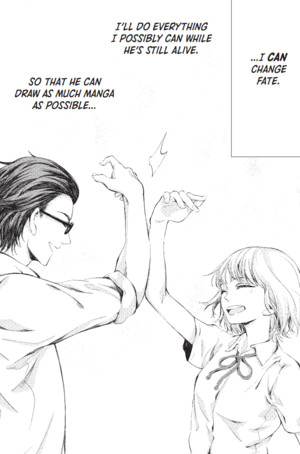
What does it mean to live beyond those who had so much potential to live a full life? I was originally a little bit confused about what Drawing From Your Memory was going to be about. Originally it seemed like it was going to be a story about plagiarism as a young woman makes it as a manga creator, but is ashamed because she only made it so far because she was building off of the ideas of her late senpai. But then, I find out that this is more of a Groundhog Day scenario where the shame of living that life makes her want to appreciate the magical do-over that she's been given, wanting to make sure that her senpai lives the dream that he was always meant to before inevitably meeting an unavoidable death. That's a really sad, tragic story on paper because no matter what happens, the end result is arguably going to be the same but this is a story about somebody trying to cram as much joy into a person's life before they pass. There are wrinkles thrown in there like any typical Groundhog Day-style set up, which makes me wonder what the overall purpose of the story is going to be. But I do appreciate the chemistry and despair that is presented around this relationship.
Imagine if you knew someone who was going to die in a few months? I would be overcome with survivor's guilt, but if I could push past that, then I would try my best to make sure that they were doing everything they could to fulfill their dreams before that happened. Tying that to the struggling artistic endeavors of being a manga creator is also a really good choice, considering the amount of pain and sacrifice that needs to go into making that profession work. There's several layers of tragedy here, and I appreciate the fact that the manga mostly plays it straight. I want to see what the overall goal is going to be because the story has very boldly written itself into almost a no-win scenario.
This is a story about two people who want to be there for each other, but there is ultimately a powerlessness about that. Still, they are trying their best to make do with the situation that they have even if they're not fully on the same page. This is also about life and how you can't always take it for granted because you never know what's going to happen around the corner. Sometimes people think that they can't keep putting things off because there's always tomorrow or they'll get bogged down by fear of advancing forward. But what happens when there is a fixed end to your life? Does that make things easier to pursue or harder?
It's not all perfect as there is a bit of a dip in the pacing that happens towards the latter third of the book, seemingly introducing other elements with the intention of showing that the groundhog scenario is getting more complicated. The story pulls itself together just in time for the first volume to end and I'm very curious about what subsequent volumes are going to accomplish but I will definitely be sticking with this despite its tragedy. I love stories that are able to play around with these ideas in a wholesome, tragic way. If that sounds like something that is up your alley as well, then I definitely suggest giving this one to read.
The views and opinions expressed in this article are solely those of the author(s) and do not necessarily represent the views of Anime News Network, its employees, owners, or sponsors.
discuss this in the forum (20 posts) |

back to Spring 2026 Manga Guide
Seasonal homepage / archives