

Spring 2026 Manga Guide
MAGICA
What's It About?
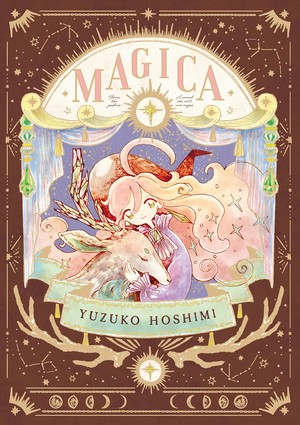
Each and every being has a wondrous story to tell, if you'll listen. Long, long ago, there once lived a beautiful mage. The mage had but only one spell: the strange ability to turn the twinkle of life into gems. It was a powerless magic that couldn't save anyone, but the mage believed in it, witnessing all the comedies and all the tragedies across the universe and weaving them into tales with wondrous luster. And so, the curtain rises on a heart-stirring fairy-tale fantasy!
MAGICA has a story and art by Yuzuko Hoshimi. English translation is done by Jan Mitsuko Cash and lettering by Jeanthrix Andres. Published by Kodama (March 1, 2026). Rated A.
Is It Worth Reading?
Rebecca Silverman
Rating:
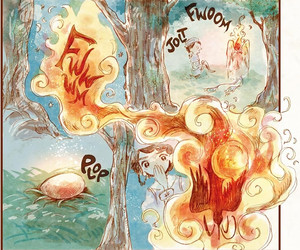
“Boundaries,” creator Yuzuko Hoshimi writes in their author's note, “don't truly exist…so why not leap over them?” That's the sentiment that fills MAGICA's first volume – it's set in a hazy world neither science fiction nor fairy tale, but something made up of equal parts of both. Like Antoine De Saint-Exupéry's Little Prince, Hoshimi's MAGICA travels from planet to planet, observing and interacting with life…although as a mage, they are always somehow removed from it. Instead they pass in and out of worlds like flipping pages in a book, with each new planet giving something new to ponder even as it reaffirms that life is a many-storied thing.
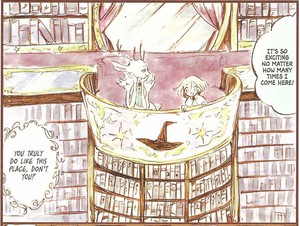
The volume is framed by a strange deer-like being called MAGICA reading stories to a child named Me. The stories appear to be the mage MAGICA's journeys through the galaxy, although it's unclear if both deer-creature and mage are the same person. Me seems unsure if the stories are fairy tales or truth, but they beg to hear just one more before bedtime, defying the boundary between awake and asleep in a way that enhances the dreamlike nature of the narratives. The manga's art is in color, generally soft, hazy pastels that enhance the unreality of the stories, and there's a sameness to most of the characters – they all look a bit like Me, which feels very deliberate.
Of the four short stories, my favorite is the last, “The Phoenix and the Dawn,” about an immortal phoenix learning to appreciate his gift of life through his interactions with a mortal. It's bittersweet but in a way that reminds me of the work of Patricia A. McKillip – beautifully ephemeral. “The Diabolical Utopia,” which comes directly before it, plays with many similar themes, but in a far more depressing way, taking for its central idea that only the rich can afford to live, even if their hearts are shriveled with greed. “The Beautiful Land,” about a country where everyone is able to be young for their entire lifespans thanks to consuming mermaid flesh, has more of a “be careful what you wish for” air and feels like the most pedestrian of the bunch, while “The Blade of Happiness” is the least subtle and consequently the weakest piece. Even then, though, it's remarkably well done, and the combination of a lyrical translation and Kodama's gorgeous edition, complete with dust jacket and obi, more than makes this worth the purchase.
Erica Friedman
Rating:
Upon opening MAGICA, I was struck immediately by the beautiful, whimsical art. My first thought was “Wow, this is gorgeous.” My second thought was “Gosh, I hope it's not miserable.” I was half right.
MAGICA is a collection of fairy tale-like stories, read to a young child by a companion creature from a magic and near-infinite library. As a westerner, growing up on the morality plays taken from Grimms' fairy tales, and the lexicon of society's rules skimmed from various mythologies, stories that have no apparent meaning, still strike me as both profound and profoundly disconcerting. More than anything, these tales make you consider humanity and their relationship to the systems they create and inhabit…and the stories we tell ourselves to perpetuate cruelty.
Tale here begin with a mage whose only magic is to turn the memories of lives into gemstones. In another story, a girl grows up in a culture based on a horrific lie. Another is set in a world where lives taken is currency. Each story appears random, almost painfully so, with no specific end. Taken as a whole, however, there is a solid through-line of the importance of giving respect for living creatures. This is made overt in a tale about a chef who can only kill animals for food and the hero who can only kill humans who are attacking him, who find solace in each other's company.
These short stories are accompanies by very beautifully rendered, water color pen art, that flows and changes—when it is supposed to hit you, it hits with a solid bang. The connecting story is one of child-like joy and wonder at the variety of stories available to be read, which works well to balance the melancholy of most of the stories themselves. These are not “Happily ever after,” but neither are they horrid and they will make you think.
The views and opinions expressed in this article are solely those of the author(s) and do not necessarily represent the views of Anime News Network, its employees, owners, or sponsors.
discuss this in the forum (20 posts) |

this article has been modified since it was originally posted; see change history
back to Spring 2026 Manga Guide
Seasonal homepage / archives