

Spring 2026 Manga Guide
On the Boundary's Road
What's It About?
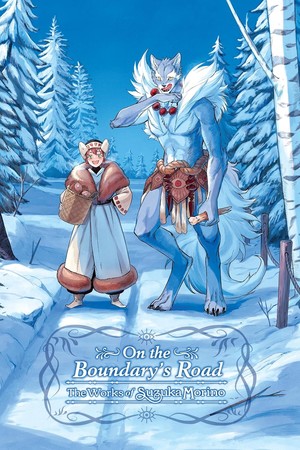
A boy meets a cursed beast on a road at the edge of a forest. A demi-human becomes the servant of a wealthy mistress. A witch and her familiar chat it up. These and other stories of cross-species communication by Suzuka Morino have been compiled into a beautiful collection filled with the author's exquisite linework.
On the Boundary's Road has story by and art by Suzuka Morino. English translation is done by Masaaki Fukushima. Lettering is done by Abigail Blackman. Published by Yen Press (May 26, 2026). Rated T.
Is It Worth Reading?
Rebecca Silverman
Rating:
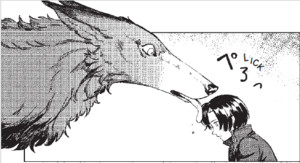
Suzuka Morino draws some of the absolute best creatures I have ever seen. From furries to plain old monsters, Morino's designs are creative, expressive, and unique. Even more basic characters, like Wolfy in the first story, have a lot of very special touches that set them apart from the way most manga artists draw wolfmen, such as the way his feet and legs function or even just the expressiveness of his face. For my money, the best creature in the book comes from the third story, “Training a Gryphon.” The protagonist's nemesis is his unusual gryphon (actually a flying dog called a nightwalker, according to the bestiary in the back of the book), and the canine expressions Morino gives him are amazing.
While the art is, obviously, my favorite part of the book, the stories are also very good. The word “bittersweet” feels like it was coined to describe the way Morino tells a story. “Training a Gryphon” is the most upbeat of the batch, although “Working as an Apprentice Butler” is also fairly light. But Wolfy's story is about abandonment and feeling insecure, like you're never good enough for those you love, while the title story looks at the intersection of kindness and greed. “Birdcage of an Egg” is perhaps the most bittersweet, exploring a grieving wirbelwind (giant bat monster)'s efforts to replace his lost child. He adopts a human girl he finds as the lone survivor of an accident, hoping that she will stay with him always. But as she grows up and realizes that she's different, he has to learn to put her wants above his own.
Most of the tales deal with this sort of interpersonal relationship. While “Birdcage of an Egg” is the most obvious, “Go for It, Wolfy!” also handles the delicate balance of wanting someone to love you and being afraid that they never will. The title story focuses on a younger brother who feels ignored by his older brother and his attempts to prove himself, which leads to him interacting with the monsters of the forest. He must learn to negotiate a friendship with someone who doesn't speak his language, or even share his basic culture, and it is his brother's failure to do so successfully that makes the younger boy stand out, even as it sets him up for a truth he's not ready to face.
On the Boundary's Road isn't a light read or an easy one. It has something to say about how we interact with others, and even the most monstrous-looking creatures are remarkably human in their actions. It's a beautiful book, and one that I think any fantasy fan can appreciate, if not enjoy.
Erica Friedman
Rating:
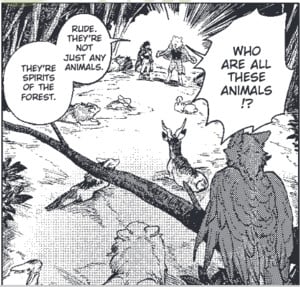
This collection of fantasy shorts about beast people is drawn so well that upon reading one of the stories, I thought, “Well, that's the hottest tiger I've ever seen.” I was not familiar with Suzuka Morino's work before this, but I'm a fan now. The art is truly outstanding.
Stories range quite far and wide in this collection. A wolf butler finds a new mistress to serve, a child is captured by a beast of the forest, and old beast soldiers' fantastic stories might just be true. The forest is a terrifying place in this book, but so is human society.
There's an undertone of melancholy in many of the stories, and often a sense of discomfort. Beasts and humans don't have the same ways of looking at life, even if there are occasional similarities. This leads to some unpleasant scenes in several of the stories, including when a beast who adopts a human foundling tries to mate with her and some inevitable death and destruction. In fact, I suggest reading these chapters in reverse order, if you'd rather be left with tears of schmaltzy joy than lingering unease as a final thought.
The final pages are a bestiary, but also serve as a repository for the inner workings of a manga artist's mind. No creature just exists; they have been carefully thought through. How they look, how they live, and why they look the way they do are laid out in short essays and designs. It's almost interesting that Morino took such time to explain the beasts, but hardly any time at all to explain the human society we encounter.
I could see this book being super popular with many different kinds of readers. It's a provocative, beautiful …and violent… world that Morino has created, filled with magnificent beasts, beast-people and, sometimes, even decent people.
Disclosure: Kadokawa World Entertainment (KWE), a wholly owned subsidiary of Kadokawa Corporation, is the majority owner of Anime News Network, LLC. Yen Press, BookWalker Global, and J-Novel Club are subsidiaries of KWE.
The views and opinions expressed in this article are solely those of the author(s) and do not necessarily represent the views of Anime News Network, its employees, owners, or sponsors.
discuss this in the forum (20 posts) |

back to Spring 2026 Manga Guide
Seasonal homepage / archives