

Spring 2026 Manga Guide
That's Not Love
What's It About?

Forty-year-old Akane attends the opening of a new art exhibit by her former cram school teacher, Mr. Imai, who has now become a sculptor. Akane notices that Mr. Imai's new sculpture bears a striking resemblance to her middle school best friend, Yukari, who she remembers suddenly transferred out of the school. It even has a distinct scar that Yukari shared with Akane privately. Wondering what this could mean, Akane reaches out to her old friend, and learns that there was something else going on when they were children that she only partly understood. Was Yukari just a muse? Or something with more upsetting implications?
"I began thinking about situations where violence might not be recognized as violence, where it might be permitted for the sake of art or because of someone's talent, and about the hierarchies that exist between people in small, tightly-bound businesses." –Peko Watanabe
That's Not Love has a story and art by Peko Watanabe. English translation is done by Sawa Matsueda Savage and lettering by Madeleine Jose. Published by Kodansha USA (May 26, 2026). Rated M.
Content Warning: sexual abuse of a minor, grooming, alcoholism, disordered eating
Is It Worth Reading?
Rebecca Silverman
Rating:
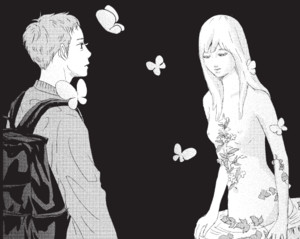
It would be easy to read the synopsis of Peko Watanabe's That's Not Love and make assumptions about sensationalism and topical subjects. But that's not what this book is about – in presenting the story of two women who suddenly realize that a fourteen-year-old cannot be in a consensual relationship with an adult decades after it happened, Watanabe hews close to the bone. She doesn't imply that Yukari's or Akane's lives were ruined by what happened, but she does dig into the repercussions Imai-sensei's actions have had down the years and how both women feel like they need to confront them and take charge of their own lives again.
It was Yukari who had the “relationship” with the girls' cram school teacher years ago. Akane, who was jealous at the time, suddenly remembers it when she goes to see a show of his sculptures. She immediately recognizes the model for the show's centerpiece: her old friend Yukari, whom she lost touch with. Something about seeing Yukari's fourteen-year-old nude torso on display doesn't sit well with Akane, and she reaches out to find her former friend.
There are no moments of shocking, grand realization here. Akane's life has been on a slow downward slide, but not because of Yukari and Imai. She's not happy that she gave up on her career when she had her daughter, and she's been struggling with disordered eating and alcoholism for years, the former dating back to middle school, when she was bullied. Yukari has clearly been gravely affected by her affair with her teacher, but she's been trying to move past it until the sculpture shows her that she still has a lot to deal with. Akane wants to help her because she's always felt that she ignored Yukari's plea for help back in the day out of jealousy of what she, as an adult with a middle school-aged daughter herself, she now recognizes as an abusive relationship. It's a slow process, quietly building up to the women confronting Imai and his wife.
Watanabe has a point to make, and it's an important one. No one has the right to your body in any way, and despite Imai's wife's protestations of “art,” what Imai did was wrong. Akane is furious with him and with herself for not recognizing that her friend and her teacher weren't “in love,” he was grooming and taking advantage of her. And Yukari is just trying to get through, and to take back some of the power she gave up. It's frustrating and enraging and entirely too familiar, and it needs to be all of those things. No one should have put up with it then, and they don't need to put up with it now.
This is a book that requires some self-care to read. It won't be for everyone, because, despite its deliberate pacing, it is intense. But I'm glad it's being translated into English, because this is a story that we have to keep telling until it's finally put behind us for good.
Lucas DeRuyter
Rating:
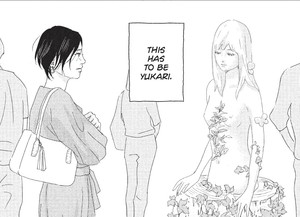
In reference to That's Not Love, Peko Watanabe is quoted saying, “I began thinking about situations where violence might not be recognized as violence, where it might be permitted for the sake of art or because of someone's talent, and about the hierarchies that exist between people in small, tightly-bound businesses.” With this mentality behind the tome, it's no wonder that every one of That's Not Love's nearly 200 pages feels like a slow gut punch. This is a story about people with relatably compromised lives, who slowly realize just how tainted elements of their childhoods were, and begin taking shaky steps to address the injustice done to them.
Akane is a nearly middle-aged woman with a husband, middle-school aged daughter, and works in her chosen field of Japanese to English translation in a freelance capacity. On the surface, she has a life that most would be envious of, but is actually struggling with depressive ideation and is increasingly turning to alcohol as a form of self-medication. When she finds out that a former teacher of hers, Toru Imai, is now a famous sculptor, she goes to visit his local exhibit and discovers that his latest work is based on a nude photograph he took of her friend when the two women were fourteen years old.
While That's Not Love deftly navigates how things like eating disorders, alcoholism, and grooming manifest and affect a person's day-to-day life, this is still a really heavy work and readers should be aware of these content warnings before diving into it. However, reading That's Not Love is a rich and rewarding experience that examines these difficult topics in a way that feels both grounded and captures the complexities of how they often materialize in the real world. For instance, Akane's friend who was the victim of the grooming, Yukari, is trepidatious to take any action against Imai, and much of her life seems to be the result of running away from this and other traumas from her childhood. She's not motivated to bring Imai to justice, but instead just wants to not feel violated by him profiting from her image without her consent.
Similarly, Imai isn't depicted as an outright creep, and seems genuinely torn about this sculpture being his most popular work and profiting from its sale. However, as his spouse and business partner points out, he's a working artist with a wife and daughter to care for and needs these funds to continue his career. That's Not Love isn't an overtly inspirational story, but instead a deeply honest look at what it's like to be a real and flawed person trying to take the internal and external steps necessary to hold a powerful person accountable for your exploitation.
The worst thing I can say about That's Not Love is that I desperately wanted to keep reading it after I finished this first volume. This is not only a well told story, but what feels like an increasingly important one as we live in a world that's struggling with the idea of what a victim “should” look like and the “correct” way for them to feel about their abuser. If you're in a headspace where you can handle these themes and the related content warnings, I strongly recommend that everyone read this manga.
The views and opinions expressed in this article are solely those of the author(s) and do not necessarily represent the views of Anime News Network, its employees, owners, or sponsors.
discuss this in the forum (20 posts) |

back to Spring 2026 Manga Guide
Seasonal homepage / archives