

The Winter 2026 Manga Guide
Out of the Cocoon
What's It About?
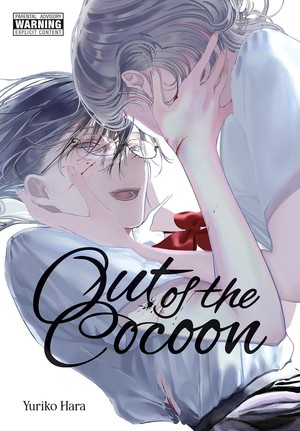
Yuriko Hara, author of the atmospheric, eerily beautiful yuri Cocoon Entwined, brings us five haunting stories of love and attachment. Ranging from horrific to wistful, these captivating tales, featuring both yuri and boys' love, are sure to ensnare readers. Fans of her previous work will be especially delighted by the final piece, which provides an extra chapter of Youko and Hana's story.
Out of the Cocoon has a story and art by Yuriko Hara. English translation is done by Amanda Haley, and lettering by Madeleine Jose. Published by Yen Press (December 16, 2025). Rated M.
Content Warning: cannibalism, zombie love
Is It Worth Reading?
Rebecca Silverman
Rating:
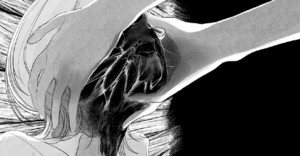
I knew going in that there would be parts of Out of the Cocoon that I wouldn't be able to stomach. That was how I felt about Yuriko Hara's previous English-language release, Cocoon Entwined, otherwise known as “the hair yuri.” And yes, there was one story, “Dog-Eat-Dog,” that triggered my gag reflex with its tale of a cannibal and the young man he came to love through eating him. But the other pieces in the collection are exercises in queer people making space for themselves in a world that doesn't want to accept them, and Hara's deployment of metaphor and joy in the face of tragedy makes them striking in a way that may be hard to forget.
The first two stories are the strongest. In “Sweet-Dreams Zombie,” which opens the book, a zombie apocalypse appears to be ravaging the world, or at least its urban centers. In a nameless small town, a mother and daughter have caught the virus, and the daughter is on the lam…being protected by her girlfriend Noumi. Although the zombie virus is said to be contagious in the extreme, Noumi hasn't caught it, despite her physical relationship with an infected, and the fear of zombism becomes an extended metaphor for homophobia. Before infection, Noumi's girlfriend Momose made a joke about how if she fell into the river, she would “contaminate” the entire town, and the sense is that this isn't because her corpse will poison the water supply. It's because the townsfolk somehow view her queerness as contagious. Noumi's loving acceptance of Momose protects her from the disease (or perhaps “disease”), and the gay classmate who becomes privy to their secret finds himself in the same position – able to touch Momose and not contract the virus.
Noumi's final words before she takes Momose and jumps into the river are, “If that's what you people believe, then you can go ahead and live in fear forever.” It's a challenge, and one that we see the couples in the following stories take up. In “If the World was Ending Tomorrow,” the protagonists discard their fears in the face of the world's imminent destruction, choosing to spend their last day admitting their feelings and accepting each other. In “52-Hertz Whale,” two women show that they have found each other despite the odds, using the metaphor of the loneliest whale to show that sometimes you just have to try, even when people tell you it's impossible. Despite the world-ending scenarios, these three stories are surprisingly hopeful.
The final story in the collection is an epilogue to Cocoon Entwined, so not having read that series will make it less engaging, although I still thought it was interesting. Hara's writing is a bit stronger than her art, but this is a very well thought out collection, and I like the use of horror to underline the stories' themes. It's a dark book, but a good one.
Erica Friedman
Rating:
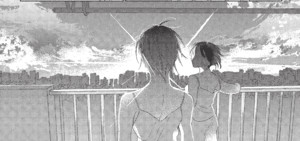
Yuriko Hara is best known in the west for her work on Cocoon Entwined, almost universally referred to as “the hair manga,” about a school in which girls wear uniforms made from the hair of previous students. This collection delves into other eerie ideas and is just as, or even more, unsettling.
Content warnings are absolutely necessary here. The first story deals with a zombie virus outbreak and an obsessive love for a zombie corpse. The second story is about love expressed as cannibalism, making for an incredibly uneasy read. The third story stands on a thin bridge between the fever-dream feeling of the first two stories, dealing with an actual fever induced dream and being uncomfortable enough to rely on someone else.
The final entry is a sequel to the events of Cocoon Entwined. The two protagonists, having walked away from their cocoon have met once again, and are navigating their new lives, awkwardly, sweetly. I originally picked this volume up in Japanese, post the series end, simply for the epilogue to see what had become of Hana and, more importantly, Youko. I'm not entirely convinced that it was worth it. It was lovely to see the characters out of the locked cage of Hoshinomiya, even if they are never truly free from it.
Hara's art is still striking. She uses a lot of screentones, which appears to have fallen out of favor in manga these day. Her characters are beautifully drawn…even if they are not themselves beautiful. For me, the art is the big drawn to Hara's work. Her narratives are sometimes clodgy. Everything here seems to have—and in one case, we know definitely has—some unspoken backstory. Short stories aren't ever my favorite, but these are particularly difficult, a bit obscure.
If you like Hara's art, and/or enjoy being made to feel deeply uncomfortable about watching acts of intimacy that are and are not sexual or illegal, immoral or disturbing, this is very much a book for you.
discuss this in the forum |

back to The Winter 2026 Manga Guide
Seasonal homepage / archives