

Edo Justice and Island Gods: What Hell's Paradise Gets Right (and Invents) About Historical Japan
by Beatrix Kondo,With Season 2 of Hell's Paradise (Jigokuraku) now ongoing as of January 2026, this is the perfect moment to examine how Yūji Kaku built his dark fantasy on the bones of real Edo-period history. The Yamada Asaemon were real, and the irezumi kei was an actual criminal punishment—the series uses documented historical practices as a foundation before launching into supernatural mythology. Yūji Kaku has certainly been building fantasy on the bones of history. But where does history end and the Shinsenkyo island's lore begin?

When History Is Already Horror
For those just tuning in or needing a refresher: Hell’s Paradise: Jigokuraku follows Gabimaru the Hollow, a legendary shinobi from Iwagakure village, sentenced to execution after his clan betrays him. The problem? Nothing can kill him. Beheading fails. Burning at the stake fails. His body refuses death because somewhere deep, he still wants to live—specifically, to see his wife Yui again.
Enter Yamada Asaemon Sagiri, an executioner who offers him a deal: travel to the mythical island of Shinsenkyo, retrieve the elixir of immortality for the Shogun, and earn a full pardon. Simple, except he's not going alone. A whole crew of death row convicts gets the same offer, each paired with a Yamada Asaemon monitor tasked with killing them if they step out of line. The island, naturally, is crawling with supernatural horrors—plant-human hybrids, immortal Tensen deities, creatures that make death look like mercy.
Season 1 (Spring 2023) covered the first expedition to Shinsenkyo, introducing the convicts, executioners, and the island's grotesque ecosystem. Characters died brutally. Alliances formed and shattered. Gabimaru learned that survival requires acknowledging weakness, not only hollowing himself out into a weapon. Season 2, which premiered in January 2026, dives deeper into the island's mythology and the Tensen's true nature, escalating both the body horror and the philosophical questions about what it means to be human.
The series sits comfortably in the "dark trio" of shonen alongside Jujutsu Kaisen and Chainsaw Man—all animated by MAPPA, all trafficking in violence that refuses to be clean or heroic. But while those series draw their darkness from contemporary anxieties and supernatural systems, Hell's Paradise roots itself specifically in Edo-period Japan, using historical brutality as scaffolding before launching into myth.
Yui's facial scar looks like creative liberty. Most viewers assume it's a dramatic flourish, a visual shorthand for "this character has a dark past." But that burn mark was real punishment. Her father branded her face to prevent her from ever living as a normal woman, aiming to destroy her prospects for a common life and bind her to the village's traditions—branding as control, a form of mutilation documented throughout history. The mark was exaggerated for effect only in our modern imagination.
Hell's Paradise operates in a fascinating space between historical accuracy and pure fantasy. The line between documented Edo-period records and Kaku's imagination remains deliberately blurred, becoming clear only through research. Understanding this distinction makes the supernatural elements more effective. When you know the execution methods are real, the monsters feel more threatening. When you realize the Yamada clan actually existed, their battle against immortal beings carries more weight.
The Real Yamada Asaemon: Neck-Chopper Asa and Eight Generations of Death
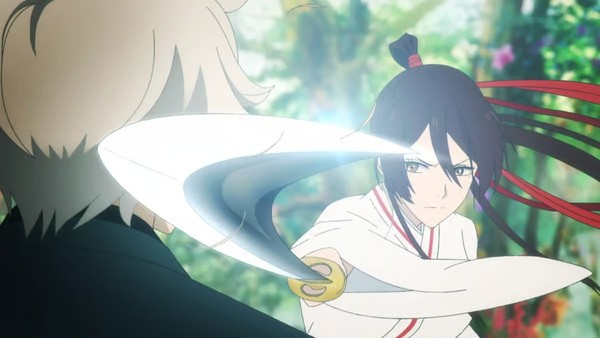
The Yamada Asaemon was a hereditary title held by the heads of the Yamada family, who served the Tokugawa Shogunate from 1657 to 1868. Eight generations bore the name "Asaemon," each serving as official executioner and sword tester. They were called "Kubikiri Asa" (Neck-Chopper Asa) or "Hitokiri Asa" (Decapitator Asa) by the public, and their role included performing executions via beheading and testing new swords on corpses before presentation to the shogun.
Their social position was complex. The Yamada were ronin—masterless samurai without a fief or rice income—who worked on government contracts. They held this specialized, low-prestige position despite their essential function. The contradiction defined them: society needed their skills but stigmatized their profession. Even as they performed vital services for the shogunate, they remained outside the formal samurai hierarchy.
The historical record documents their work. Yamada Asaemon VII executed revolutionary Yoshida Shoin in 1859. The profession continued for generations, ending in 1882 when decapitation was abolished as punishment. The last Yamada resigned from government service, closing a chapter of Japanese judicial history that had lasted nearly three centuries.
The Yamada family's primary income source came from the corpses of executed criminals, officially handed over to them after beheading. Since government compensation remained modest and they held no fief, they needed alternative revenue streams. The bodies provided two lucrative opportunities.
Tameshigiri (sword testing) functioned as a paid service. Wealthy samurai commissioned blade tests, and the Yamada performed them on execution corpses. Executions happened rarely, so the same body might be tested repeatedly. Multiple samurai could verify the sharpness of their swords on a single corpse. Some samurai who wanted to test their personal blades had to purchase corpses for this purpose.
The second revenue stream was pharmaceutical. The Yamada extracted organs and fluids—liver, brain, bile—from corpses and processed them into medicines sold throughout the country. These "Yamada pills" (山田丸), also called "Asaemon pills" (浅右衛門丸) or "human skin pills" (人胆丸), were marketed as treatments for tuberculosis and other ailments. This macabre medical practice continued until 1870, when the Meiji government prohibited both corpse sword-testing and organ extraction.
The clan's economic model treated death as a renewable resource. Bodies became both testing material and pharmaceutical supply. The anime nods to this historical reality through Fuchi, the 9th-ranked Asaemon with medical knowledge who treats wounded companions whose anatomical expertise reflects the clan's documented history of working intimately with human bodies, understanding their structure through repeated dissection and testing.
Irezumi Kei: The Tattoo That Marked You Forever
Irezumi kei (入れ墨刑, "tattoo punishment") was a criminal penalty during the Edo period, introduced under Tokugawa Yoshimune's reforms. Classified as corporal punishment alongside caning, it replaced earlier practices like nose or ear amputation when society became, ironically, "gentler and less bloodthirsty" around 1745.
The system operated with brutal logic. Tattoo location signaled crime type: thieves received arm tattoos, murderers got head markings. The tattoo's shape and design identified the region where the crime occurred, creating a permanent, visible criminal record readable by anyone familiar with the codes. The punishment typically included tokorobarai (banishment): exile to remote islands and forbidden entry to certain areas.
Regional variations added complexity. Hiroshima used a three-strikes system with the Chinese character 大 (large), applying one stroke per offense. After three offenses, the character was complete, and the criminal faced the death penalty. Most regions operated similarly—accumulating three or more irezumi kei resulted in execution.
The system served multiple purposes beyond punishment. The pain deterred repeat offenses. The permanent marking provided a public criminal identification for life, serving as a record-keeping system before modern databases existed. The social consequences proved devastating. Marked criminals often commissioned elaborate decorative tattoos to cover their punishment marks, contributing to the association between yakuza culture and body ink that persists in modern Japan. Hell's Paradise uses this historical practice selectively in character design. While the main protagonists don't bear penal tattoos—Gabimaru as an elite shinobi would have been executed immediately rather than marked, and Nurugai belongs to the marginalized Sanka people whose imprisonment stems from their existence outside Shogunate law rather than common crimes—background prisoners in the selection scenes display marks closer to actual documented practices: lines on arms indicating repeat offenses, forehead symbols denoting crime locations. The series takes these markings seriously because they were serious—lifetime brands that announced your crimes to everyone you encountered.
The "Embraced Head" and the Art of Perfect Execution
The Yamada clan's signature technique involved beheading in a single stroke while leaving only a thin flap of skin connecting head to body. Called "Dakikubi" (抱き首, "Embraced Head"), this method required deep anatomical knowledge. Executioners studied muscle, sinew, and bone structure to find the precise "openings" where their blade could pass through cleanly.
The ideal cut embodied the clan's doctrine: the victim should feel no pain, show no emotion from the blade. Perfect execution represented the executioner's skill and upheld the honor of the act itself. One historical anecdote describes a prisoner who finished telling a rakugo joke even after being beheaded due to the flawlessness of the cut—consciousness persisted for seconds because the strike was so clean.
Sagiri's character arc revolves around this historical reality. Her motivation centers on achieving her father Kichiji's level of perfect execution. Her "flaw" manifests as emotion showing in her blade, making cuts imperfect. She hesitates, feels guilt, and allows her humanity to interfere with technical precision. The series grounds her internal struggle in the documented philosophy of Edo-period executioners: the blade should be emotionless, surgical, and merciful through its perfection. The Yamada clan members' combat abilities in the anime derive logically from their execution expertise. Their sword techniques penetrate the toughest defenses because they know exactly where to cut. They understand human anatomy at a level most warriors never achieve. Death was their craft, their science, their legacy across eight generations.
Tameshigiri (試し斬り) was the art of testing blade sharpness, prominent throughout the Edo period. Only master swordsmen performed it to ensure a fair assessment of weapon quality. The primary testing material was corpses of executed criminals, though historical records confirm that sometimes living criminals were tested on during their actual execution.
Results were engraved on the sword tang (nakago), documenting how many bodies were cut and where the cuts were made. Samurai who wanted personal blade tests had to purchase corpses. The Yamada family controlled access to this resource, another revenue stream from their monopoly on execution. The practice continued well into the 20th century—swords were tested on prisoners during World War II, though by then the tradition had warped far from its Edo-period origins.
Modern tameshigiri has transformed entirely. It's now a martial art that demonstrates the wielder's skill on a goza (rolled mat), testing the person rather than the sword. The historical practice—using human bodies to verify blade quality—belongs firmly to Japan's past.
Hell's Paradise draws on this history to depict the Yamada clan's dual role as executioners and sword testers. Their reputation for assessing blade quality comes directly from documented practice. When they evaluate swords in the anime, they're performing the historical function their real-world counterparts held for nearly three centuries.
What Kaku Invented: Shinsenkyo and the Mythology of Immortality
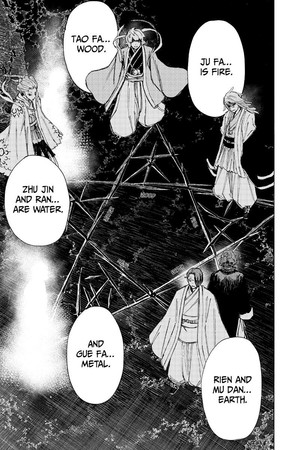
Shinsenkyo Island is pure fiction, though. No historical parallel exists for a mysterious island southwest of the Ryukyu Kingdom harboring immortal beings. However, the name "Shinsenkyo" itself comes from a real sacred garden in Hakone, Japan, created by Mokichi Okada between 1944 and 1953 as a prototype of paradise on earth. Kaku borrowed this name and concept of a divine paradise to create Hell's Paradise's fictional island. The Elixir of Life quest functions as a creative device, using the real execution system as a springboard for supernatural adventure.
The Tensen represent Kaku's original creation, though they draw heavily from Chinese Taoist mythology. The Eight Immortals of Taoist legend—legendary sages who achieved immortality by mastering paradoxes—provided the template. Kaku adapted them into gender-fluid beings that embody the Yin-Yang balance, possess godlike powers, and rule over Shinsenkyo.
The gender-fluid nature of the Tensen is particularly significant. In Taoist philosophy, the interplay of Yin (feminine) and Yang (masculine) represents cosmic balance and completeness. By making the Tensen literally embody both energies within single beings, Kaku visualizes this philosophical concept in a strikingly literal way. Their ability to shift between male and female forms carries deeper meaning than aesthetic design—it actively demonstrates their transcendence of human limitations and their mastery over the dualistic forces that govern existence. This gender fluidity marks them as truly beyond mortal comprehension, beings who have achieved a unity that ordinary humans can only conceptualize abstractly.
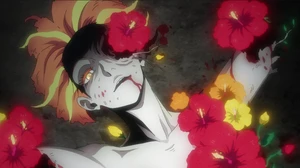
The Tensen's ability reflects Taoist philosophy about balance and the Middle Way. Their leader, Rien, created them as part of research into immortality, seeking to revive her husband, Jofuku—himself a reference to Xu Fu, the Chinese explorer sent by Emperor Qin Shi Huang to find the secret of immortality.
Tao, as a combat system, draws from real Taoist philosophy about life force and balance. Like the qi-based mecha-piloting system in Xiran Jay Zhao's Iron Widow, Kaku takes the ancient concept of vital energy and fictionalizes it as a supernatural power that characters can manipulate and weaponize. The island's monsters, flower-corpses, and arborification process draw on botanical body horror similar to works like Jeff VanderMeer's Annihilation, though Kaku's specific execution is original.
Gabimaru's Iwagakure draws on the real concept of hidden villages (kakurezato) in feudal Japan—remote settlements associated with ninja clans. The name itself echoes Naruto's Iwagakure (Village Hidden in the Stones), though Kaku's version replaces flashy jutsu and elemental powers with Tao-based combat and brutal psychological conditioning. The specific training methods, facility structure, and supernatural abilities, however, are Kaku's invention rather than historical facts.
The series carefully blurs the line between history and invention. The brutal justice system grounds the story in reality, while supernatural elements weave seamlessly into this historical foundation, providing adventure, thematic depth, and an exploration of the cost of immortality. Kaku knew when to research and when to create, blending both into a cohesive world.
The Deliberate Anachronisms: 2020s Values in 1700s Japan
Kaku made an explicit creative choice: Gabimaru and Sagiri possess modern ethical values despite their Edo-period setting. He explained his reasoning in interviews, saying that if they share our perspective, we feel close to them, and they stand out as unique in their historical context.
Sagiri, as a female Yamada Asaemon, represents the most deliberate anachronism in the series. The historical Yamada clan was exclusively male, serving as Otameshi Goyō—official sword testers and executioners for the shogunate. Women held no such positions. Sagiri's presence isn't a historical oversight; it's a calculated provocation.
Kaku exploits this anachronism for direct commentary. Sagiri exists in a male space while being actively sabotaged by it. The other Asaemon dismiss her skill, question her resolve, and frame her compassion as a fatal weakness. Her struggle mirrors contemporary workplace discrimination: competence doesn't matter when the system itself refuses to recognize you as legitimate. The historical setting amplifies rather than dilutes this reality—institutional exclusion operates the same way across centuries.
Sagiri's arc refuses the tired "strong female character" formula of becoming "one of the boys." Her strength emerges from holding onto emotion rather than suppressing it, from maintaining compassion rather than adopting masculine brutality. She forces the system to expand its definition of strength. She wields a blade with lethal precision while keeping the compassion her male counterparts dismiss as liability. Her acceptance comes from proving the clan's standards were incomplete. She reconciles violence and empathy by demonstrating that they were always compatible.
Gabimaru's devotion to Yui embodies modern romantic equality rather than the typical Edo-period arranged marriage dynamics. Their relationship presents mutual respect and genuine partnership, values that would have been uncommon in this historical context. The series frames their bond as exceptional, making Gabimaru different from other shinobi and worthy of redemption.
This approach works because Kaku preserves the violence, social hierarchies, and execution methods while updating characters' internal ethics. They retain the capacity for empathy, question systems, and recognize injustice even as they participate in brutal practices. The balance makes them accessible to us without erasing the historical brutality of their world.
What Kaku chose to preserve tells us what matters to his story. The real judicial cruelty provides weight and stakes, and the modern values make characters relatable guides through that harsh landscape. When Sagiri struggles with the morality of execution, we understand her conflict because she thinks like we do, even as she operates in a world we find horrifying.
Why the History Matters: Grounding Fantasy in Documented Horror

The effectiveness of Hell's Paradise's horror stems directly from its historical foundation. Viewers experience cognitive dissonance after researching what they watched. "This can't be real" transforms into "oh god, it was." That moment of recognition amplifies every element.
Yui's facial brand stops being a dramatic device and becomes a window into actual methods of control through mutilation. The Yamada clan's execution methods gain weight when you know they're documented techniques passed down through generations. The supernatural elements—Tensen, monsters, Tao—feel more threatening because the "normal" world already operates at nightmare levels of brutality.
Kaku demonstrated restraint in his worldbuilding. The Edo justice system was already horrific—he saw no reason to exaggerate. Criminal tattooing was real. Execution as a public spectacle was real. Using corpses for sword testing and medicine was real. The series asks an implicit question: if humans historically did this to each other, what are gods capable of?
The historical accuracy provides credibility that pure fantasy couldn't achieve. When the anime shows the Yamada clan's techniques, when it depicts irezumi kei—even if only at a glance—and when it explores the social stigma around executioners, it grounds itself in documented practice. That foundation makes the fantastic elements land harder. The monsters become more frightening because they emerge from a world that was already monstrous.
Season 2 of Hell's Paradise will continue this balance, layering Tensen mythology over Edo-period brutality. The series succeeds because it understands that effective horror requires recognizing existing cruelty. History provides plenty. You just need to recognize it, respect it, and build your fantasy on those bones.
Yui's facial brand serves as the perfect symbol of Hell's Paradise's approach. It's a historically grounded punishment transformed into a character backstory. Her father's brutal control mirrors documented methods of subjugation, grounding her in real cruelty while propelling her into supernatural adventure. The series operates constantly in this space, one foot in documented history, one foot in mythological invention.
The Yamada clan, irezumi kei, tameshigiri—these elements required accuracy to provide weight. The Tensen, Shinsenkyo, and Tao—these elements required imagination to evoke wonder and thematic depth, but even his fantastical creations weren't invented out of nothing—he drew on existing mythology within his own culture. Kaku built his supernatural framework from recognizable mythological architecture, then twisted it into something new. He kept historical brutality and mythological inspiration separate from pure invention, using each for its proper purpose.
As Season 2 continues, this understanding enriches the viewing experience. When we watch the Yamada Asaemon fight, we're seeing techniques rooted in three centuries of execution expertise. When we see the Tensen's gender fluidity, we're encountering Taoist philosophy filtered through Kaku's creative vision. When Sagiri struggles with her role as an executioner, we're witnessing modern values colliding with historical practice.
The scariest thing about Hell's Paradise lives in the realization that the "paradise" the characters left behind—Edo Japan—was hell even without gods or demons. The documented brutality of their justice system, the social hierarchies that crushed people into roles they could never escape, the casual violence of daily life—these were real.
Kaku created the horror by making the subtext literal. He took a society that already practiced judicial tattooing, corpse medicine, and hereditary execution, then asked: What if that world faced actual immortals? What if the brutality they inflicted on each other had to face beings who embodied different philosophies about life, death, and power?
The answer is Hell's Paradise—an anime series that succeeds because it respects both its historical sources and its fantastical inventions. It knows which elements to research, which to create, and how to blend them into something that feels true even when it's impossible. That balance between real and imagined, between documented horror and supernatural mythology, makes Kaku's work effective.
Maybe we needed the monsters to help us see the humans clearly. Maybe we needed the fantasy of Shinsenkyo to process the reality of Edo Japan. Either way, understanding where history ends and invention begins enhances Hell's Paradise rather than diminishing it, showing us exactly how carefully Kaku built his nightmare on the bones of actual practice, then launched into mythology knowing his foundation would hold.
discuss this in the forum (1 post) |
