

Spring 2026 Manga Guide
Sun-Ken Rock
What's It About?
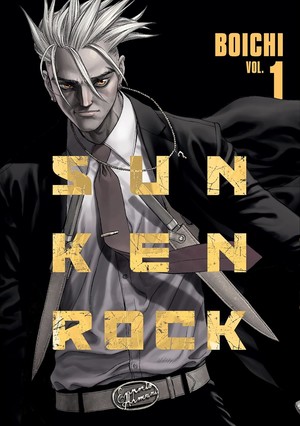
Ken Kitano has lost everything. He's lost his family, his dreams, and even his first crush, Yumin, who suddenly left for Korea to pursue her dream of becoming a police officer. He spends his days getting into one meaningless fight after another, but one day, after learning Yumin actually managed to make her dream come true, he decides to follow in her footsteps and head to Seoul. Only, instead of becoming a cop, he ends up catching the attention of a street gang and becoming their boss! Suddenly, his strength, values, and beliefs are put to the test as he navigates a new life that he's determined to keep a secret from Yumin, a cop to her very core. Sun-Ken Rock is a gritty and raw action-drama by Boichi, the renowned artist behind Dr. Stone! This cult classic combines explosive artwork with powerful storytelling and makes its English debut in a must-have edition
Sun-Ken Rock has a story and art by Boichi. English translation is done by Joshua Hardy and lettering by Henrique Silva. Published by Kodama (April 1, 2026). Rated M.
Is It Worth Reading?
Erica Friedman
Rating:
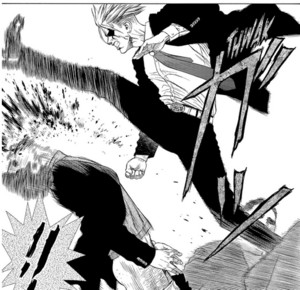
“Ken Rock,” a loser and hopeless nobody from Japan, follows the woman he idolizes to Korea, where he bumbles his way into becoming the leader of a resourceless street gang in this attractive omnibus edition of Boichi's series.
Along with violent action, inflamed rhetoric, and a lot of gang fighting is a tale of political fallout that lasts for generations. This background radiation of anger about the corruption and lies that sustains politic and wars sits just under the skin of this series like butter on roasting chicken, giving it aroma and depth that keeps one reading. Violence against women adds the sprinkle of flavoring across the top for a powerful, yet incel-friendly, tale of a man who can and will do nothing while raging at the machine that provides him with what little status he has.
I enjoyed Boichi's art here quite a bit. There's a mild homoeroticism in the way the men here look and talk about each other, and a fair amount of men showing off steely abs to one another. Manly tears are also a common feature of this man's man world. The hierarchy, the trappings, the way these men measure up against one another are all familiar to anyone who has ever consumed “underworld organization” narrative. Like so many heroes of that genre, Ken is a strong loser with a heart of gold, and his success against the other gangs is our entertainment.
Rebecca Silverman
Rating:
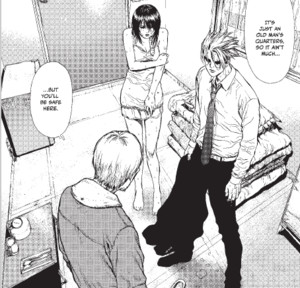
Sun-Ken Rock has a tone issue. At moments, it revels in its own lunacy, with characters pulling funny faces and making silly comments. At others, it delights in scenes of guys punching and kicking the hell out of each other. These two coexist well enough, but then creator Boichi will throw in a scene of a woman being sexually brutalized and spend multiple chapters discussing the Vietnam War and South Korea's role in it, and those really don't work at all in the context of the larger omnibus.
To be clear, I think Boichi is absolutely right that Korea's role in that war needs to be discussed – I didn't know anything about it and I should. I also appreciate that he has a character die from the effects of Agent Orange, because a couple of my parents' friends did and it was awful. I'm just not sure that a story about a Japanese guy moving to South Korea to impress a girl only to wind up leading a gang of sharp-suited thugs is the right venue for it.
I'm much less inclined to be kind on the rape front. Although the scenes aren't explicit, they're more than clear enough to make it obvious what's going on, and having over half of the female characters in the story subjected to sexual violence to motivate the “good” male characters is not acceptable. Of the two women who are not assaulted, one is the motivating factor behind protagonist Ken's move to Korea and the other is of the “too strong to be assaulted” trope; she's also the only one shown to be in charge of her own sexuality, which she naturally uses to tempt Ken and his compatriots rather than just being confident as part of her character. I know this is seinen, but that doesn't need to mean that it treats women badly.
I do appreciate how much Boichi clearly loves creating this series. The afterwords to both volumes included in the omnibus are filled with the extremes he went to in order to make this look exactly the way he wanted, and his apology to Vietnam for the atrocities committed during the war is important. The action scenes and the funny faces radiate the fun he's having drawing this, and if he goes a little too heavy on the blurred lines for movement, it's still hard to deny that the artwork is dynamic. But the tones are too unbalanced to make this really work, reducing it from a cohesive book to a collection of scenes starring the same characters.
Kodama has put out a beautiful edition, though!
The views and opinions expressed in this article are solely those of the author(s) and do not necessarily represent the views of Anime News Network, its employees, owners, or sponsors.
discuss this in the forum (12 posts) |

this article has been modified since it was originally posted; see change history
back to Spring 2026 Manga Guide
Seasonal homepage / archives