

Absolute Borderline: The Early Days of Evangelion Fandom, Part Three
by Brian Stremick,So, ADV had just announced that they had acquired the North American rights to the Evangelion TV series. Not only that, but they also promised a version with all new animation, confusing Western fans. And how did Gainax respond to the news? Four days after ADV's announcement, Michael House, Gainax's in-house translator, posted a message from Gainax General Manager Takeda Yasuhiro declaring that ADV did not have any rights to the show, and was preparing to take legal action against them for copyright infringement. Williams replied in a later post, apologizing for any confusion and stating that MOVIC told them that the show was going to be redone with OVA-quality animation. To the fans following this on RAA, it seemed to them that one of the parties involved was either mistaken in their assessment or worse, lying about it. This incident was then dubbed by RAA user Angst-sensei “EvaGate '96.” In a post, Angst provided a summary of the situation and phrasing it like he was announcing a boxing match, ended with this: “There's the bell. It's time for round one of what 'What the Hell is Going On?'”
Episodes 21 and onward didn't have the level of explicit content that the prior episodes had, but as one user put it, “What violence is there is disturbing though. Ugly, real, and sickening.” One Japanese user thought that the elevator scene with Asuka and Rei in episode 22, one of the most iconic moments in the show, was too long. Another user thought the Rei clones giggling during the big reveal was scary.
One of the most surprising discoveries going through RAA posts was that, of all the discussion about the previous episodes, there was little or no comment found about episode 24. One would think that some viewers, figuratively, would be losing their heads as easily as Kawrou lost his. So, we would need to find another source. Lucky for us, we have a reaction from Carl Horn himself. As was written in the coda to the English translation of volume 11 of Sadamoto's manga, he had been renting the untranslated episodes from a shop. As he reminisced watching this episode, “I remember my impressions during that one minute going something like this: the first twenty seconds: all right, this is the dramatic pause...the tension is building...any moment it will; the next twenty seconds: for God's sake, it's called animation...Hey, I bet the storyboards for this didn't take too long to draw...I can practically see the budget savings adding up, it's like watching the meter on an idling taxi, and then, oddly enough, breaking through, once again, to admiration in the final twenty: wow, as usual, Anno's got a lot of guts. So presumably, did the hand of Unit 01, a moment later.”
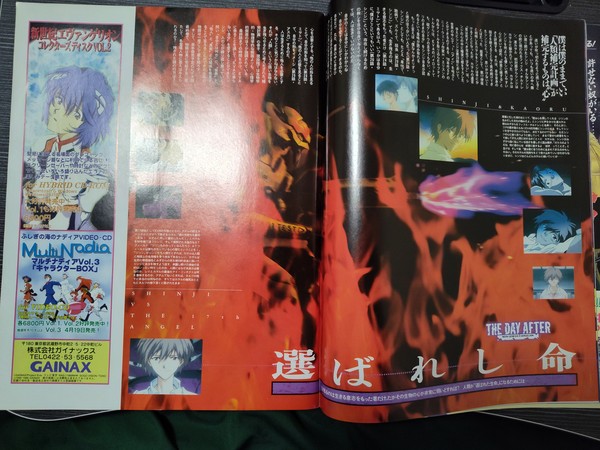
And then came episodes 25 and 26. If fans were angry about the events of the previous several episodes, they would become livid at what they watched, with the show chucking the narrative events in favor of what is essentially a psychological evaluation of the main characters and Shinji in particular. Claude J. Pettelier and Myoko Graham in Protoculture Addicts recorded the reactions of Japanese fans writing things such as “I was stunned! I thought the ending was a bad joke!” “I think that Evangelion ended practically at episode 24. The rest is absolutely ridiculous. The creators didn't care about the fans' feelings! I almost threw up!” “I won't watch this show any longer!” On RAA, some were making comparisons to the second Urusei Yatsura film Beautiful Dreamer and the British cult TV series The Prisoner, while others were comparing the show with previous Gainax works such as Gunbuster.
William Chow gives one possible explanation for why the final two episodes caused so much consternation. “There was a structure to these shows. There are 26 episodes in a show. [At] Episode 13 [there is a] break [and] summary episode. The plot starts shifting between 13 and the end. [Episode] 24 brings everything to a crux, and wraps it with 25 and 26. Evangelion didn't do that. Maybe it did, but you know, a lot of people were left hanging, unsatisfied, thinking there's still more, that sort of thing. That is one of the structures [of] some TV shows, they hang the last episode to make a movie or OVA.” He went on to say that a lot of people were interpreting the ending based on many things as Gainax left the ending open. Theories such as “the good guys didn't win” or “they all went to a better place” among others occurred because people wanted the ending to be a certain way.
Perhaps one of the most well-known reactions to the final episodes was from Spike Spencer, who played Shinji in ADV's dub. As he told Dylan G, “I did not know that the ending was coming [and] I had no idea what was going to happen, then suddenly it's like 'congratulations.' I was like, 'That's the end?' and Matt [Greenfield]'s like, 'Yep, that's the end.' When Spike asked to confirm, and Greenfield replied that it was true, Spike said to him, “' I need to rant, man, can you just open the mike for a second?' [Greenfield] goes 'go,' and that's what I did.'” Greenfield stated that “we kept it simply because A: it's hilarious, and B: as all the other actors came in and had the same reaction [to the ending], so [I say] 'here's Spike's reaction' and would play it for them.” The recording would then be included as an Easter egg in the various releases of the series put out by ADV.
Even though the show was over, the EvaGate controversy remained with no word from either Gainax or ADV. It didn't help that Gainax was cracking down on English Eva fan sites following the announcement. While some were thinking that it was hypocritical of them, considering their own fan origins, others were thinking that the whole fiasco was forcing them to make this move to protect their copyright. Two months later, Yasuhiro released another statement written by the studio's Publicity Manager, Sato Hiroki, stating that episode 19 would be getting a re-dub and episodes 21-24 would be getting “extensive retake footage” and the final episodes would be remade “using their original scripts.” Today, we know that this reanimation would be for what is now known as the Director's cuts of 21-24 (some of that additional animation first appeared in the compilation movie Death), while a remake of the original scripts is now known as the End of Evangelion. A month later, ADV announced that the first volume on VHS would be released on August 20th. Whether this was a case of one party speaking out of turn or an accidental game of telephone with two languages involved, further complicating things, we can only speculate.
It should be noted that the most shocking and disturbing of the fallout over these episodes wasn't widely known until recently. According to the documentary Hideaki Anno: The Final Challenge of Evangelion, which covered the making of the final New Theatrical Edition film, Anno said that he was an emotional wreck when the final episode aired. He had believed that he had done his best for the fans and the world in general, but some believed he was sloppy and careless, receiving criticism. Worst of all, there were online threads about killing him, and the best way to do it. “People came up with ideas about how to kill me,” Anno said. “When I saw that, I lost my will to live. I didn't want to make anime anymore.” He went on to say that it drive to the point of suicide on two separate occasions, the only thing stopping him was that he didn't want it to hurt. Today, we unfortunately read and hear tales of people suffering from online harassment. In 1996, it was easy to imagine the sheer shock and terror of having something like this happen to you, and from what you can tell, it must have been extremely distressing and isolating, especially if one had preexisting mental health issues.
But still, many fans on both sides of the Pacific wanted to know what that ending was all about, with many of them wishing that if they could speak with Anno himself, they'd get a clearer answer. Lucky for English-speaking fans, that opportunity would soon come.
Anime Expo 1996 was held from June 28th to 30th at the Marriott Hotel and Convention Center in Anaheim, California. Evangelion had a major presence at the con as the show won best new TV series at the con's awards ceremony, as well as a figure of Rei winning the official modeling contest. There were even people cosplaying as characters from the show. Like the previous four Expos before it and the ones after it up to today, there were guests flown in from Japan to attend. Anno was a guest that year, and along with him, other guests attending were Noburio Ishiguro (Macross), Yoshiaki Kawajiri (Cyber City Oedo 808), Mamoru Oshii (Ghost in the Shell), and Kenichi Sonoda (Gunsmith Cats), making this a more notable than average con at the time. Other events included the North American premiere of Tenchi the Movie - Tenchi Muyo in Love . Even the SciFi Channel provided coverage of the event, and filming bumpers showcasing the various aspects of the con and even the Japanese guests answering interview questions.
Like all guests, Anno had a panel where he answered questions from the hosts as well as from the audience. Carl Horn mentioned that while fans in the US had heard about Evangelion and its assorted controversies, most were fans of Anno and Gainax in general. So when Anno arrived at Anime Expo, “he wasn't seen as merely the mysterious and august presence behind an esoteric and controversial series, but also as the guy who was hurled into the pool at AnimeCon91, evidently, at his own insistence” (and there are pictures to prove it). While no complete panel exists as far as we know, bits and pieces that we do know of were recorded in magazines such as Protoculture Addicts and Animerica. Miyoko Graham of PA remarked that he appeared tired and some of his words were too harsh to be reprinted (we are fortunate that the September 1996 issue of Animerica coverage of the panel wasn't as kind).
Anno talked about other topics such as his OVA Gunbuster and his experiences scuba diving. As for any questions on Eva, they were varied. He did answer a few general questions, such as saying the Eva Units were inspired by the concept of Oni in Japanese mythology. When he was asked about episodes 25 and 26, he replied, “I have no problem with them. If there's a problem, it's all with you guys. Too bad” (According to Carl Horn, when the audience began to complain, Anno pulled the microphone close to him and said the last two words in English). Anno also discussed various characters in the series (and he also noted that all the characters are “sick”). He remarked that Asuka was his favorite character because “she's cute.” When he was told that the audience preferred someone like Misato, he said that he was surprised and that Japanese viewers preferred Rei. “They can't handle strong women such as Misato and Asuka.” When asked a follow-up question about Rei, he replied, “I think that she's very quiet and doesn't talk very much, and doesn't complain...she was created solely for the purpose of being an Eva's pilot, and I'm not quite sure if she's happy.” As for Shinji, “[He] does reflect my character, both in conscious and unconscious parts. In the process of making Evangelion, I found out what kind of person I am. I acknowledged that I'm a fool.” Concerning Gendo, Anno said that “He takes drastic and extreme measures by fair means or foul... to accomplish his own purpose. In some ways, he's mean. He hardly cares about Shinji.”
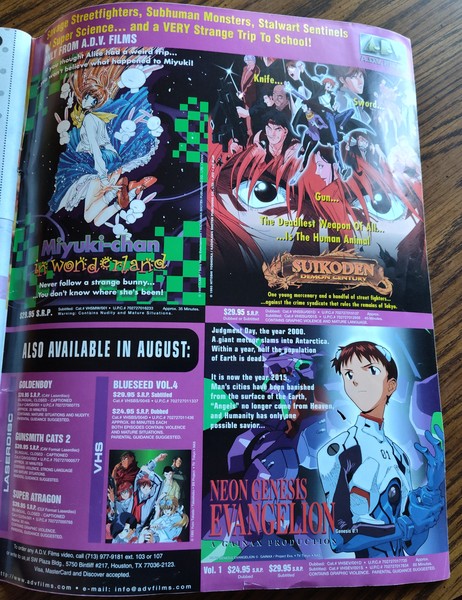
On August 20th, 1996, the first volume of the official North American release of Eva went on sale on VHS, and on May 17th, 1997, on Laser Disc (the LD release was canceled after two volumes due to disc rot issues). The VHS release would continue, two episodes per tape, until the final volume was released on July 7th, 1998. It was a combination of these commercial releases and extant VHS fan-subs, along with cultural osmosis emanating from various pockets of online and real-world portions of the growing anime community, where the show's popularity exploded, mirroring how the show took off in Japan. Not only was there discussion and debate about the show in both digital and analog realms, but there was a wave of fan art, fan sites, Eva-themed advertisements; a person couldn't get away from it. In an interview with Spike Spencer in the February 1998 issue of Animerica, he states that he found it frightening. “[I] mean, it's funny, and it's neat and all, but...it's just a cartoon, a fantasy...When people start taking the fun out of things, it bothers me.” Today, fans have moved on from RAA to other parts of the Internet, such as the Evangelion subreddit and Evageeks.org to discuss theories, interpretations, or to get basic information on the show.
Anno, for his part, released Evangelion: Death & Rebirth on March 15, 1997, and the End of Evangelion on July 19th, which completed the story. After several years of working on both animated and live-action works, he returned to the Eva franchise with the New Theatrical Edition films from 2007 to 2021. Today, the original TV series, which has been acclaimed both critically and commercially in both Japan and the West, can easily be seen either streaming on Netflix or through Blu-ray complete collections. Even with such easy accessibility today, we should not forget those early days when it was not so simple, and how it led to the anime ecosystem that exists today.
Sources and Further Reading
Further Information on Anime Expo 1996
Capps, Borealis. “VHS Trading and Fansubs in the Modern Era”
Dylan G. Bringing Evangelion to America 1996 to 2002: The Unofficial Documentary, Part 1.
Graham, Miyoko & Pelletier, Claude J. “Neon Genesis Evangelion: The Controversy” Protoculture Addicts #41 (July/August, 1996).
Graham, Miyoko. “Anime Expo 96: Anecdotes From Mr. Hideaki Anno” Protoculture Addicts #43 (November/December, 1996/January, 1997).
Horn, Carl Gustav. “Gainax Returns to Anime with Shinseki Evangelion” Animerica vol. 3 #2 (February, 1995). Portions of this article were reprinted in volume 10 of the English translation of the Evangelion manga (Viz Media, April 2007).
“A New Direction for Robot Anime?” Animerica vol. 3 #6 (June, 1995)
Coda to volume 11 of the English translation of the Evangelion manga. (Viz Media, November 2008). Reprinted in volume 4 of the 3-in-1 editions (Viz Media, August, 2013).
“Virtual Panel: Meet Hideaki Anno” Animerica vol. 4 #9 (September, 1996). Note: I've been informed by Mr. Horn that there were several Animerica staff members besides himself attending the panel, so it's possible that the article could have been from other people than just him.
“Sound Bites: Spike Spencer” Animerica vol.6 #2 (February, 1998).
Interview with Carl Horn. Conducted by email in November, 2025.
Hideaki Anno: The Final Challenge of Evangelion. NHK, 2021. Directed by Aki Kubota.
Nabours, Rex. “EvaGate: The Short-lived Controversy Behind ADV's Licensing of Neon Genesis Evangelion” A more in-depth telling of the whole Eva-Gate controversy.
O'Mara, Sean. “The Resin Punks Never Left”
Interview with Gordon Waters. Conducted by email in September, 2025.
Special Thanks to William Chow, Dave Merrill, Gordon Waters, and Carl Horn for their help.
discuss this in the forum |
