

Spring 2026 Manga Guide
Void: No. Nine
What's It About?
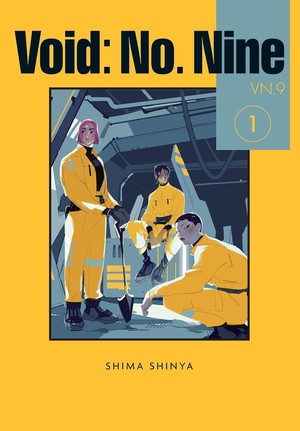
Three hundred years ago, God destroyed the world. All that remains of humanity lives deep underground, far from the blasted surface―and far from The Emissaries, remnant soldiers of the divine war against mankind. Most live quite lives in the tunnel cities, but the few daring or desperate enough to risk death work as scavengers, collecting relics of the old world...
Void: No. Nine has story and art by Shima Shinya. English translation is done by Sean McCann. Lettering is done by Abigail Blackman. Published by Yen Press (May 26, 2026). Rated T.
Is It Worth Reading?
Rebecca Silverman
Rating:
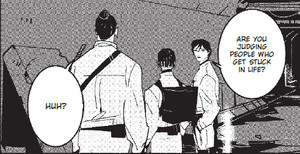
For my money, Shima Shinya is one of the most interesting manga creators being translated into English today. While nothing has quite reached the heights of their Lost Lad London series (for me, anyway), Void: No.9 is off to a very promising start. Nominally a post-apocalyptic series, the first volume is already setting itself up to explore what happens to the people society fails or deems unworthy, with a focus on the incarceration of teens emerging.
Set in a hopefully distant future, Shinya presents us with a world where our society has fallen. Mythologized as “God killed the world, so humans killed God,” it seems awfully like there was a nuclear war that forced people into underground or otherwise barricaded cities. Now with that far enough behind them, people have begun venturing into the ruins looking for lost technology and other things, for reasons that the plot is very cagey about telling us. We know that there are collectors, but also that the government wants “useful” items. Given the framework supporting the story, I think we'd be right to be very distrustful of what they intend to do with them.
In order to gather these bits and pieces of lost civilization, groups are sent into the ruins as scavengers. No one gives their real names and death is almost a guarantee, so it stands to reason that these scavengers would be from the fringes of society. What's striking is that as we get backgrounds on some of them, an awful lot seem to have been incarcerated at some point, generally in juvenile facilities. Their prison sentences all seem to have stemmed from gang activity, and as one former prisoner's story suggests, most of them didn't have families. No one was looking out for these kids, so they were swallowed up by a system designed to fail them, and now with the only work open to them being dangerous, society continues to fail them. They have no hope because they were given none.
Shinya isn't explicit about any of this. Their usual storytelling style of obliquely guiding readers to discover the themes of a work themselves is out in full force here, backed up by their blocky, bold artwork and impressive diversity of cast members. This book is one of the few manga I've encountered that specifically mentions a trans man having top surgery (and another character congratulating them on it), and the cast is racially diverse as well. It feels like it reflects our world, which makes the science fiction elements even stronger.
This volume is largely set up, which means that it doesn't quite get everything off the ground. But the mysteries and real-world parallels all make for an intriguing start to what I hope continues to be a strong series.
Erica Friedrman
Rating:
Post-apocalyptic stories can be a tad predictable at times, especially when they adhere to trope-y plots and dialogue. Here in Void: No. Nine, the story and, to some extent, characters and dialogue are all as one might expect, but it still has some appeal.
In a post-apocalyptic landscape, complete with a wealthy upper class who treats people of the lower classes as disposable, teams of three are sent into the tunnels to retrieve rare artifacts and survive relics from a previous age, the Emissaries, with only one dose of performance-enhancing drugs per person.
We meet key players on the teams, learn snippets of their mostly traumatic backstories, and, presumably, some part of their motivation for doing what is, objectively speaking, a shitty job. In the middle of this, somehow we find ourselves learning enough about characters to care about them: Rain, who just got top surgery, Siang, who is living with an old woman assigned to act as his grandmother, Ira, who wants to kill someone, and Asa, who seems clueless but managed to defeat an Emissary on her own.
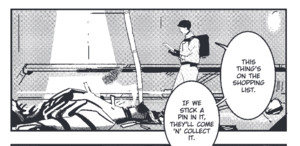
The art here is stark, with heavy uses of black on white and grey tones. Objects and monsters are drawn in enough to be recognizable as things, but not so well that we know what they are, specifically. In a world that other creators might populate with a ton of technical jargon and sci-fi technology, Shinya renders everything in simple lines and words that make this immediately understandable. No need to learn arcane jargon or understand complicated politics.
If you like working underclass folks cope with unreasonable danger in a post-apocalyptic landscape, Void: No. Nine will absolutely scratch that itch.
Disclosure: Kadokawa World Entertainment (KWE), a wholly owned subsidiary of Kadokawa Corporation, is the majority owner of Anime News Network, LLC. Yen Press, BookWalker Global, and J-Novel Club are subsidiaries of KWE.
The views and opinions expressed in this article are solely those of the author(s) and do not necessarily represent the views of Anime News Network, its employees, owners, or sponsors.
discuss this in the forum (16 posts) |

back to Spring 2026 Manga Guide
Seasonal homepage / archives