

Show, Don't Tell: Sentenced to Be a Hero Director Hiroyuki Takashima, Screenwriter Kenta Ihara
by Lynzee Loveridge,
We met with Takashima and Ihara at Studio KAI in March. Over the course of the interview, Takashima, a seasoned animator whose previous work includes Re:ZERO -Starting Life in Another World-, SSSS.Gridman, Symphogear XV, to discuss crafting Sentenced to Be a Hero's dynamic action sequences, how FromSoftware games influenced the monster designs, and the show-don't-tell approach to the story.
Note: This interview contains spoilers for the final episode of Sentenced to Be a Hero Season 1.
This is your first anime work as the director. The reception in the West has been positive, especially with respect to the action scenes. How do you devise such intense moments? Was there anyone who gave you important advice that you worked into your craft?
Director Hiroyuki Takashima: I've often been called what's known in the industry as an "action animator." However, in my career so far, I haven't been praised much as an action animator. In fact, rather than my action scenes, I've been praised more by my mentors and senior animators for my dramatic and emotionally charged character scenes. Honestly, I don't really consider myself an animator who's particularly good at action scenes. Even so, the fact that my action scenes were so popular makes me truly happy.
When I create those types of action scenes, I don't have any one specific reference I consciously use. Everything I've watched over the years—movies and anime— is reference material for me. I really like anime films from the '80s, '90s, and the early 2000s. I absolutely love OVA anime from the '90s, so I naturally use those as references when I'm drawing storyboards, I guess.
When it comes to putting together action scenes, something I've always been careful about since becoming an animator is how to use the flow of time. In many films and anime, it often feels like it's action for action's sake—it's disconnected from the story. That's how it looks to me anyway. I personally feel that during any action scene, the story should be moving along as well. I've always been careful about making sure that the action doesn't grind the story to a halt—and that the action creates a kind of catharsis within the story. Regarding my style and approach to structuring scenes and action scenes, there's something else I'd like to mention. I apologize for bringing up another anime, but I'd like to talk about one that aired in January, Fate/strange Fake.
The directors, Shun Enokido and Takahito Sakazume, are my contemporaries. We're friends of the same age, and ever since we were newcomers, the two of them—as well as other animators around our age—we've been asking ourselves and each other, “How does one create action scenes that convey the sense of time moving in real-time?” I think that in Sentenced to Be a Hero, the accumulation of all those experiences allowed us to express time that way to some extent—and that's what led to the positive reception of our action scenes.
So it's not that many people gave me advice; rather, it was the result of constantly talking with my fellow animators and industry friends about how to do things better and create the best possible visuals from my early days on.
What challenges did you encounter as a first-time director that you didn't expect, or maybe there was something you expected that went differently than anticipated?
TAKASHIMA: There were way too many things—how do I go about picking which to talk about...? If I say the one I struggled with the most, it is, unfortunately, about me; I was late in submitting the storyboards. This caused trouble for the voice actors and the sound director. It's the area where I fell short the most—and, to everyone involved, it's something I'm very sorry about.
I also caused trouble for the art director, the colorist, and the cinematographer by being late in revising my storyboards. That is actually the thing I regret the most. Also, this was my first time as a director. I knew I needed to manage things objectively—to see the series, episodes 1 through 12, as a single package. But when I looked at each episode individually, I couldn't help but become an animator again and was very concerned with all the small details. I had decided beforehand that I should stop doing that, but the fact that I ended up doing it without even realizing it while in production is another thing I regret.
Is there a scene in an episode that you are most proud of?
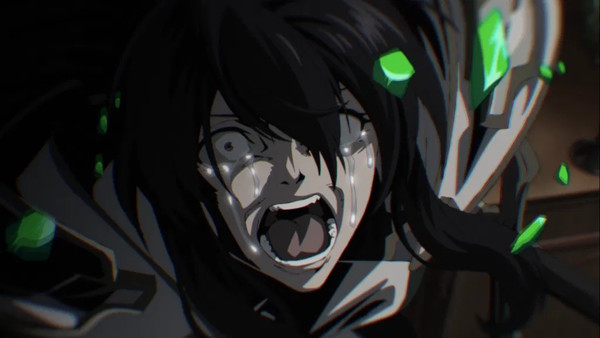
TAKASHIMA: The scene I'm most attached to, the one I wanted to direct the most, is the one in episode 12 (the final episode) where Kivia ended up killing Marlen. Originally, in episodes 1 through 6, the focus was on Xylo's story. But in episodes 6 through 12, Kivia's story, which was originally a subplot, became the main focus.
In the end, the season concludes with Kivia being sentenced to the 'Hero Punishment.' But for me, while it's a story of Xylo's growth, depicting Kivia, who is kind of the co-protagonist or even the hidden protagonist of the first season, in that way, at the end, was the part I was most looking forward to as the director of the first season. It was also the scene I felt the most emotionally invested in while drawing the storyboards. I was thinking about how to leave a scar or mark on both first-time viewers and fans of the original work — how to betray viewers' consciousness or, in a way, shatter their emotions. I apologize for using such negative words, but that was what I was thinking about when storyboarding that scene. It was fun.
When it came to visually adapting Rocket Shokai-san's novels, how did you decide on the monster designs, especially the Demon Lords?
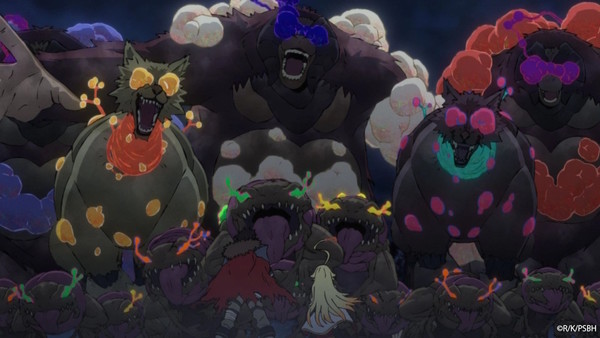
TAKASHIMA: In Rocket Shōkai's Sentenced to Be a Hero novels, the monsters are depicted in a distinctive way. My assistant director, (Yoshitake) Nakakōji, and I put our heads together. In the original Sentenced to Be a Hero novel, there is a description that says that the creatures appearing are being forced to experience nightmares. So, we decided to feature the idea of being forced to experience dreams and of being manipulated against one's will by a greater power. So it started off that the design of the Demon Lord has eyes, and the rest of the creatures, those that are being controlled or enslaved, do not.
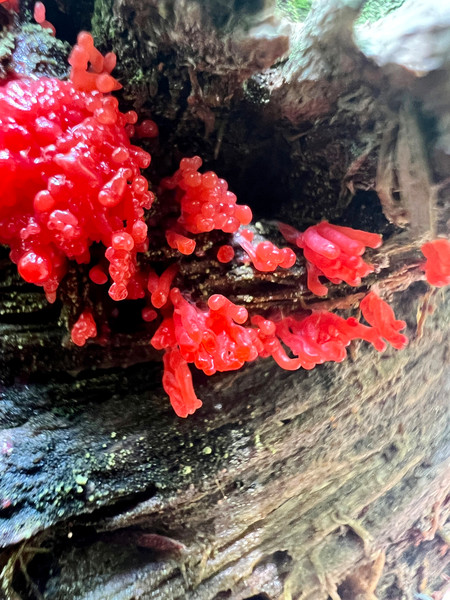
However, we ended up feeling that focusing on just that would be boring. I wanted to experiment with vibrant colors that you don't see much in other anime in Sentenced to Be a Hero. For reference, I took ideas for colors from natural objects, especially slime molds (like mushroom slime molds, for example)—the extremely vibrant, non-chemical colors found in nature—and mixed them together to start. Then, assistant director Nakakōji told me he didn't want designs that were just cool and nothing more.
 |
 ©2024 Rocket Shokai/KADOKAWA/Project Sentenced to Be a Hero |
"Designs that are different from other fantasy anime, designs that are more than just one-word descriptors like 'cool' or 'disgusting,' how about we make designs like that?" That was how we fleshed out our ideas, and through those conversations, we refined the designs into what is in the final anime.
There's that first monster, the one that looks like a big fly and spits out something, right? Where did the idea for that monster come from? For example, was it originally in the illustrations for a light novel?
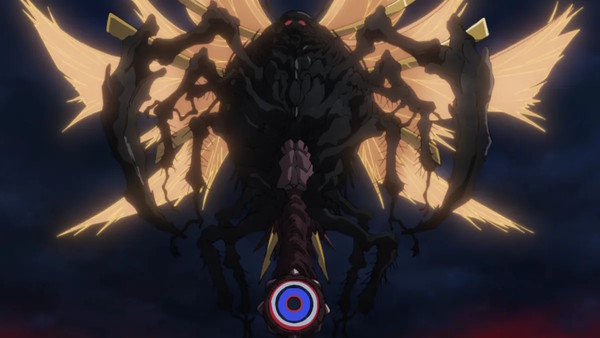
TAKASHIMA: That's not an illustration from the light novel; the demon lord was originally based on a cockroach. FromSoftware's creature designs were used as a reference, and this time, we created it by taking an actual cockroach as the base and incorporating elements of Cthulhu into the design. Also, there's this tube-like thing attached. I discussed with Nakakōji... how should I put it? A kind of androgynous element? A kind of sexuality, or rather, a rawness that people instinctively feel, and a kind of grotesqueness that Japanese anime designs don't usually have, so I tried to mix them in.
Ihara-san, you've previously worked on many fantasy and isekai anime in the past. What was different about working on Sentenced to Be a Hero?
Screenwriter Kenta Ihara: The biggest difference was that, initially, Director Takashima told me not to use internal monologues. Though we wanted to show things as much as possible through visuals alone, being given the rule of not using any at all was definitely difficult.
So, explaining the world setting couldn't be done through internal monologues in the anime. In the novel, there's the natural, first-person narrative text—but it was completely unusable! Even when I tried to use it, I had to change the format a little bit. That was definitely difficult. That was the biggest difference—and the biggest challenge.
Which character was most enjoyable to write for the series? Which was the most unusual?
IHARA: Everyone's a bit unusual, since they're all experiencing the Hero's Punishment—His Majesty, in particular. When I first read about Norgalle, I didn't really understand him. I'm not sure how much I can say, but in the upcoming second season, you'll come to understand his background to some extent. When I first heard about him—and even after hearing a bit more—I couldn't immediately grasp his character. It was more like, "Oh, I see."
He's a bit complex, but definitely an unusual character. And to bring out that slightly unusual character—in episode 2, I think—we used some "slightly unusual' lines" that weren't in the original. Of course, those came from Rocket Shōkai-sensei—'Wouldn't this be good?' We'd go, “Yeah, let's go with it”. So there are some unusual lines in the anime that aren't in the original, and I think everyone will enjoy looking for them.
What do you think is appealing about Xylo Forbartz's story and character?
IHARA: This might be a bit of a digression at first, but when I asked Rocket Shōkai about the theme of the first season of the anime, they said something like, "What is a hero?"
And in a way, in terms of the overall series as a single package—as Director Takashima mentioned earlier—this is clearly evident in episodes 6 to 12. High Priest Marlen, Sodrick, and the people in Sodrick's Shell—they all cherish and want to help their families and friends. But on the other hand, characters like Xylo and Kivia risk their lives for people they don't even know the names of. I think that's the biggest difference—the kind of heroism Rocket Shōkai is presenting: someone who can risk their life for people whose names they don't even know.
That's a big part of who Xylo is, but even as I was writing, I didn't know if his heart was truly in it. The biggest thing for him was not to let himself be underestimated. I really like that about him. To me personally, he's definitely a hero, but at the same time, there's something small and relatable at his core. I think he possesses grand and subtle qualities, which make Xylo such an interesting person. However, the fact that he likes poetry—that gap in appearance and interest—gives him a sense of duality. It makes him hard to pin down, and I think that's what's so wonderful about him.
Certain elements, like Demon Lords, are recurring in fantasy and isekai stories. What keeps these elements interesting to the audience?
TAKASHIMA: Well…the question is, how deep should I go here? Ultimately, I think that as long as religion exists in the world, people will continue to be interested in these elements. As long as religion exists in our world, I think people will continue to be fascinated by, yearn for, or rely on things like demon lords, fantasy worlds, and other fictional things. If I were to really get into this, it would probably involve ethnology. It would probably become a discussion of cultural anthropology or sociology, depending on how deeply I delve into it.
But, humans are drawn to things unlike themselves—talented people—or something far beyond their own reach, be it nature, machines, AI, or anything else. They both yearn for and fear these immense forces beyond their imagination. As these emotions rise, so does interest in them. As long as there are grand things with no limits like that in the world, I think people will probably continue to love things like gods, demon lords, and heroes.
IHARA: These have always been strong elements in great stories, but conversely, stories focusing on small, individual relationships and romantic comedies have also been popular recently. So I don't think it's always the case that stories about defeating a demon lord or some other powerful entity will be featured.
However, having lived for 40 years, I've certainly experienced at least one or two instances of such injustice that I can only describe as "encountering a demon lord." (laughs) So, in terms of building resilience against such situations, I think these kinds of stories are important, and I believe someone, somewhere, is looking for them.
When you encounter something unfair—it's not exactly a source of encouragement, but if it helps you remember that you won't let yourself be defeated here and gives you the strength to try even a little more, then I think it has meaning, right?
Of the large cast of heroes, which one would you trust to rescue you?
TAKASHIMA: I don't really like any of the members of the Hero Squad. [laughs] But who would it be? That's a difficult one. Hmm, maybe Tatsuya?
IHARA: I also was thinking that all of them were bad choices, but I'm starting to think that Neely might actually be a good fit.
TAKASHIMA: Sorry…it might be hard to communicate this with it using words.
IHARA: Well. [wry smile] Neely can fly. And it can give rides.
TAKASHIMA: That's true. And it's kind to people.
IHARA: I think it's okay as long as you don't look under its wings.
discuss this in the forum |
