

Spring 2026 Light Novel Guide
Beacon of Light in the Dark Sea
What's It About?
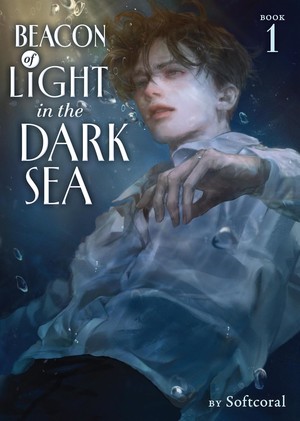
Humanity's hunger for resources has sent us where we were never meant to go—down into the crushing dark. The North Pacific International Undersea Station is a submerged labyrinth of labs, mining decks, and narrow living quarters where the sun never reaches.
Muhyeon, a dentist by trade, joins the station expecting routine work, but the eerie silence and the crew's increasingly unstable behavior quickly prove him wrong. From quirky to unsettling, every encounter makes one truth impossible to ignore: the danger isn't outside the station—it's already here.
Beacon of Light in the Dark Sea has a story by Softcoral. English translation is done by Soyo Hong with an adaptation by Arisia Santiago. Published by Seven Seas Entertainment (May 26, 2026).
Is It Worth Reading?
Erica Friedman
Rating:
This was a really excellent book. The writing is compelling, the characters are not cardboard cut-outs, and—I say this with complete honesty—the parts about dentistry are both relevant and interesting in the context of the story. Yes, I said dentistry. Our protagonist, Muhyeon Park, is the new dentist at an underwater station. He finds nothing at all to be normal, and then everything goes pear-shaped. Muhyeon and researcher Gumi Yoo join forces with an eccentric group of people to try to survive an unthinkable situation.
I was raised on the disaster movies of the 1970s, and from the first page, you just knew what was going to happen here. There was no way to predict why. And, again, to be honest, I'm not sure the “why” worked. But even as the story gets more and more complicated and weird, the driving force of human survival makes for a very good read. Translation by Soyo Hong is outstanding. Every character feels realistic enough, and they have their own unique voice. Despite it being sold as a light novel, it is actually an unillustrated novel. I've been really pleased at the novels being translated by manga companies this year—it's a good trend I hope to see continue.
This book is 371 pages of non-stop WTF is going on here, a sentiment expressed constantly by Muhyeon. Which is both a strength and, ultimately, its biggest weakness. As I was getting towards the end of the volume, it became apparent that the story was not going to end here. Yes, this is a two-volume series. I'm torn between wanting to find out what happens and reading what is going to have to be a messy second half, given where the first half ends. As I said, the “why” not only makes no sense, but makes less sense the more we uncover. On the other hand, this volume was, on its own, a very exciting and forceful story…even the dentistry. So maybe I'll be back for the next one after all.
Rebecca Silverman
Rating:
This book is a two-volume novel in the sense that the Victorians used the term. That means that it doesn't end – it just stops. For a variety of reasons, that's pretty damn frustrating; even if you don't have my fixation on whether or not the cat protagonist Muhyeon rescued from a lower level of the slowly flooding undersea base is still okay, this is still only half of the story. For that reason, I'd recommend waiting until the second volume comes out, because otherwise you'll be on tenterhooks for months.
And that in itself is a statement of how engrossing this book is. Mapped onto the blueprints of the disaster films of the 1970s, the story takes place on one of humanity's first undersea bases. Having largely decided that space colonization wasn't going to work, people are looking to the (polluted) oceans as a viable method of survival, and Muhyeon has been hired as the base's first dentist. But he only gets to practice for five days before disaster strikes, and most of the book takes place over the course of several tense hours as he tries to escape. He quickly learns that he's one of the few true civilians on base, and that rules like “no guns” and “no alcohol” really don't mean much to the purported engineers and miners who keep things moving. In fact, human life doesn't seem to matter much to anyone besides Muhyeon; when the alarms first go off, he takes it upon himself to force open doors to warn others. When he finds two illegal pets – the aforementioned cat and a snake – he takes them, too. But most of the other people he encounters aren't so kind.
What's interesting is the way that Muhyeon and Gumi (a researcher) begin to rub off on their three engineer companions. Muhyeon's insistence on humanity and Gumi's distaste for violence force the other three to act differently, and by the time the book ends, it feels like they've become a team. That may be dangerous to believe, though, because Aehyeong proves close to the end that she's still willing to resort to violence, even when there may be another option.
The novel's major failing is the logic. While I understand the desire to make the villains just this close to socially acceptable fanaticism, it frankly doesn't make a whole lot of sense. The way the base is constructed also seems haphazard in that Softcoral may not have put quite enough thought into it. But the writing, translation, and adaptation are all strong enough that it's only when you put the book down that you realize the flaws. It's solid high-octane escapism, and I'll be back for volume two.
But if the cat dies, there will be hell to pay.
The views and opinions expressed in this article are solely those of the author(s) and do not necessarily represent the views of Anime News Network, its employees, owners, or sponsors.
discuss this in the forum |

back to Spring 2026 Light Novel Guide
Seasonal homepage / archives