

Spring 2026 Manga Guide - Komi Can't Communicate: Making Friends and Not Scaring People
What's It About?
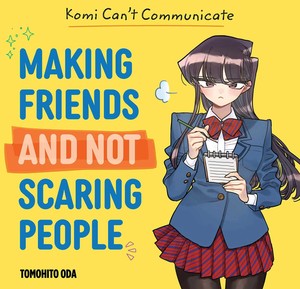
Do you find it hard to speak to people? Know anyone who blushes, stammers, or sweats whenever someone looks at them? Or perhaps you'd like to learn new ways to make friends and navigate social situations? If so, this fun and informational guide is the perfect book for you!
In the manga Komi Can't Communicate, Komi attempts to overcome her social anxiety with the help of her very first friend, Tadano. This full-color book collects snippets of the practical advice, tips, and tricks Komi accumulates along the way, providing fun and useful pointers on meeting people, having conversations, and truly connecting so friendships can grow.
Komi Can't Communicate: Making Friends and Not Scaring People has a story by Natalie Schriefer and art by Tomohito Oda. Published by Viz Media (March 10, 2026).
Is It Worth Reading?
Erica Friedman
Rating:
I loved this book. If I could, I would keep copies of this book on me to hand out when I meet folks who struggle with communication, which is rather often. After all, the Venn diagram circles of variously nerdy people and people who find it hard to navigate social situations overlap quite a bit. I have myself pretended to be more extroverted than people I know (“What Would XYZ Do?”) when in situations where, normally, I'd just hang out in the corner. Starting, maintaining, and continuing conversations and friendships can be a lot of work. We're not all “people” people.
Author Natalie Schriefer offers up a very friendly, fun, and relatable guide to these behaviors that are sometimes serious, often quite goofy— never insulting or condescending—by utilizing the characters and situations from Tomohito Oda's hit manga about this very topic, Komi Can't Communicate.
The whole thing feels like a more experienced friend, someone who has cracked the normie code, but also isn't telling you to mask or lie about yourself. This friend is just giving you simple, totally doable steps to break free of your own anxiety about talking with people. Right from the beginning, steps are doable, like “Greet someone you already see.” Chapters include how to deal with rejection and embarrassment. The book even goes into romance, if that's where the relationship goes.
It's a fast read; you don't need to have read or watched Komi to understand the characters or the jokes. I'd say every early teen ought to read this, but honestly, I think every adult ought to, too. It's a good place to begin, and I'll be using the tips for myself as well.
Kevin Cormack
Rating:
So this is a weird one to review, as it's not exactly a manga, and it's not by the creator of the titular series. While there are plenty of manga panels distributed throughout the book, they're mainly taken out of context from their chapters to loosely illustrate some kind of point from the nearby text. As far as I can see, this volume is exclusive to English-language readers and not translated from a Japanese original, so its life lessons are perhaps more targeted towards Western introverts than those keen to learn how to socialize in Japan.
Komi Can't Communicate is a 37-volume manga that was adapted into an anime back in 2021. Its main premise is that painfully shy female protagonist Shoko Komi desperately wants to make one hundred friends, but has no idea how to overcome her fear of socializing enough to make genuine connections with others. While the manga plays this off for laughs, social anxiety is a real and often debilitating condition. Although I myself am definitely on the far more introverted side of the social spectrum, I've mostly overcome the shyness that plagued my school years. This book isn't really targeted at me, as, to be honest, I found most of its “lessons” rather simplistic and trite. That's not to say it won't be helpful to some folks who really struggle with the most basic of human interactions, but I can't admit that I personally got anything out of its self-help material.
At least it's a bright, breezy, and relatively fun read, full of little in-jokes best appreciated by Komi manga readers (of which I am one). Those without adequate Komi familiarity may not get much of the integral humor. It's hard to tell how much, if any, input Komi's original creator had with this volume, which suggests to me it's a tenuously related spinoff at best. There's absolutely not a chance I'd even glance in this volume's direction if it were on a bookshop's shelf, and reading through it for review purposes hasn't changed my mind. If you want painfully basic coaching on the most elementary of human interactions mixed with funny manga panels, then by all means, pick this up. It may be better to forgo the manual and practice by trying to interact with people yourself, though.
Bolts
Rating:
Have you ever gone to a bookstore and seen those self-help books that break down various different skills for your average person to understand? Maybe it could be a book about understanding basic mathematics, or maybe it's about social skills like how to talk like a businessman. What I like about manga is that every now and then I'll come across a book that will present an idea in a way that feels unique for this genre, even if I've seen it pop up in other mediums before. The idea of a self-help book on how to make friends and how to communicate can be pretty useful, especially if you're somebody who needs things to be explained or compartmentalized for you in a very specific way. But what happens when you specifically frame how to make friends or advice on how to generate relationships through the lens of a series that was comically all about that?
Making Friends is extensively a self-help book broken down with various different sections and tips on how to make friends, but the whole thing is framed from the perspective and actions of the characters in the Komi Can't Communicate series. This elevates the material from being a pretty reasonable standard help book to a treasure trove of comedic gold presented in probably one of the most economical ways I've ever seen. Literally the entire book is broken down into sections like “how to start a conversation” or “how to avoid confrontation,” but almost every bit of advice is followed with a manga panel, art piece, or straight up section removed from the original series as a form of context. It's absolutely hilarious because while the advice technically applies to the situation that is being used as an example, what made Komi Can't Communicate so funny was just how exaggerated all of the character personalities were. People misunderstood each other to ludicrous degrees, people got into arguments over crazy situations and Komi's reactions to dealing with her potential communication disorder was played up for laughs in a rather wholesome but still silly way. I kinda like this because it felt like I was revising a series I was very fond of in a slightly different applicable lens.
I didn't really need the advice the book was giving even if it was pretty useful. There's a part of me that feels like a lot of the advice and how it was written would mostly apply to people more on the younger side of things, but I've also met a lot of adults who don't know how to talk or interact with each other so maybe I could give this to them as a gift so they'll get the hint. I'm mostly kidding but from my perspective, there was a lot of value in reading this book as an established fan of the series, but I also think the book is brilliant because it almost works as a great advertisement for the series itself. If you haven't read the series, you have no full context for any of the scenes the book presents because the appeal is that a lot of these scenes are out of context. So if you pick up this book at a bookstore, read its advice and then are at all curious about the scenes or artwork that is used to follow all of these examples, that could be enough to make you think “huh, maybe I should check out the main series to see what all of this is about?” Does that make the appeal a little bit limited? Yes, but I do admire the creativity and how this book is able to accomplish so much with so little.
The views and opinions expressed in this article are solely those of the author(s) and do not necessarily represent the views of Anime News Network, its employees, owners, or sponsors.
discuss this in the forum (4 posts) |

back to Spring 2026 Light Novel Guide
Seasonal homepage / archives