

Spring 2026 Manga Guide
A Starlit Darkness
What's It About?
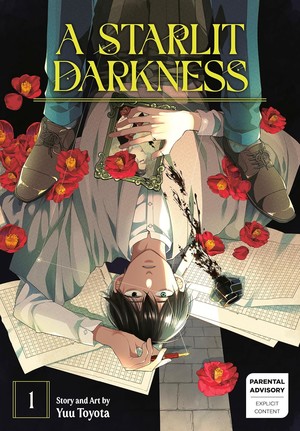
Japan, early 20th century. Subaru Karasuma, an aspiring writer with dashed ambitions, neck-deep in loans he has no hope of paying back, decides it's time to draw the curtains on his miserable life. Before he can follow through on his dark intent, he's diverted by the spectacle of a neighbor working frenetically with his literary group to meet the deadline for a work commissioned by Geppo Yagira, a rich and famous novelist. When the devilishly handsome, fiercely talented Geppo lays his eyes on Subaru, the latter's life is set on a new course. But the new path he's now treading seems to lead ever deeper into the darkness...
A Starlit Darkness has story and art by Yū Toyota. English translation is done by Kiki Piatkowska and lettering by Rebecca Sze and Arbash Mughal. Published by Square Enix (May 12, 2026). Rated M.
Content Warning: Suicidal ideation
Is It Worth Reading?
Rebecca Silverman
Rating:
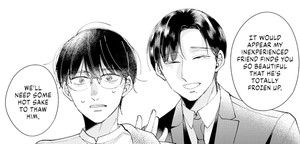
Forget Cherry Magic and Papa and Daddy's Home Cooking. This is not Yū Toyota at her cozy BL best – it's Toyota plumbing the depths of psychological darkness. Set during the Taisho period (1922, to be precise), A Starlit Darkness explores the world of writers. Subaru Karasuma found success early in his career, inspired by an actress who far outshone her stage, but when her theater closed, his creativity dried up and a different up-and-coming young author, Geppo Yagira, took over his spotlight. Now, a few years later, Karasuma is barely scraping by and is ready to end it all when he stumbles into a writing studio where aspiring authors are putting together a self-published literary magazine. Yagira is the mentor to the group, and he takes a keen, albeit strange, interest in Karasuma. He seems determined to get the other man to write again, but why is a question unanswered until the end of the volume – and even then, it's more of a hint than a clear reason.
Professional jealousy is just one of the pervasive themes of this book. Karasuma has long seen himself as inferior to Yagira, but Yagira feels an intense envy of Karasuma, despite the fact that the man, as of the start of the series, hasn't written in years. They epitomize different ends of the authorial spectrum, with Yagira feeling that nothing he does is ever real or good enough yet still craving the accolades he's sure he deserves, while Karasuma needs very specific inspiration and then feels distress or disgust at his own work. It's not that much of an exaggeration of authorial circles, and the glosses in the back suggest that Toyota may have based Yagira in part on Jun'ichiro Tanizaki, with Karasuma representing Haruo Sato.
There's an unrelenting darkness to this volume that only grows more profound as it continues on. Karasuma is on the verge of committing suicide when we meet him, and is stopped by Yagira, but even without that, we can see that his mental health is precarious. In Karasuma's eyes, other people at first appear as animals, suggesting that he sees himself at a distance from others or that he doesn't believe that he fits in with society in general. Names are important in the book's world on this front, as Yagira has the word for “goat” in his name (“yagi”), while Karasuma's name has the word for raven, “karasu.” But his first name, Subaru, is the name of a constellation, and Yagira is Japanese for Capricorn; Karasuma speaks about writers drawing lines between stars to form constellations, and that seems to indicate that, whether he and Yagira like it or not, someone (possibly Toyota) is drawing lines between them.
A Starlit Darkness is heavy. It's not a book you should just pick up because you liked Toyota's other titles, because you will not get the same affirming feel-good story here. But if you want to see what she can do as a creator or are a fan of psychological horror, give it a chance. This cements Toyota as a creator to keep an eye on.
Erica Friedman
Rating:
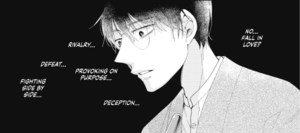
The first page provides a clear warning that there will be content that could make a modern reader uncomfortable. I appreciate proactive warnings, although some clarity of content might be helpful. So, content warning for suicidal ideation and threats of violence.
The opening chapter for this series is amazing. When our protagonist Karasuma stumbles upon a “literary coterie,” that is to say a circle of amateurs who are creating self-published literature, his first impression is…let's call it prosaic.
From there, a very gothic tale of a young man who has no understanding of the world in which he desires to exist, at odds with himself and, ultimately, with his benefactor, plays out. This volume spends a lot of time in Subaru's immature emo phase, where he wrestles with his delusions and lo-self-esteem. But, the end of the volume puts that aside and gives both Subaru and us an external antagonist…the very person who gave him his opportunity to grow.
Sadly for us, the story of a young artist whose mentor works to undermine their work and reputation is not unheard of. This story is, thus far, free of sexual coercion or violence, thankfully. Unfortunately, as so much of the first volume spends time on how self-centered and incoherent Subaru is, I ended the volume not rooting for him, nor is Geppo, the self-absorbed mentor likable. So while I thought this was a very solid first volume of a historical drama, I think the only character I liked was the actress who has already left the narrative. That seems symbolic, somehow.
The views and opinions expressed in this article are solely those of the author(s) and do not necessarily represent the views of Anime News Network, its employees, owners, or sponsors.
discuss this in the forum (20 posts) |

back to Spring 2026 Manga Guide
Seasonal homepage / archives