

Old-Fashioned Magic: A Brief History of Studio Pierrot's Magical Girls
by Rebecca Silverman,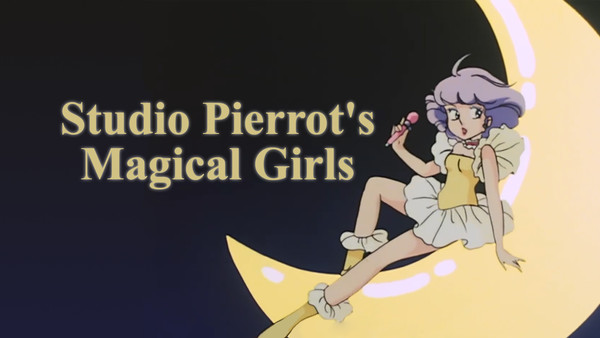
Where do magical girls come from? An academic answer might be the 13th-century emaki (picture scroll) Tales of Gisho and Gangyo, which features a young woman transforming to protect others. An equally valid response is 1962 with the manga Himitsu no Akko-chan (not animated until 1969) or 1966 with the anime Sally the Witch. But for most modern anime viewers, the answer is more likely 1982's Magical Princess Minky Momo, followed closely by 1983's Magical Angel Creamy Mami. Creamy Mami marked the start of Studio Pierrot's famed magical girl series, which lasted throughout the 1980s, had one additional series in the 1990s, and then only finally returned this year, 2026, with Magical Sisters Lulutto Lilly. For many classic magical girl fans, Studio Pierrot's four series from the '80s – Magical Angel Creamy Mami, Magical Fairy Persia, Magical Star Magical Emi, and Magical Idol Pastel Yumi – define the genre as we know it today.
What Defines a Magical Girl? How About a Studio Pierrot Magical Girl?
Today, magical girls can be fairly easily divided into three distinct categories: superheroines (Sailor Moon, Precure in general), phantom thieves (Saint Tail, Star Detective Precure!), and idols (Magical Sisters Lulutto Lilly, You and Idol Precure♪) – though of course, there are plenty of subcategories, such as Hime-chan's Ribbon, where the change is simply appearance-based.
Almost all of Studio Pierrot's magical girls fall under the “idol” heading. Bizarrely, Magical Idol Pastel Yumi is the only one who isn't a performer despite having the word “idol” right in the title, but Mami, Emi, Lala, and sisters Lilly and Lulu all perform onstage. (Persia has moments, but it's not the focus of her story.) But more than the simple classification, Studio Pierrot's magical girls all share distinct similarities:
- They are all elementary school girls who have magic for a limited time. (Exception: Rui, who is in middle school.)
- They all transform into teenage versions of themselves. (Exception: Yumi, who can change clothes, but doesn't age up.)
- Their parents are all working in a trade, often food-related. (Exception: Mai, whose family is stage magicians, and Miho, whose parents are a TV producer and a paleontologist.)
- They have a crush on an older boy and often become their own rivals for his affection.
Studio Pierrot is admirably devoted to these basics (although as you can see, they aren't slavishly devoted), and that holds true up through 2026's Magical Sisters, which feels very much like a throwback to the '80s – in a good way, I promise! Arguably, many of these ideas were hammered out in Creamy Mami, who has, in many ways, usurped early magical girls as the grande dame of the genre.
Magical Angel Creamy Mami
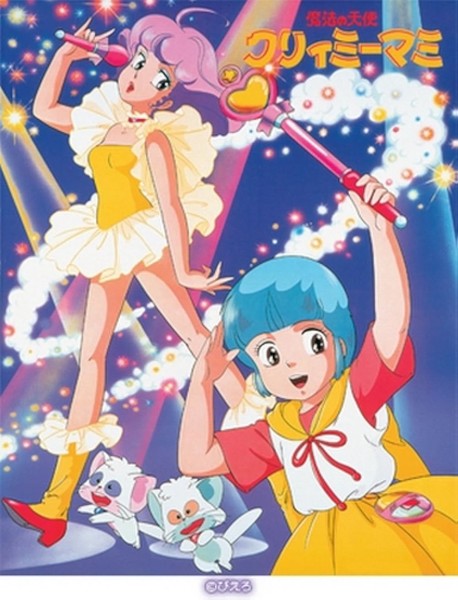
Airing between 1983 and 1984, Creamy Mami is the foundation upon which all of Studio Pierrot's magical girls were built. The story follows ten-year-old Yuu Morisawa, a bouncy, energetic girl whose parents own Creamy Crepes, a crepe shop. One night, Yuu sees a spaceship and, upon being taken aboard by its friendly alien owners, she's given a magic wand that's usable for one year. The wand allows Yuu to transform into a sixteen-year-old, and it's in this form that she's scouted by Parthenon Productions and ends up making her debut as an idol. Yuu uses her magic to enhance her performances, becoming Parthenon's top talent and sparking a rivalry with another of their stars, Megumi Ayase.
Yuu's story establishes many of the tropes Studio Pierrot would return to time and again, which, in turn, would influence other magical girl stories. For example, unlike Minky Momo, who predates her by a year, Yuu has two magic companions who exist solely to monitor and help her with her use of magic. Poji and Nega are given to her at the same time as her wand, establishing the character type fans will recognize Luna and Artemis (Sailor Moon) and Kyubey (Puella Magi Madoka Magica) as belonging to (and Kyubey couldn't have subverted our expectations had Poji and Nega not established them in the first place). Similarly, Yuu and Mami become their own rivals for the heart of Toshio, Yuu's slightly older childhood friend – Toshio falls for Mami rather than Yuu, and it takes the entire series (barring a blip in episode twenty-five) to sort it out. Both of these tropes carry over into Pierrot's other magical girl stories, sometimes with better results.
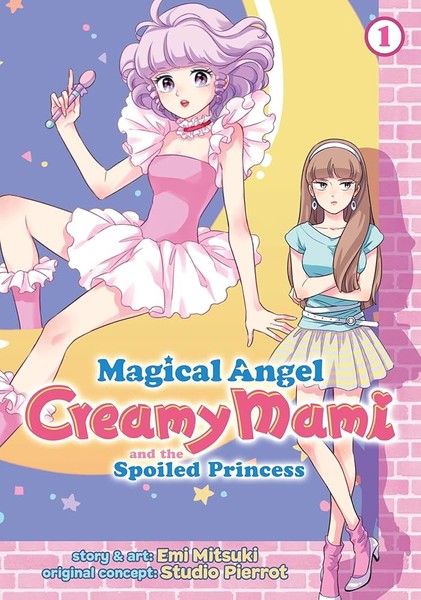
Creamy Mami was successful enough to merit several spinoffs, both during and after its fifty-two episode run. Two of these are team-ups with Pierrot's other magical girls in the 1980s and are truly bizarre, but others include a three-volume manga series that ran during the anime's original airing, music videos, two feature-length movies, and, most surprisingly, a 2018 manga series focused on the story from her rival Megumi's perspective. This last is definitely for older fans who grew up with Mami, and it's particularly interesting in how it reframes the narrative.
Magical Fairy Persia
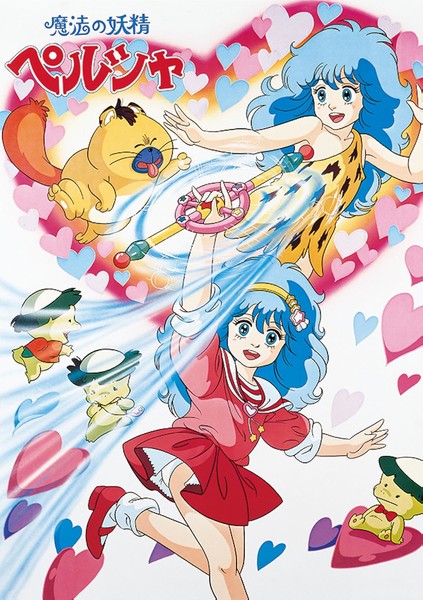
Unlike Creamy Mami, Magical Fairy Persia is based on a manga – 1984's Persia ga Suki! by Takako Aonuma. The manga ran in Margaret and was collected in nine volumes, and Pierrot's anime adaptation (1984-85) follows it fairly closely. Persia is a rambunctious eleven-year-old girl who was raised on the Serengeti plains with wild animals. There she met Japanese scientist Goken Muroi and his twin grandsons, Riki and Gaku, who took her back to Japan with them. While en route, she somehow ends up in a magical land called “Lovely Dream,” which is in serious decline due to a lack of love-spawned magic energy. The queen of Lovely Dream asks Persia for help and gives her a magic headband to aid her in gathering energy. She also dispatches three kappa to watch over and help Persia in her mission.
Like Yuu, Persia is able to transform into a teenager with the help of her magic headband and the wand it creates. But where Yuu is an active little girl, Persia is basically feral. The Murois house her with a couple who run a grocery store and act as her parents, but Persia prefers living as she used to – i.e., with few-to-no rules and trappings of so-called civilized society. Persia's first act of magic is to bring her lion friend Simba to Japan, where she quickly has to transform him into a house cat, something she never considered. Yuu may not show much forethought, but she's a deep thinker compared to Persia.
Persia is the most problematic of all of Studio Pierrot's magical girls, which may be why of the six, she's one of the only ones whose show isn't currently available on any streaming service in the U.S. Persia, along with being a magical girl, is also part of the archetype known as the “jungle girl.” This is, to put it mildly, a trope associated with white saviorism and other similar racist elements. Originating in 1886 in H. Rider Haggard's novel SHE, the jungle girl is a white woman raised in a remote jungle or forest by indigenous people, whom she grows up to lead. She's typically shown wearing an animal print bikini or a similarly scanty outfit. Although Persia doesn't fit the white savior aspect of the archetype, she's still uncomfortably linked to it through her outfit and origins, as well as the relative taming she undergoes as the series progresses. While there are clearly no overt intentions to make Persia a racist trope, the link, however well-intentioned, remains, making Persia the most difficult of the Pierrot girls to track down and the most uncomfortable to watch. That said, she's still an interesting variation on Pierrot's theme, because unlike Mami, Emi, and Lala (it's too soon to tell for Lilly and Lulu), Persia doesn't solely transform into a performer. She does perform a fair amount, but, in what is perhaps an effort to distance herself from Mami, she's a bit more varied in her transformed activities.
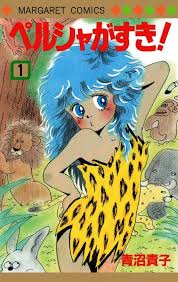
Persia's TV series ran for 48 episodes (compared to Mami's 52) and also had two OVAs. She joined Yuu in the group OVA adventures as well, along with Mai, whose transformed activities represent a sharp departure from the music sphere.
Magical Star Magical Emi
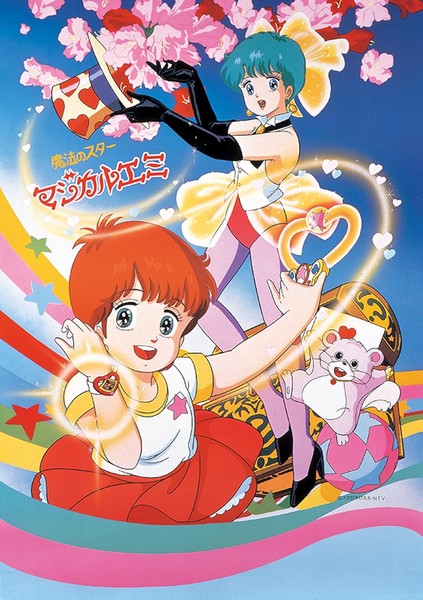
Of the early Studio Pierrot magical girls, 1985-86's Magical Star Magical Emi is my favorite. In part, that's because she feels very different from Persia and Yuu: before she transforms into Emi, she's a girl named Mai Kazuki, and she comes from a family of stage magicians. Her grandparents run the Magic Carat troupe, and as a child, Mai's mother performed with them. Now the troupe is made up of other, unrelated members, but Mai still dreams of becoming a stage magician and particularly admires an American performer named Emily Howell.
Mai's transformation isn't the result of visiting another place, but rather when a mirror fairy named Topo comes through her heart-shaped mirror and possesses the body of her stuffed flying squirrel. Because Mai has seen him, he's under an apparently legal obligation to give her the ability to use magic for a time. He gives Mai a bracelet with the four card suits on it and explains that it can produce a magic wand. Mai then uses this to transform into Emi, a teen magician alter ego she names after Emily Howell. As Emi, Mai can help elevate Magic Carat because, while they're all using stage magic, she's using real magic. Like Persia and Mami, Emi also ends up singing, but the majority of her show is devoted to magic tricks, giving Magical Emi a unique feel.
What makes it stand out, though, is the fact that, unlike Yuu or Persia, Mai is a bit conflicted about her transformation. She absolutely enjoys it, likes the accolades, and especially likes that she can help her grandparents, but at the end of the day, Mai wants to be a stage magician. She wants to thrill audiences with her skills, not a magic wand borrowed from a fairy. She has a career goal and wants to achieve it through her own hard work, which sets her apart from her early Pierrot sisters. This is never just a game for Mai; every transformation into Emi is her trying to get closer to her dreams. Mai doesn't have any rival but herself, so most of her conflicts are internal as she tries to reconcile the easy route Topo the Mirror Fairy provides with her understanding of how very hard it is to learn to be a good stage magician. Both the plot and her character are better developed, with more depth than the antics of Yuu and Persia, and it also attempts to deal with issues like sexism and sibling rivalry in the form of Mai's relationship with her three-year-old brother Misaki, who is treated very differently than she is by most of the adults in a way that has little to do with their ages. At 38 episodes, it's also more tightly plotted than its predecessors, and it continues the trend of Pierrot magical girl shows shedding episodes as they progress.
Like Persia and Yuu, Mai also appears in two multi-girl OVAs and has her own feature-length OVAs as well. In fact, the only early Pierrot magical girl who misses out on most of this is Pastel Yumi.
Magical Idol Pastel Yumi
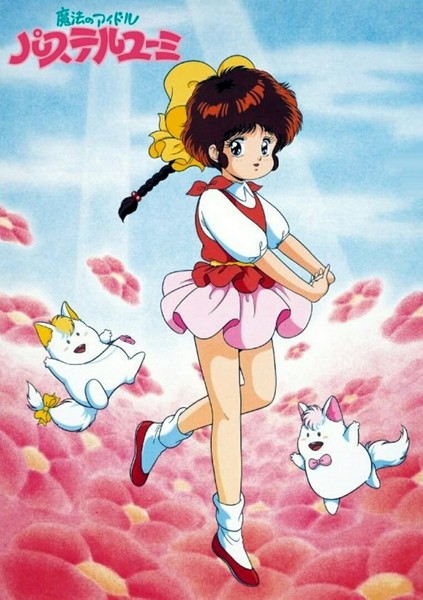
1986's Magical Idol Pastel Yumi is an outlier in many ways. The most important one is that Yumi can't, or at least doesn't, use her magic to become a teenager. While her baton twirling routine to access her magic looks a lot like a transformation sequence, she never actually uses her magic on herself. Instead, she uses it to solve problems for other people or to create items for her own fun, making her a magic-using girl rather than a true magical girl. Yumi's use of magic is much more centered on fun than anything else – she doesn't perform, she's not trying to save a magic kingdom, and she's not working towards a specific career goal. Instead, it's more a nostalgic “magic of childhood” sort of story, which is fine, but feels a bit underbaked when compared to Magical Emi, its direct predecessor.
Yumi's powers come from Flower World, and her mascots are two catlike fairies named Kashimaru and Kakimaru. Unlike Mami, Persia, and Emi, there's a time limit on her magical creations, giving everything a much more temporary air; Yumi's magic isn't going to solve any major issues or change the world. The underlying idea is that magic is meant to be fun and provide a bit of an escape from everyday life.
Although others may not agree with me, I'd say that Yumi needs that. Unlike her Pierrot sisters, Yumi's family life is a bit tumultuous. Her parents fight a fair amount, and Yumi is constantly hearing sexist messages from both them and the people around her – such as that her mother is a “bad mom” for letting her husband do chores or that “fat girls” aren't attractive. Yumi's father doesn't always respect his wife and daughter, and strict gender roles are generally enforced throughout, which, again, is a real comedown from Mai's story.
While all early Pierrot magical girl series are episodic, Pastel Yumi is even more so, due to a lack of overarching plot. This is a double-edged sword: it allows for zany episodes and characters like Yumi's treehouse-dwelling, short-shorts-wearing, ex-explorer grandpa, or a town hang-gliding race, but it also makes the series feel a bit meandering. It's got a feel much more similar to a Western Saturday morning cartoon than what we think of as anime, with a throughline guiding the series. Arguably, this makes it one of the best contenders for Western kids to get into, with its familiar pacing, although it is very much of its time in more ways than the sexism I mentioned before.
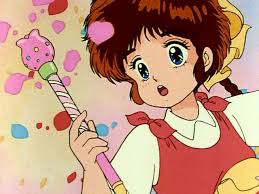
Magical Idol Pastel Yumi is the shortest of the four early Studio Pierrot magical girls, airing for half a year at only 25 episodes. She does have her own feature-length OVA, too – and she appears in the second multi-girl OVA, Majokko Club Yoningumi A-kūkan kara no Alien X. Although an outlier among the magical girls, the fact that she has to draw her spells does serve as inspiration for the next in the series, Fancy Lala.
Fancy Lala
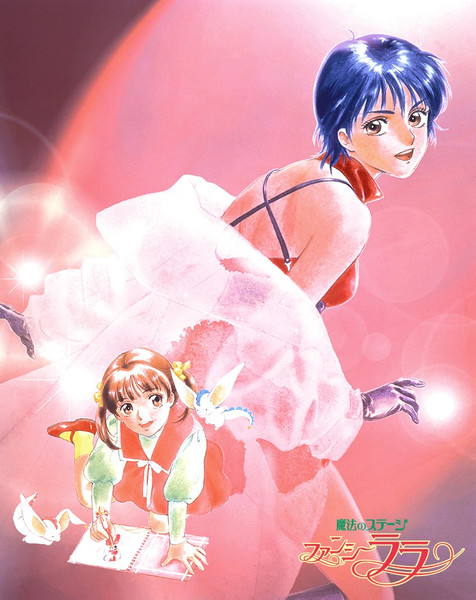
Although Fancy Lala wasn't released until 1998, she made a very brief appearance as an OVA called Harbor Light Story - Fashion Lala yori. Although not a 1:1 comparison, the similarities are still nonetheless clear: the heroine's name is still Miho Shinohara, and she can still transform into a teenager named Lala. But where Harbor Light's Miho is 11, an aspiring fashion designer, and has a whole Cinderella-style element to her story, Fancy Lala's Miho is nine and, after transforming, becomes a fashion model and singer. This Miho wants to become a manga artist, and she gets her fairies – two little dinosaurs named Migu and Pogu – from a mysterious, unnamed man. While this might sound a little creepy, the implication isn't that he's a stranger with a weird investment in little girls and their dreams, but rather an agent somehow involved in time travel. Because while Miho's transformation into an older teen isn't unusual for Pierrot magical girls, it is explicitly about moving time forward and back rather than the “it's just magic!” approach of Mami, Persia, and Emi.
Although Harbor Light Story is the obvious inspiration for Fancy Lala, Miho's story in some ways feels like a refinement of Yuu's. With only 25 episodes, it's certainly not a work that has room for the goofy, filler-tinted antics of Creamy Mami, but what's more striking is that so many of the plot points used in that series reappear in Fancy Lala in a more serious form. Most notably, Miho/Lala also has a rival in Miki Yumeno, who's vying for the affections of pop star Hiroya Aikawa. Miho had a crush on him before her transformation, and once she becomes Lala, he serves as her mentor. He's drawn to Lala not because of her looks, but because Miho's personality shines through. Although this is a bit more pronounced in the manga – like Creamy Mami, Magical Emi, and Pastel Yumi, Fancy Lala has a two-volume manga adaptation, in this case by Rurika Kasuga – the implication that he's attracted to Miho's childlike innocence can be read as more than a little disturbing. But for the intended audience, the message isn't “older guys like younger girls,” but rather that they don't need to change for someone to love them.
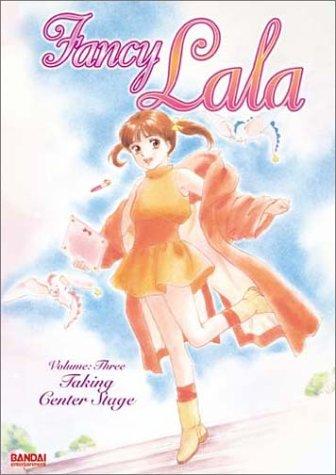
Fancy Lala isn't quite as rambunctious as her older Pierrot sisters, and while it's still a good series, it lacks a bit of the whimsy of Pierrot's magical girls from the 1980s. But that makes sense – Fancy Lala exists in a post-Sailor Moon world and a post-Magic Knight Rayearth world. Magical girls changed between 1986 and 1998, and their second wave of popularity was ushered in by darker stories and heroines who were predominantly superheroines or phantom thieves. Fancy Lala could be seen as a throwback to at least 1992 (when Hime-chan's Ribbon aired) or really to 1983, and her story doesn't feel quite as solid as her Pierrot sisters', despite being more tightly written.
Magical Sisters Lulutto Lilly
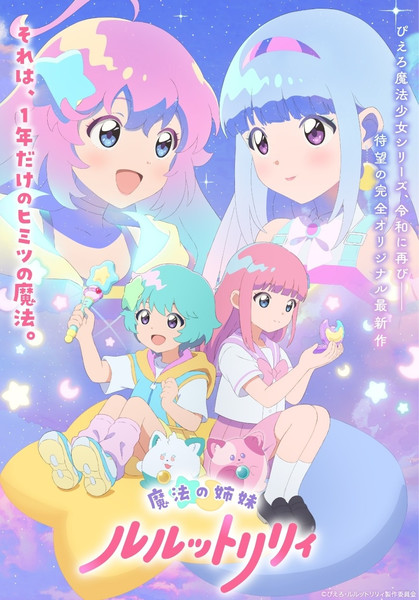
That's what makes Pierrot's first new magical girl series in twenty-eight years so striking. Magical Sisters Lulutto Lilly is 100% in the vein of their earlier shows in its tone and bubbly joy, even hearkening back to Creamy Mami in its pastel palette, but it shakes things up by having two magical girls instead of Pierrot's usual one.
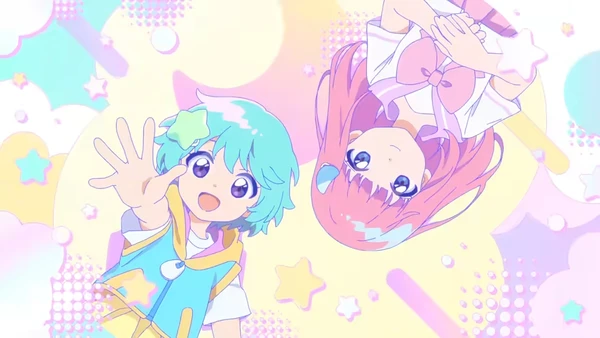
The girls are the eponymous magical sisters, Lulu and Lilly. In their regular life, they're Rui and Fuu, daughters of a Japanese sweets maker. As younger girls, the two were very close, and Fuu used to love to listen to Rui sing. But now Rui's in middle school and much more withdrawn – no longer singing after an unspecified illness. Fuu misses her sister, but she tries to keep on keeping on, and one day she spots a spaceship no one else can see. As she chases it, she's beamed aboard and meets the aliens from Felix Star, a distant planet. As a sign of goodwill, the aliens grant Fuu a locket with a magic wand and teach her how to use it to transform into a teenager. They also send two feline aliens, Uguisu and Azuki, home with her to help out.
For three episodes, only Fuu can transform, but at home, Azuki has bonded with Rui, and in episode four, she also gains the power. Both girls, once transformed into older teens, immediately catch the eye of a talent scout and, unbeknownst to them, end up working at the same agency. The two girls are utterly unaware of each other's secret identity. This confusion is part of the fun and feels like a callback to Magical Emi, which it absolutely is: both Emi and Mami have cameos in ads and posters as Lilly walks around downtown. Although it's too early to say definitively how Magical Sisters compares to Pierrot's earlier magical girls, it is off to a very promising start, with Fancy Lala's tauter writing and the fun of Creamy Mami, Persia, and Magical Emi.
Studio Pierrot's influence on the magical girl genre is important. Although its brand of lighter, goofier stories isn't the current fashion, its output in the 1980s helped to keep the beloved, but often underappreciated, genre in the light. If you're a fan of magical girls, it's worth seeking these six out. Pierrot magical girls may follow a formula, but they're all unique in their ways and are a good reminder of how fun children's media can be.
Where to Stream:
Magical Angel Creamy Mami: film Forever Once More on Tubi and Amazon Prime; second-hand DVDs of the TV series may exist
Magical Fairy Persia: Currently Unavailable
Magical Star Magical Emi: Studio Pierrot's channel on YouTube (French dub)
Magical Idol Pastel Yumi: Currently Unavailable
Fancy Lala: Tubi, second-hand DVDs may exist
Magical Sisters Lulutto Lilly: Studio Pierrot's channel on YouTube and Tubi
discuss this in the forum |

this article has been modified since it was originally posted; see change history