

Spring 2026 Light Novel Guide
My Grandfather the Master Detective
What's It About?
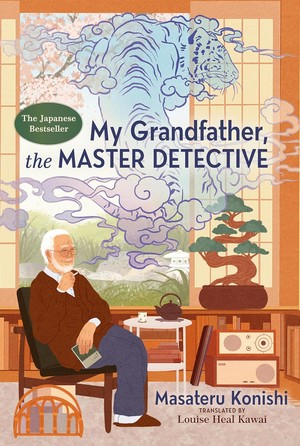
He's not your average Grandpa.
As a lover of classic crime stories, it's no surprise that schoolteacher Kaede encounters everyday mysteries more often than your typical twenty-seven-year-old.
Solving them is another matter, though. For that, she turns to her beloved grandfather, who retains a keen sharpness of mind despite his dementia, and who was once a key member of The Waseda Mystery Club. From impossible locked room murders to confounding missing persons cases, the grandfather-granddaughter duo "weave stories" to get to the bottom of every mystery. But all the while, an insidious shadow from Kaede's past slowly closes in on her . . .
My Grandfather the Master Detective has a story by Masateru Konishi. English translation is done by Louise Heal Kawai. Published by G.P. Putnam's Sons (March 17, 2026).
Is It Worth Reading?
Rebecca Silverman
Rating:
Allow me to preface this by saying that my father has Parkinson's Disease and my mother suffered a traumatic brain injury about five years ago, resulting in some dementia-like side effects. That makes the way this story works with the eponymous grandfather's Lewy Body Dementia a particularly sticky element of the plot for me. On the one hand, it does try to make it clear how difficult caregiving can be and how horrible it is to watch your loved one deteriorate. On the other hand, there are moments when it seems to treat his condition as a superpower. It's torn between being real and being semi-magical, and in this case, that's really not great.
The basic plot follows Kaede, a twenty-seven-year-old elementary school teacher, as she interacts with two men who both like her and navigates her grandfather's dementia. As she goes about her daily life, she encounters small mysteries, which she brings to her grandfather to solve. Both avid readers of Golden Age mystery fiction (generally that means the period between the world wars), they've always enjoyed telling tales, their own vernacular for playing armchair detective. Although Kaede's grandfather's disease means that he's not always fully aware of his own surroundings, he generally perks up when it comes to mystery time. This is where the aforementioned treatment of his dementia as a superpower comes into play – Lewey Body Dementia involves hallucinations, and in the smoke of his cigarettes, he sees the mysteries play out as if he's there. Had he not been written to have this disease, it would be a neat narrative trick, but as it stands, it's very uncomfortable.
The writing is generally good (and I'm always a fan of Louise Heal Kawai's translations; appropriately, she's translated Pushkin's editions of the Kosuke Kindaichi mystery novels), but the plotting isn't as tight as it needs to be. Konishi is attempting to utilize tricks from classic mystery works, with the ending deliberately invoking Frank Stockton's The Lady or the Tiger?, and it doesn't always come across as smoothly as it ought to. The locked room mystery chapter is the strongest, but it, too, suffers a bit from an overeager wish to mimic the works of the Golden Age greats. But the mysteries are all fair play, as is fitting for a book that name-drops Ellery Queen so often, and they're mostly interesting. Some pieces of the overarching plot come out of nowhere, though, and that drags things down a bit. I suppose the best response to this work I can give is that it tries just a bit too hard to be all things to all readers, and the result is that it barely manages to be some of them.
Overall, My Grandfather the Master Detective struggles to find its niche. Despite good writing and an engaging translation, its central conceit is flawed, and this drags down the rest of an otherwise interesting cozy mystery. I suspect that it's much more enjoyable if you don't have personal experience with caring for an elderly relative with a degenerative brain condition, so that may be the best measure to use when deciding whether or not to pick this up.
Erica Friedman
Rating:
My Grandfather the Master Detective, has something for mystery fans of all kinds. Grounded in cozy armchair mysteries, steeped in mystery lore and the knowledge of mystery writers, this story can be appreciated by long-time mystery fans and folks coming to the genre through light novels and manga as well. The story, which begins with a gentle entrée into the life of teacher Kaede and her grandfather, who suffers from dementia but on good days, has a mind as sharp as any great detective of literature. Slowly, carefully, the tale turns darker, until we are no longer sure if we, like Kaede's grandfather, are hallucinating the danger.
The characters are engaging, and the situation closes in on you carefully, right until the very end. The story is crafted carefully, with practice scenarios, as we learn both the characters and their lives, surroundings, and practice how we are meant to read and understand the circumstances of the “real” mystery, when we finally see it for what it is.
This is not a light novel, in any meaning of the word – there are no illustrations, the story is not a franchise extender, is quite dark and adult. This book is simply a good mystery written by a decent mystery writer, well-translated by Louis Heal Kawai, a leading literary translator. Amusingly, the book contains a reference to one of the famous Kindaichi mysteries by Seishi Yokomizo, Death on Gokumon Island, a book that has been translated into English by Kawai herself. Kawai's work is a great way to get into translated novels, as it's accessible for both practiced readers, familiar with Japanese culture, and folks less familiar with Japanese language, literature, or life.
Kevin Cormack
Rating:
In general, I'm not a huge fan of “whodunit” stories. While I can appreciate the clever way they're structured, I was always more drawn to fantasy and science fiction. That's not to say I'm completely ignorant of the genre. I've read many of Victorian physician Sir Arthur Conan Doyle's original Sherlock Holmes stories, and as a medical doctor myself, enjoy the forensic attention to detail the titular character employs to solve mysteries. It's just that I spend most of my working life investigating my patients' real-life problems, and in my leisure time like to take a break from the perpetual sleuthing!
It's for my medical, rather than literary, experience that editor Rebecca requested my opinion on this very odd book. Much of the its plot (and novelty) hinge on the fact that protagonist Kaede's grandfather suffers from Lewy Body Dementia, a degenerative neurological condition closely related to Parkinson's Disease. I'm very familiar with patients suffering from this illness, and I have to say the vast majority of them would struggle with any of the feats of intellectual capability that Kaede's grandfather exhibits here.
Lewy Body Dementia is characterized by significant day-to-day variability in cognition and confusion, which, to be fair, is indeed reflected in the text. Kaede's grandfather has good days and bad days, some days where his hallucinations are pronounced (which, fascinatingly, becomes integral to the plot later), and other days where his logic-based rigor could shame even the most logically-gifted intellectuals. It does seem to be the case that prior academic achievement can help stave off the development of dementia, though perhaps this is more closely studied in Alzheimer's Dementia, where we know that university-educated individuals tend to maintain the ability to comprehend complex concepts for far longer than less-educated peers. Kaede has always looked up to her grandfather for his wit and imagination, enjoying his ability to use the stories they tell each other to solve conundrums.
That's the very episodic structure taken by the book: a series of stories related by Kaede, to her grandfather, each with a central mystery she seeks help to solve. Most of them are fairly low stakes affairs, but each reference a common mystery story trope, like locked room mysteries, or mistaken identities. It's only in the final chapter, when various subtle clues that have been threaded throughout previous chapters are woven together quite skillfully, that there is drama that endangers both main characters.
Otherwise it's a cozy, easy read, that tends towards the twee rather than the profound. Kaede's grandfather's dementia is used mostly as a plot device, and although many of the details are accurate, I found it difficult to shed my disbelief at her grandad's unrealistic mental clarity. It's probably best not taken too seriously, and I certainly don't think it's offensive in any way. I just don't think readers with relatives suffering from Lewy Body Dementia should get their hopes up that their loved ones might start solving murder mysteries any time soon.
The views and opinions expressed in this article are solely those of the author(s) and do not necessarily represent the views of Anime News Network, its employees, owners, or sponsors.
discuss this in the forum |

this article has been modified since it was originally posted; see change history
back to Spring 2026 Light Novel Guide
Seasonal homepage / archives