

The Best Anime of Fall 2025
by The ANN Editorial Team,
The fall anime season lacked a main character. While past anime seasons included big protagonist energy from the likes of DAN DA DAN, The Apothecary Diaries, and Mobile Suit Gundam GQuuuuuuX, alongside emotional supporting stories from My Dress-Up Darling and Apocalypse Hotel, this season lacked a community focal point. The closest contender was My Hero Academia FINAL SEASON, which barrelled to its conclusion (only to announce a final-final episode coming soon). Instead, fans split into smaller, passionate discussions or dug into their backlogs from past seasons. Some of this could be due to the diversification of anime on streaming services; Crunchyroll still bags the bulk of streaming anime every three months, but several entries in our top list are running exclusively on Netflix, Amazon Prime, or even YouTube.
Below are the top 10 anime of the Fall 2025 anime season. Let us know which ones you watched, made your top 10, and what anime you bounced off of in the comments.
10. DIGIMON BEATBREAK
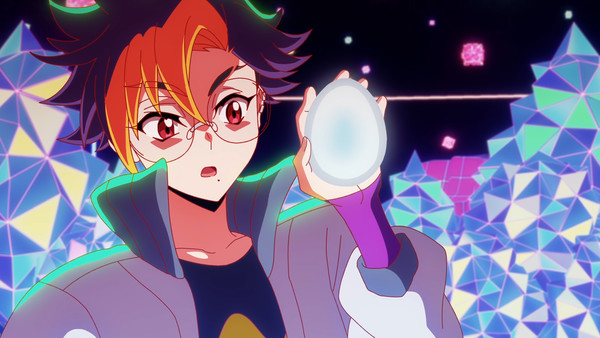
Can I offer you a nice egg in these trying times?
I didn't know what to expect when I decided to give DIGIMON BEATBREAK a watch. While I liked Digimon plenty as a kid, I fell off after Frontier aired on U.S. TV, and I haven't watched a new Digimon anime since then. Plus, for years I've meant to try one of the newer games—I know, I hear they're great!—but I just haven't gotten around to it yet. “If this is good (and that's already an 'if'), is it going to be, like, actually good?” I wondered, “Or is it going to be the kind of thing that's only going to be good because I have a bunch of nostalgia for Digimon?” And I'm happy to report that it's the former: As it turns out, BEATBREAK has thus far proven to be a pretty fun watch, regardless of any nostalgia factor or familiarity with Digimon.
BEATBREAK hits the ground running, giving us what reads as something adjacent to a named character's death as soon as the first episode. It's the beloved older brother of our protagonist, Tomoro, who's obviously now wanting to do something to help him. To that end, he gets involved with Glowing Dawn—a group of “cleaners” (essentially, bounty hunters) and their Digimon. But even as BEATBREAK starts easing into episodic adventures, Tomoro's brother and the life they once shared are always on his mind—even if, at times, it feels like they're on the series' back burner.
And speaking of things going on in the background, there's also something to be said about the non-digital world that BEATBREAK inhabits, which feels like a depressingly grounded vision of the not-too-distant future. The consequences of climate change are plainly visible at every glance, and a dense fog of wealth inequality hangs so thick across the subtext that I honestly don't know that it qualifies as subtext anymore.
There's also something to be said about Tomoro as a protagonist. We've seen unwilling protagonists in plenty of other adventure anime before—even in other Digimon series—but Tomoro hits different. He feels like the kind of character who would normally be a cool foil to a more traditional, upbeat Digimon protagonist (say, an equivalent to Matt/Yamato in the first series) rather than the central protagonist. He's not necessarily afraid of the battles to come; he's just plain uninterested. And I don't mean that in a “he's single-minded” battle shonen protagonist sort of way, but rather, in a “he just wants to do what he needs to do so he can go back to his life as soon as possible” way. Combined with a generally aloof attitude that makes him hesitant, if not downright annoyed at the thought of getting close to anyone else, makes him pretty interesting as a central Digimon protagonist—especially in contrast to his friendly, energetic, food-loving Digimon partner, Gekkomon.
Suffice to say, this is exactly the kind of Digimon series that I could easily see working well as someone's entry or re-entry point into Digimon, because it's got so much going for it so far, and doesn't seem to be relying on nostalgia or pre-existing familiarity with Digimon to keep people's attention. If you were unsure about this series, let me put your mind at ease: This has definitely proven to be one of the more egg-citing anime of the season, and has plenty of appeal to new and old Digimon fans alike.
—Kennedy
9. The Fragrant Flower Blooms With Dignity
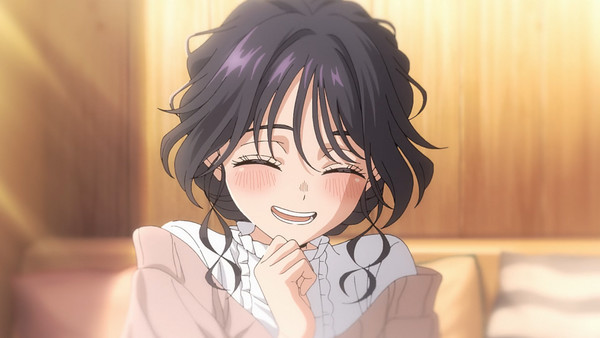
Inexplicably delayed by Netflix for two whole months post Japanese TV broadcast (perhaps because it seemed to be a last-minute license acquisition?), CloverWorks' wonderful adaptation of the beautiful high school romance manga The Fragrant Flower Blooms With Dignity didn't make its English-language streaming debut until September 2025, over 2/3rds of the way through the Summer 2025 season, therefore bleeding into the Fall 2025 season. For those fans not aligned with piracy, the wait was frustrating, to say the least.
The Fragrant Flower Blooms With Dignity is mostly seen through the eyes of intimidating-looking boys-only public high school student Rintaro Tsumugi. His parents run a bakery with a small cafe at the front that sells delectable cakes. Kaoruko Waguri loves cakes, and after a seemingly chance encounter in the cafe, she and Rintaro get to know one another. Rintaro finds it hard to accept that such a pretty and upbeat girl can look past his thug-like exterior, and his anxieties run into overdrive when he learns she's a student at the high-class private girls' school next door to his own, the prestigious learning establishment.
Over the course of thirteen immaculately-produced episodes, their relationship gradually blossoms, with their initially separate friend groups sucked in by the gravity of the central couple's adorably awkward puppy love. The course of true love never runs smoothly – Rintaro's particularly adept at self-sabotage, always overthinking and elevating the opinions of others above his own. This isn't helped by the fact that the boys at his school are looked down upon with disdain by the girls at Kaoruko's school – there's definitely an element of class-related snobbery that goes both ways.
Most of the show focuses on breaking down artificial societal barriers among a small group of teenagers and on how they navigate complex feelings and difficult relationships. I particularly like Kaoruko's extremely protective (to the point of rudeness) best friend, Subaru Hoshina, who initially comes across as mean, but as the layers of her personality are gradually peeled back, she reveals a deeper side.
One could argue that no teenagers were ever as emotionally literate and mature as those portrayed in The Fragrant Flower Blooms With Dignity, and perhaps that's a valid criticism, but it doesn't diminish the fact that it's a delectably sweet and satisfying romantic drama with a delightful cast of characters. With 21 manga volumes published in Japan at the time of writing, there's plenty more material for a potential second, and maybe even third anime season. I'd love to see more of these good boys and girls!
—Kevin Cormack
8. Uma Musume: Cinderella Gray Season 2
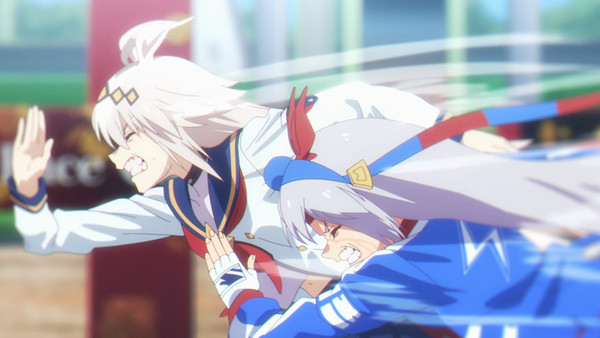
Is Uma Musume: Cinderella Gray a Christmas anime? Much of it involves the lead-up to and the events of the Arima Kinen, a race which takes place on December 25. I have certainly enjoyed rounding out the year with Oguri Cap, her friends, and her rivals. In Season 2, Oguri's rags-to-riches Cinderella story has gotten to the good part, giving her the chance to face off against ever tougher opponents. More than any other Uma Musume property, Cinderella Gray has leaned in hard to shonen sports anime tropes. Combined with fantastic characterization, it's a winning formula for some monstrously suspenseful races.
Looking for something to do between seasons of Cinderella Gray, I began playing Uma Musume: Pretty Derby, the franchise's award-winning mobile game. The biggest surprise was Oguri Cap's in-game appearance—soft and rounded and puglike, the very definition of a moe blob. I think the anime's art style better suits the many faces of Oguri Cap. Sometimes she really is that bloblike, like when she's feeling down after a loss to Tamamo Cross. Other times, she's all sharp edges, the platonic idol of a shonen sports hero. And other times she's permitted to go into straight-up freak mode as the fearsome racer known as the Gray Phantom. What's fantastic about Cinderella Gray is its willingness to portray the horse girls as a mix between human and monster. Put horse ears on girls, and they transcend girlness, somehow. With the ability to run up to 75mph, these athletes are part human, part monster. These girls are scary! And unlike in the cutesy game, the takeaway is that we should be afraid. Whether I'm watching Tamamo Cross's White Lightning, Michelle My Baby's sheer brawn, or whatever Obey Your Master has going on, the feeling I get from these action scenes is intensity. You can really imagine just how fast the girls are going and how firmly their horseshoes stamp into the turf.
Originating from a gacha game, it should be no surprise that there are dozens of well-designed characters to populate every race and crowd scene. But what I especially appreciate about this show is something you won't find in the game: a delightfully motley cast of trainers. From Super Creek's youthful, princely trainer to Dicta Striker's sad, wet-cat-of-a-man, it's clear that it's not only the Umamusume who have standout designs. This huge variety of visually interesting characters adds more personality to the show's standard shonen sports tropes. It's not necessarily that the training arc is super interesting in itself—but it's fascinating to see how Tamamo's training differs from Oguri's, for example. Not to mention, the crackling tension between these two makes their passionate rivalry all the more fascinating to watch. And since horse girls are such an original concept, it's easier to take their over-the-top abilities seriously without the show suffering from unintentional OP sports anime humor. I'd argue that it isn't, despite the sci-fi horse-girl premise, but because of it that this show is so much fun.
—Lauren Orsini
7. My Hero Academia FINAL SEASON
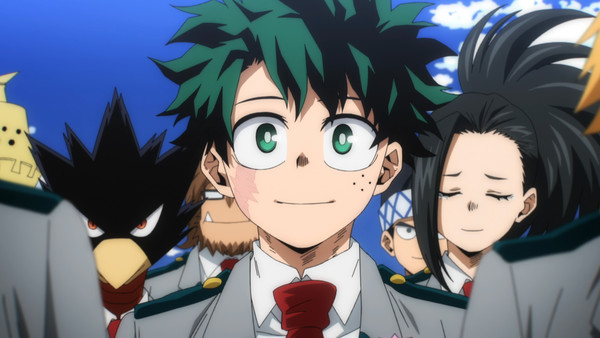
It's hard to stick with a series for almost a decade and not feel emotionally distraught when it finally comes to an end. Even if this series had a really bad ending, it would be hard to separate my emotional investment in the franchise as a whole, especially if it already resonated with me enough to stick with it until the end. Recently, I feel like many major shounen series have struggled to end in ultimately satisfying ways. So while it's not perfect, I do think that this final season of My Hero Academia is a great example of how you can bring your franchise full circle, leave things open up to interpretation because you trust your audience, and conclude with a sense of heart that I also feel like is becoming harder to find in media nowadays. The final season of My Hero Academia is an example of a well-executed conclusion.
It starts off a bit rough, with the first episode literally recapping the buildup from the previous season, but once the show gets into the actual new material, it's pretty much all amazing from start to finish. Almost every character gets one final push, and I finally get to see many major elements set up or referenced at the beginning of the show come full circle here. I got to see Bakugo finally able to make it up to All Might for saving him, I got get to see All For One finally be taken down after his true intentions were revealed, One For All was finally able to fulfill its mission through Deku and Deku was finally able to reach out to Shigaraki, even if he ultimately wasn't able to succeed in his mission. Not to mention that the animation in almost all of these episodes was practically movie-quality. Some details were toned down from the original manga, but some of the action sequences from this conclusion are still gonna stick with me for years to come.
This season also does a good job of expanding on and adding context to what might've been missing, as made clear in the original manga. I felt this way most when the show highlighted how these experiences ultimately change everyone's lives. When I say it feels like My Hero is actually trying to be about something, this is what I mean: it is a show about heroes trying to right past wrongs and create a future where more villains are saved. Yes, it is a lot of spectacle, but My Hero doesn't skimp on the emotions that make it more than just the popular flavor of the week.
Many scenes in the climax show ordinary people watching events unfold on TV. There are distraught people secretly hoping that Shigaraki will take down the old establishment so they can feel less trapped by it. But there are also people from all over the world watching Deku, hoping he can put a stop to this major evil that could threaten everyone's safety. It's about watching, hoping, and pushing through the deep-rooted fear of danger that lurks around every corner. This is a show about being there for people when nobody else will, no matter how hard it is, because heroes aren't about making the easy calls; they're about making the right calls.
Deku made the right call by trying to get through to Shigaraki and not just kill him, Bakugo made the right call for saving his mentor even if he had a tear his body apart to do it, the entire extended cast made the right call for being there for Deku right up at the very end when he needed them to be there most despite how terrified they were. Ultimately, this conclusion made me feel better about the world. It's a series that reminded me that there are people like this in the real world who are fighting a difficult fight, taking the road less traveled by, and not asking for anything in return. They are out there, whether they are right in front of our faces or hidden somewhere in the shadows. Even if you don't get a chance to see them or even if people like that aren't near you, they're out there. Maybe it's time more people were like that because then we could go beyond to a brighter future.
—Bolts
6. This Monster Wants to Eat Me
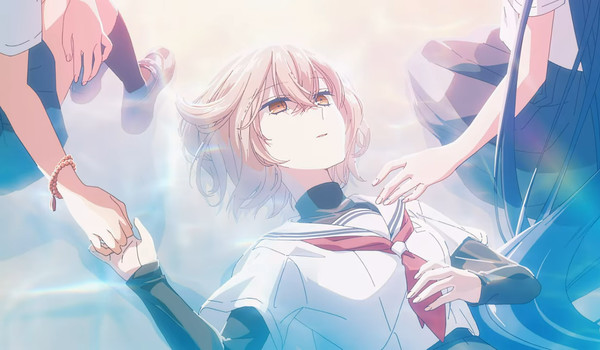
There is no easy way to cope with loss. For This Monster Wants to Eat Me's Hinako, the deaths of her parents and older brother ten years before the story's start have become the defining moment in her life, and their loss – and the feeling that she should have died with them – drives her emotionally. So when a mermaid named Shiori appears and says that she'll end Hinako's pain by eating her, the high school girl feels a measure of relief, believing that Shiori offers a tangible release from her pain. But rather than a story of suicidal ideation fulfilled, This Monster Wants to Eat Me is a tale of mixed emotions and differing desires seen through the lens of a yuri vore horror story.
Hinako's conflicted emotions form the backbone of the series, all the more so because she doesn't even realize that they are conflicted. Because she has Shiori's reassurances that death will come for her (and her own assumption that death will arrive sooner than later), Hinako allows herself to live a bit more than she had been. With Shiori's urging, along with her friend Miko's, Hinako goes places, eats things, and generally lives a more typical life than she had been living. The pain of her memories doesn't truly recede, but she's able to accept it on a level she hadn't been before. The promise of death gives her life, which is precisely what Shiori aims to do…because Shiori doesn't truly desire Hinako's death any more than Miko does. She's just using what she sees as her best method to make that happen.
It's a complex situation, one that only becomes more fraught as the series goes on. With the ending not yet aired as I write this, I don't know whether Hinako will learn to find worth in life or choose death. But the use of oceanic imagery as a metaphor for her emotions, the sheer horror of Shiori's yokai form, and the quietly stunning vocal performances have made this a compelling watch. Before the season began, I called it the distaff side of The Summer Hikaru Died. I stand by that, but it's also a look at the other side of that series – where tears drown, and hope seems lost…and maybe you can't save everyone, at least not in your idea of what “saving” them means.
—Rebecca Silverman
5. Gnosia
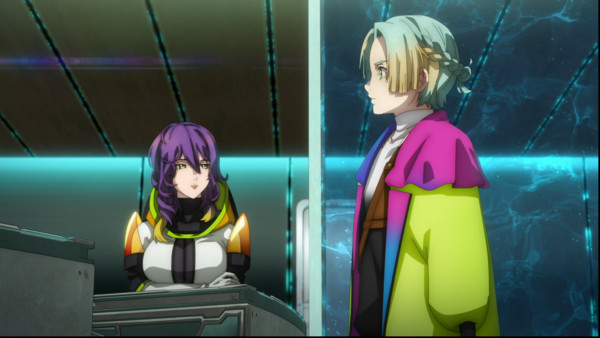
I've been a Gnosia evangelist for years, but when they announced the anime, I wasn't sure it would make for a good adaptation. The story was too nonlinear, the gameplay too repetitive. It seemed like the kind of thing that I had a great time playing, but wouldn't translate well to a linear, non-interactive narrative. Ace Attorney and Danganronpa were both mediocre-to-bad anime; why should I expect anything different here?
What I definitely was not expecting was that the anime might actually be better than the game. Oh, it takes a while to get started. They really wanted the audience to understand the logic behind Werewolf, Mafia, Among Us, whatever you want to call this form of social deduction game. Despite the simplicity of the rules, it's actually quite complex, and the first few episodes are devoted to explaining how to break down who the enemy could be based on the roles, the number of enemies versus allies, and so on.
But then we start getting into the real meat of things, the character events, and everything starts to shine. The passengers of the DQO are a group of lovable weirdos, from a guy who wants to be a cat to a literal little gray alien. I've adored them since the game, but the anime truly shines when it comes to portraying them and all their quirks. So much care has been put into the staging, their body language, and other aspects of their presence in space that can't be conveyed through visual novel portraits. Of course, Remnan is hiding under the table the first time you see him; that expresses more about his character than his words ever could.
The voice acting is also unbelievable. This cast of superstars speaks to the care put into this production. Tomokazu Seki, a longtime favorite of mine, deserves special mention as Shigemichi, the aforementioned little gray. The man has one of the broadest ranges in voice acting, and he's using all of it here, jumping from silly, high-pitched tones to deep and serious within the same scene. The whole cast does a great job, but Seki kills it.
Normally, I don't pick incomplete shows for my “Best of,” but Gnosia is a special exception. It brings these characters I've loved since the game first came out in English to life with great care and affection, through their examination of what it means to be human and their nuanced exploration of gender.
—Caitlin Moore
4. Spy×Family Season 3
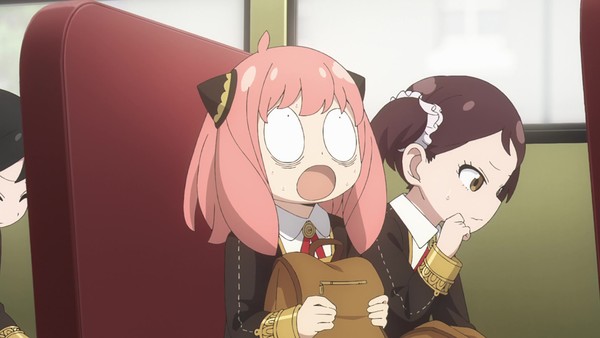
Spy×Family is the anime equivalent of comfort food. You don't go in expecting big surprises or dramatic twists; the idea of describing any episode of the show as “filler” feels beside the point in the same sense that describing the average sitcom episode as “filler” would. You know what to expect — Loid and Yor alternate between cool, covert spy/assassin shit and adorkable domestic awkwardness; Anya makes funny faces, reads minds, and flails about at school; maybe Bond BORFs an image of the future. That's really all you need to smile for 22 minutes a week; any ongoing plot development is just a bonus.
This latest season has been very good at delivering those bonuses. The multi-part dream flashback to Loid's childhood is the most serious and emotional the show has ever been, delivering a powerful anti-war statement. Yor joining a mother's social group that helps ease her anxieties about “being normal” would be a sweet bit of character development on its own; that the group's leader is Donovan Desmond's wife, and their friendship is now Loid's “Plan C” turns it into a bigger shakeup of the show's formula. The biggest ongoing story arc of the season, the school bus hostage crisis, earns Anya rewards for bravery in the face of danger while dealing with an unusually sympathetic antagonist — a terrorist who wants to strike fear but NOT actually hurt anyone in his quest to avenge a daughter murdered by the state. I'm not sure if Spy×Family has necessarily gotten more political than it used to be or if it's just that its politics have taken on heavier resonances in 2025, but that's one aspect of the show that's only gotten more interesting to me this year.
It continues to amuse me that, with so many “brought to you by Shinzo Abe” anime begging otaku to make babies over the past decade, the one anime that's seriously had me and other people I've talked to seriously thinking about wanting to become a parent is Spy×Family, with its decidedly non-traditional “fake family” unit. I expect this show to continue ranking among the best anime of any season it returns to.
—Reuben Baron
3. Tojima Wants to Be a Kamen Rider
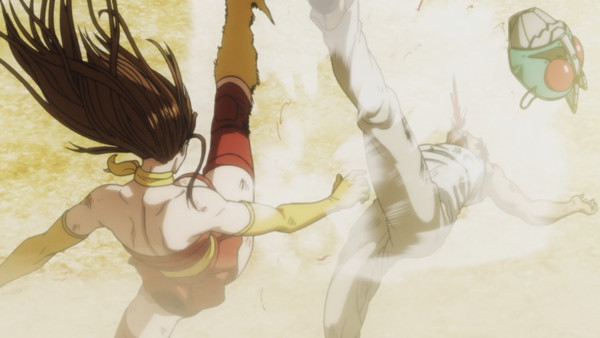
Tojima Wants to Be a Kamen Rider is a misleading title, as the titular character had been a Kamen Rider(minus the bike) since his school days. The series begins with Tojima, a 40-year-old single man who wishes to be abducted and experimented on by Shocker, as happened to Takeshi Hongo, the protagonist of his favorite TV Series, Kamen Rider. You may think that this is a story about delusion and midlife crisis, but you are 100% wrong! Tojima may sound old, but he downed a mature bear with his bare hands and dented a giant tree's trunk at leisure with, of course, his punches. Tojima couldn't be happier when he learned that the real Shocker existed in his world and that he could brawl with them to his heart's content.
As a Kamen Rider fan since childhood, I quickly relate to Tojima. I, too, wished to stumble upon an ancient ruin and pick up a stone belt, to join a certain ferry ride that got into a supernatural incident, be a journalist who picked up a blank card deck in a crime scene, accidentally switched a fancy suitcase with a random girl, and so on. Tojima's life before meeting the real Shocker didn't seem to be fulfilling. He even thought about growing old and dying alone in the first episode. A sad thought that I also had during a time when I had no friend to share my hobbies, though fortunately not for too long. Tojima and his new friends (with their pseudo-metahuman fighting capabilities) might be risking their lives by challenging real Shocker, but they are all in the happiest moments of their lives. It is a reminder that having the right friends and having a life goal make your life better.
The anime itself is quite an embodiment of hype and adrenaline. I could feel the impacts of their punches, tackles, and kicks across the screen. It helps that the actions here have a Wrestlemania feel that dampens the effect of its sometimes limited animation. Since Tojima and friends are mostly inspired by the 1970s Kamen Rider fighting style, the sloppiness and awkwardness charmingly match their inspiration. The animation is generally decent, though I wish it were better. Imagine KyoAni or Madhouse animated this series. Still, the characters' hype and adrenaline carried the series.
Unfortunately, as much as I love Tojima, the flaws are almost immediately noticeable. Namely, it feels tailored to older Kamen Rider fans. It might still be a good gateway into the Kamen Rider franchise, but one has to leap through a lot of obstacles. First and foremost, Kamen Rider Ichigo, V3, Riderman, and Tackle (#tackleiskamenrider) were all designed in the 1970s and arguably didn't age well. Pair that with the Shocker footsoldiers' wacky design, and many would turn their heads right away. Yuriko's portrayal in the early episodes is also quite distasteful, but it improves over time. Especially in episodes 10 and 11. The not-so-amazing animation and grounded action scenes might also immediately turn off viewers used to recent shonen anime titles. Sometimes, it felt like a guilty pleasure when I tried judging this anime from a non-Kamen Rider fan point of view.
However, a guilty pleasure is still a pleasure. What matters the most is the entertainment value, and Tojima delivers it to me weekly without fail. Tojima might not transform into a real Kamen Rider, but his soul is one. Be true to yourself and live proudly. RIIIIIDEEEER PUUUNCH!!!!
—Gunawan
2. May I Ask for One Final Thing?
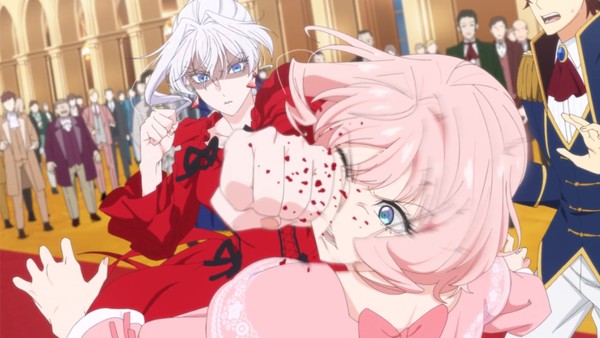
I love villainess stories—I can't get enough of them. They provide a set base for the story to build on—and seeing what gets built is where the fun comes from. Sure, sometimes we get something utterly derivative—with nothing to set it apart from numerous other stories in the sub-genre. Other times, we get something truly special—like in the case of May I Ask for One Final Thing?
On the surface, Scarlet ticks all the boxes for a villainess. She is the well-educated, lady-like daughter of a duke—and is even engaged to the kingdom's prince. But when she is condemned as a bully, and the prince breaks off their engagement so he can be with his true love (the heroine, Terenezza), Scarlet asks for one final thing: to punch him (and the heroine) in the face.
While Scarlet is all of the things mentioned above, she is also someone who prefers to solve problems with her fists. Freed from the expectation to keep up appearances, she begins a crusade that will allow her to punch people to her heart's content: going after the evil and the corrupt. This is both the setup and the series' main recurring joke. Scarlet has never met a problem she can't punch her way out of—to the constant surprise of those who expect their positions and power to protect them.
Her partner in crime justice is Prince Julius, her former fiancé's older brother. Much like Scarlet at the start of the anime, he appears to be the perfect noble on the outside. However, on the inside, he is a man who doesn't harbor strong emotions toward others and instead ranks them by how interesting he finds them—with Scarlet at the top of that list. This all makes him Scarlet's fiercest ally as well as a constant annoyance (as he teases her in various ways simply to see how she will react).
All of this comes together in a story of political intrigue, where Scarlet's small kingdom is surrounded by enemies both inside and out—where gods and mortals alike scheme for its fall. And as twists and turns come one after another, only one thing is for certain—whoever is responsible is going to get a lady-like greeting followed by a bloody beating unlike anything they could have ever expected. It's pure catharsis and will put a smile on your face—and in your heart.
—Richard Eisenbeis
1. SANDA
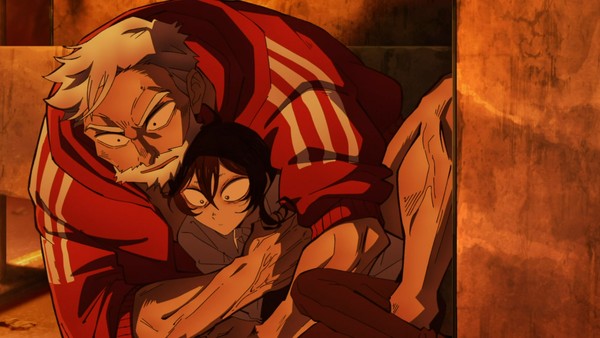
Paru Itagaki's take on battle shonen is predictably bizarre. Our hero is a middle schooler who transforms into an old man rippling with muscles and brimming with Santa-based superpowers like fire immunity (because chimneys) and retractable blades on his feet (because sleighs). And given the timing of the holidays, it's no wonder that SANDA sits at the front of my mind when I think about the most noteworthy titles of the past season. It's a consistently surprising Christmas-themed anime that received a strong adaptation from Tomohisa Shimoyama at Science SARU. Pair it with a warm blanket and a cup of good nog, and you've got a lovely night in.
However, SANDA's true brilliance lies beneath its surface-level winter wonderland weirdness. Under the guise of Santa shenanigans, the story explores the exploitation of children and the fetishization of youth that propels much of the modern fascist movement. SANDA extrapolates current concerns about birth rates and “unruly” kids into a near-future dystopia laden with authoritarianism and body horror. I was blown away when, several episodes into the narrative, the show casually revealed that the students don't sleep. Adults engineer a special diet and social pressure to discourage any of them from so much as taking a nap, out of fear that the healing power of R.E.M. might accelerate their puberty. That's terrifying in both its concept and its closeness to the rhetoric espoused by real politicians who refuse to acknowledge juvenile agency.
SANDA also recognizes that adolescence, even under the best of circumstances, is laden with body horror. Sanda's transformation into Santa is a blunt metaphor for how people his age straddle the worlds of children and adults, belonging to both and neither, depending on the situation. He awkwardly navigates his mature body as he enjoys the new powers it gives him. On the flip side, Fuyumura offers a window into the equally horrifying world of female adolescence. Tall and gawky, she looms over her peers while feeling disconnected from them. Her body hasn't developed as theirs have, and she isn't sure if she's an adult, a child, a girl, or a boy. Her explorations of queer desire further complicate these unfamiliarities via her relationship with Ono. Moreover, I feel a particular connection to her now, as I too often feel like a sleep-deprived maniac in the middle of my own strange version of female puberty.
That thematic richness is SANDA's best quality, and it's the reason I keep coming back for more. Here's how deep its finger is buried into the pulse of our present-day absurdities: its main villain is a stone's throw removed from the billionaire freaks who inject child blood in an effort to stay youthful. Itagaki's brain is huge, and SANDA will make you scream for a variety of wonderful and insane reasons.
—Steve Jones
Disclosure: Kadokawa World Entertainment (KWE), a wholly owned subsidiary of Kadokawa Corporation, is the majority owner of Anime News Network, LLC. One or more of the companies mentioned in this article are part of the Kadokawa Group of Companies.
The views and opinions expressed in this article are solely those of the author(s) and do not necessarily represent the views of Anime News Network, its employees, owners, or sponsors.
discuss this in the forum (29 posts) |
