

Absolute Borderline: The Early Days of Evangelion Fandom, Part Two
by Brian Stremick,
Episode 1 aired on October 4, 1995, on TV Tokyo at 6:30 pm. Posts on RAA acknowledged the high quality of the episode, comparing it to OVAs coming out at the same time. There was also praise for both the opening and ending, with one commentator writing that the casting of Megumi Hayashibara as Rei went against the usual characters she played, which were usually loud and brash, such as girl Ranma from Ranma ½. There was even some speculation from some of the posts about the nature of the three pilots.
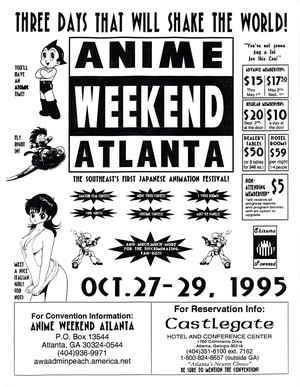
Now, we need to take a detour regarding this episode, because we need to look into how it first appeared in North America. Before the episode premiered in Japan, Gordon Waters, who was setting up the first Anime Weekend Atlanta convention (and who is still the con's Technical Advisor to this day) requested on RAA a copy that he could have fansubbed to show at the convention. A Japanese graduate student who was studying to be an English teacher sent him a tape along with his email translation on condition that Waters and his friends working on the project would, after proofreading and making corrections, send it back so he could use it for his studies.
 |  |
On the weekend of October 20-22, Waters, along with his friends Daric Koslowski and Matt Murray, completed the proofreading and script editing and entered the script into Koslowski's computer to make the subtitle. Now (it was noted by Waters that this was an important aspect to all of this), his friend Koslowski, a founding member of the Japanese Animation Club of Orlando (JACO for short), along with a man by the name of Alex Matulich and a few others had earlier created their own subtitling program called JACOSUB (one of the first fan-written pieces of subtitling software) that ran on a Commodore Amiga computer that had a video clock synchronizer attached to it to add timed titles to the video. The original tape was played on one VCR, the signal going through the synchronizer, where the computer added the titles from a timed file, and the completed fansub was recorded on a second VCR.
“We probably ran through about half a dozen iterations of the timing and subtitle file before we got it where we liked it,” Waters wrote. “I mean – Daric and Matt were very particular about making sure the timing of each subtitle occurred at exactly the moment where the spoken word began...to where we were just about frame accurate...We could have probably done it in many fewer hours, but it did look a lot better when done this way, in the end.”
Before we go on with the rest of the episodes, we should note that discussions on the RAA of series are not like any discussions we have on the Internet today. There was no separate thread for every episode. As stated before, VHS tapes were usually grouped into four episodes to maintain picture quality, so there was often no clear distinction between episodes in their posts, and sometimes entire episodes were skipped.
As the first few episodes went on, fans were still praising the quality of the animation even having discussions about the technology shown, such as noticing that the power plugs have jets on them that cushions the plugs on landing or on whether the magnetic cage in episode 10 would actually work while other posts discussed the Angels' genetic make up. Another commentator described the Eva units' designs as “twisted, misshapen things” and “almost evil” compared to other mecha in various anime. The introduction of Asuka in episode 8 led some to dislike her immediately, with one describing her as a “total and complete brat.”
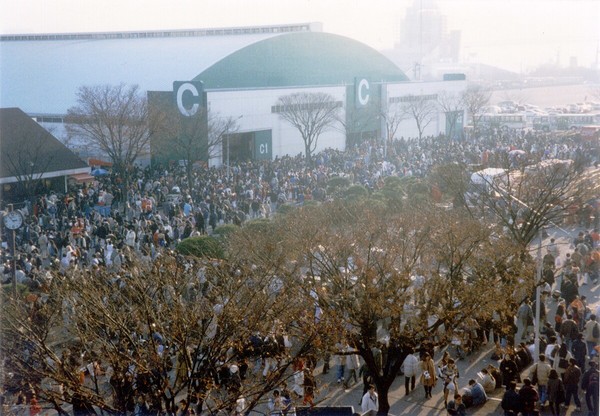
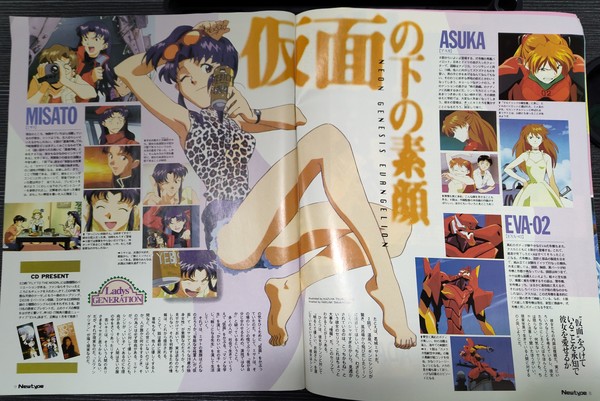
In Japan, the show's popularity skyrocketed. Posts on various RAA threads stated that the soundtrack CDs, especially the opening, were sold out. Even a Japanese user posting in English was surprised that the first Laser Disc volume was sold out as well. Comiket 49 was held on December 29 and 30 at the Arumi Fairgrounds (this would be the last year the event was held there; the next one would be at its current location, Tokyo Big Sight). Multitudes of Eva doujinshi would be present, even though the participating circles listed Gundam Wing in their catalog descriptions. This can be explained by the fact that the applications for booths were due the previous August before Eva's premiere. The show even revitalized the struggling garage kit industry (think a DIY figure you build from scratch), though not by creating figures of the Eva Units, but of Asuka and Rei.
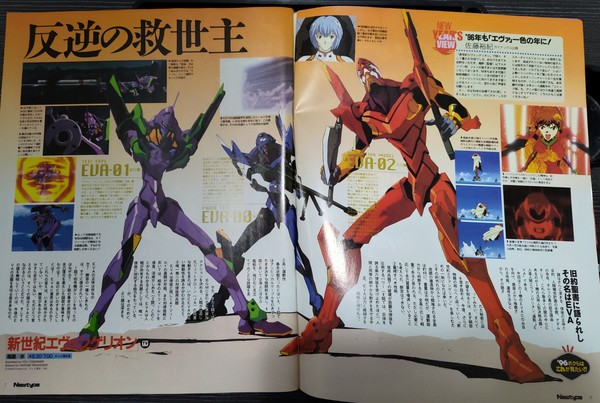
By the time the midpoint of the series came, fans were starting to make connections and having conversations on various aspects of the show. They discussed matters such as the first indications that the Eva Units have a mind and will of their own, with one poster figuring out the connection between Rei and Shinji's mother Yui in episode 15. Others were making connections between the show and the works of science fiction authors Cordwainer Smith and Greg Bear. Of course, many of them discuss matters that were disproven in later episodes, such as the belief that once Touji became an Eva pilot, he and Asuka in Unit 02 would go on to wreck things as a team in either episode 18 or 19. Others thought something would happen that would cause a battle between Evas with Touji and Asuka on one side, and Rei and Shinji on the other.
By episode 18 where an Angel infects Eva Unit 03 with Touji in the pilot's seat and Unit 01 under control of the dummy system is forced to destroy it and nearly killing Touji in the process, the fans were shown in no uncertain terms that despite the time slot it was airing in and the lightness of the episodes after Asuka was introduced, that this could no longer be considered a kids show.
One RAA poster, who was also translating scripts for the community, hated the episode, describing it as “very, very atrocious. Very cruel.” This user goes on to say that he'd refuse to translate the episode because they don't want to see those scenes again. This statement got pushback from another poster, who argued that not wanting to watch the episode again is effectively running away, which is one of the themes of the series. Another poster cited a post from Japan's RAA stating that the show should be taken off the air. The most unusual and perhaps hilarious post was someone asking what exactly happened in the episode, as he had only seen the show up to episode 3. This is a prime example of how, because of the tape trading system, different fans would be at different points in the story. While no one in these posts mentioned anything in particular about episode 19, it can be argued that it led to a similar reaction among fans with its depiction of both the ferocity of the battle with the Angel Zereul and the sheer terror of an awakened Unit 01 devouring the Angel.
Episode 20 would be just as shocking to the fans, but for a different reason than the previous episodes. In this case, it was the inclusion of a sex scene between Misato and Kaji. Even though nothing explicit was seen (but definitely heard), it still caused plenty of consternation. One RAA user wrote that Japanese fans were posting on their own version that the show shouldn't be broadcasting that kind of material in the early evening, but late at night.
This is the point where A.D. Vision entered the picture. ADV, which was formed in 1992, had, according to co-founder Matt Greenfield (who was also a producer as well as the ADR Director for the Eva dub as well as the English voice of Hyuga), in an interview with YouTuber Dylan G, an office already in Tokyo and had done some work with a couple of companies already. One of them was a company called MOVIC, which also had, as part of its role on Eva's production committee, the international distribution rights to the show.
“We were already heavy in negotiations for the title, so it was kind of like we didn't so much hear about it as we were told directly, 'This is coming, are to interested?' And our answer, of course, was absolutely yes.” Greenfield also remarked that many people in the North American anime industry were shocked by how quickly they secured the license. “I know some of the other companies thought they had an in on it, [but were] kind of surprised [to] find out, 'oh wait, they're already in.'”
On February 12, 1996, it was announced that ADV gained the license to distribute Evangelion in North America. Many fans on RAA were shocked that they got the rights compared to other companies, as ADV was then known for two things: creative liberties in their translations and fanservice (if not outright hentai through their subsidiary SoftCel Pictures).
According to William Chow, only five fan-subbing groups were translating the show, and all but a couple stopped after the announcement (the couple that continued did so because ADV was releasing only two episodes per tape). He explained that most fansubbers considered their translations to have what he described as a “shelf life,” meaning they would be replaced by official releases, even if they weren't able to translate all the episodes. However, the most important part of this announcement is that it nearly led to ADV losing the license it had just gained.
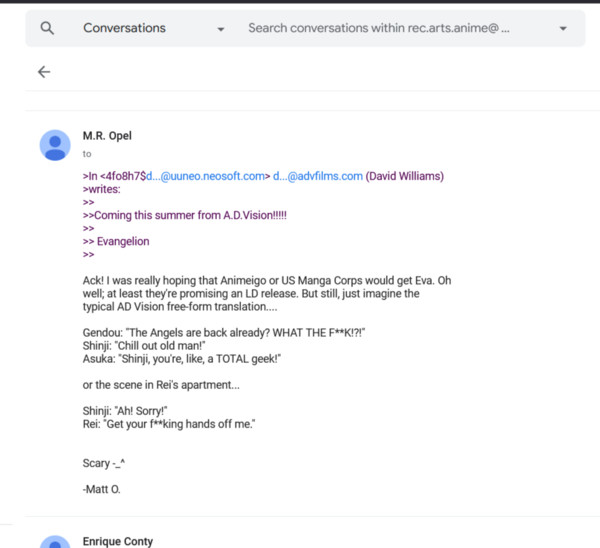
In the original announcement, ADV made a statement that raised a lot of eyebrows:
“Evangelion: The hot action-packed TV currently taking anime by storm comes to the US in a newly created OVA version. This is the same story, same action, but with all new high-quality animation!!!”
OVA version? This left the fans with many questions. Were they talking about redoing the TV show as a series of OVAs or something similar to Gainax's re-edit of their previous TV show, Nadia into a series of films titled The Nautilus Story? Would the Japanese fans get this version as well, or would they be stuck with the TV version? Others were more accusatory, stating that it was being done to sanitize the show for the American market, while others were reporting from RAA's Japanese equivalent that some fans in Japan were speculating that, because of the sex and violence that was prevalent in the most recent episodes, ADV was making Gainax add such content to cater to the American market. The next day, David Williams, ADV's “Internet Liaison,” clarified that it would be the entire TV series with OVA-quality animation. This confused some fans even more as the first several episodes were practically OVA quality to begin with, and while the animation was declining as the show went on, it would take a lot of time to redo it all (today, having a studio redo animation between the TV broadcast and home video release is more commonplace as digital technology allows for a faster turnaround).
And then all hell broke loose.
Stay tuned for part three!
discuss this in the forum (1 post) |
