

Anime in 2025: Is the Crunchyroll Cage Real?
by Kalai Chik,Over 250 anime titles premiered in the U.S. across Crunchyroll, Netflix, Amazon's Prime Video, HIDIVE, Hulu, Disney+, and HBO Max in 2025. To no surprise, series exclusive to Crunchyroll make up almost half of the anime that reach the U.S. market. Considering their built-in audience and concentration on one medium, their massive library and co-produced anime titles are vital to sustaining their business. As demand for anime has grown, other platforms have been courting publishers and animation studios to expand their reach in the U.S. anime market. But through the lens of popularity, as measured by social conversation and Google Trends in 2025, exclusively streaming on platforms outside Crunchyroll hinders more than it helps. At the same time, there are indications that the landscape will shift as Netflix attempts to purchase Warner Bros. and Disney+ integrates Hulu.
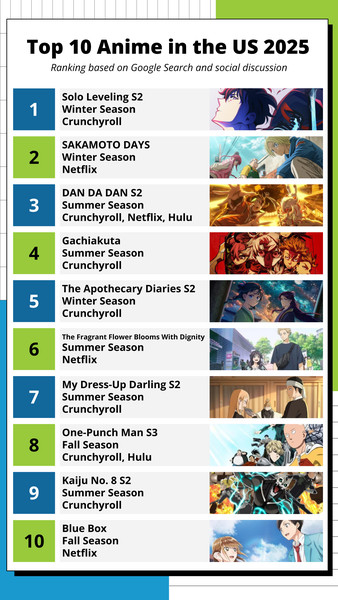
In this article, the popularity rankings were determined by calculating an average score based on publicly available data sources, including Google Search (Global, Japan, and the U.S.), as well as worldwide online discussions across social media platforms and forums. The anime titles in the dataset include ones whose season started in Fall 2024 and extended into 2025, such as Orb: On the Movements of the Earth, Re:ZERO -Starting Life in Another World- Season 3, and Blue Box.
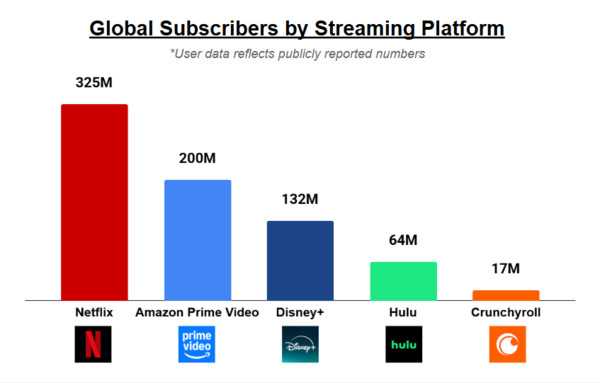
By and large, series that air on Netflix, Hulu, and Prime Video have much higher potential reach due to their large subscriber base, in contrast to Crunchyroll. However, anime series on the Sony-owned platform likely have a higher viewership than the others due to their genre-specific user base. This is tailored to its target audience and is a one-stop shop for anime fans, as opposed to its competitor's content variety. For viewers, Crunchyroll provides the path of least resistance compared to having to fight for attention among live-action series and with non-anime viewing audiences. Consequently, in the US, a title may perform worse if it's exclusively available outside of Crunchyroll because of competing resources, such as marketing budgets, and varying general consumer interests.
The data suggests a popular title in Japan may not reach the same notoriety in the US due to the difference in local reach and marketing efforts of the platform domestically in Japan, in contrast to the US. Although costs for licensing an anime series can range from US$250,000 to US$400,000 per episode, as previously reported by ANN in 2021 (those costs have raised slightly since), that is far smaller than estimates of US$10 million per episode for scripted live-action series that feature extensive visual effects work. Thus, platforms typically have more incentive to market and promote original live-action fiction and nonfiction series with higher budgets than an anime title.
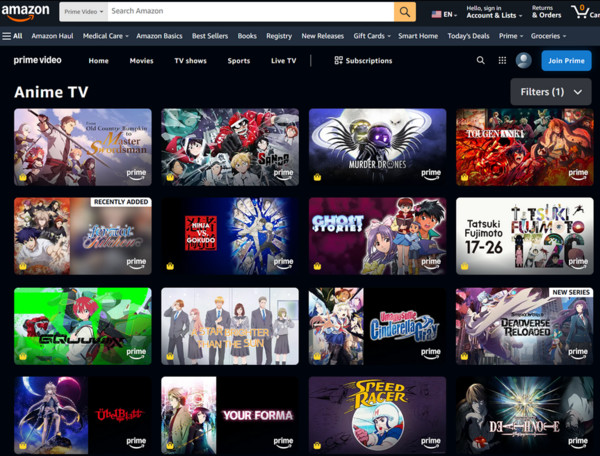
Consider how the following beloved series—Mobile Suit Gundam GQuuuuuuX, CITY The Animation, SANDA, and even Tatsuki Fujimoto 17-26—didn't have the staying power in U.S. interest compared to their popularity within Japan. In fact, From Old Country Bumpkin to Master Swordsman overtook all the Prime Video exclusive anime and remains in the top spot under their Anime genre today. This question extends to the platform's other exclusives, such as New PANTY & STOCKING with GARTERBELT. According to a report from research firm Media Partners Asia, Amazon's Prime Video was the leader of SVOD viewing, followed by U-NEXT and Netflix. Given Amazon's high penetration in Japan, it's no surprise that the aforementioned anime series reached its target audience. However, its results abroad show the limitations of putting anime on these genre-diverse streaming platforms, especially when each company's marketing focus is on its original shows from that year, such as The Wheel of Time (Prime Video), King Of The Hill (Hulu), and Stranger Things (Netflix).
That begs the question of what happens to a title when it's on the largest streaming platform in the U.S.? Outside of Crunchyroll, Netflix is the go-to choice for anime globally. Netflix itself reports “more than half of Netflix's members” watch anime, compared to Disney+ at 32% and Prime Video at 29% in a 2025 report from Dentsu. (Netflix did not define how they identify an anime viewer, and the Dentsu report is based on surveys.) With such a large reach, exclusivity on some platforms will lead to better results than others. At the same time, these numbers could also indicate the ceiling for the respective platform's inherent interest in anime.
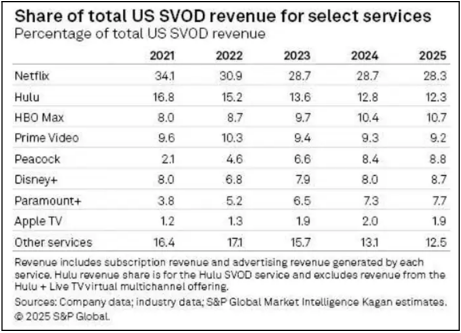
From a big-picture view, Netflix has a healthy reach in Japan and a monolithic reach in the U.S. The streamer made up 28% of paid subscription streaming revenue in the U.S. in 2025, according to S&P Global Market Intelligence (shared by Business Insider), making it the largest and tripling Prime Video's domestic reach. This aligns with Parrot Analytics' reported data in 2023, with Netflix as the top contributor to anime revenue globally. Due to its large market share in both regions, it's unsurprising to see the good reception of its top exclusive titles: SAKAMOTO DAYS, The Fragrant Flower Blooms With Dignity, The Summer Hikaru Died, and Blue Box. Even so, their library is far smaller, and they released only nine anime series exclusively last year.
Yet, overall market reach doesn't always translate to success. Arguably, Ranma 1/2 Season 2 and My Happy Marriage Season 2 were titles available on Netflix that just didn't reach the same heights as their first seasons. Other notable breakouts, such as Rock is a Lady's Modesty (exclusive on HIDIVE) and Medalist (exclusive on Hulu), also didn't reach the level of notoriety in the U.S. despite rave reviews. Based on Netflix's recently released “What We Watched” engagement report, more than 85% of its globally available anime on the list is library content (older than two years). For the anime titles that are available on its platform globally, viewers are still leaning towards popular series like Delicious in Dungeon, Cyberpunk: Edgerunners, BAKI, and Kakegurui.
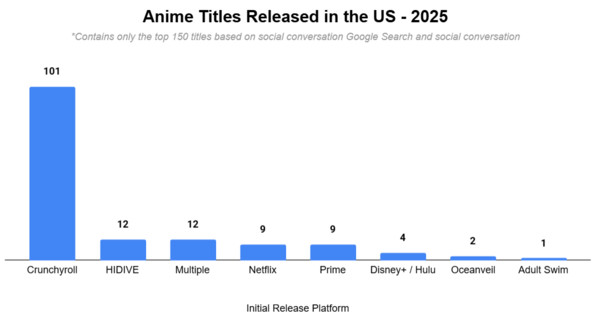
Among last year's top 150 titles, Crunchyroll held exclusive streaming rights to more than 100, more than 8 times as many as its nearest competitor. Thirteen titles, including DAN DA DAN Season 2, WITCH WATCH, and shonen titles—One-Punch Man Season 3, Fire Force Season 3, SPY x FAMILY Season 3, My Hero Academia FINAL SEASON—were available to stream on multiple platforms.
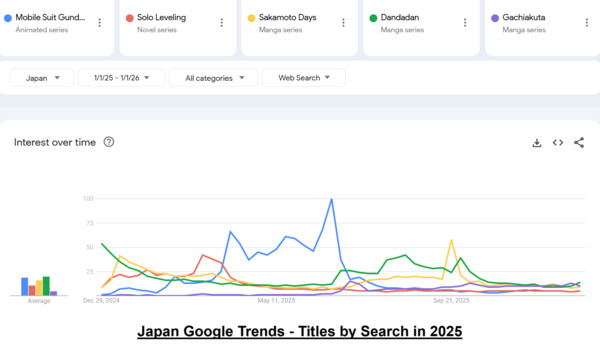
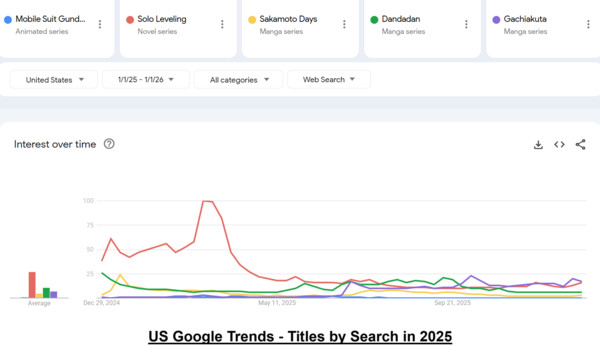
Looking at Google Trends and comparing them between their performance in Japan and the U.S., there's a ridge among the top series between the two countries. Understandably, the inherent interest in Japan for certain franchises will be greater than in the U.S., where there is either a smaller or no pre-existing fanbase. As a Gundam franchise title, Mobile Suit Gundam GQuuuuuuX topped discussion and did extremely well among the Japanese fanbase. Yet that didn't translate in the U.S. There are a plethora of reasons it didn't do as well, but did locking it away on Prime Video prevent people from watching the series?
Considering the lower performance of Prime Video exclusive titles, the answer is a resounding yes. The most popular title available on the streaming platform was From Old Country Bumpkin to Master Swordsman. Within the dataset, the Prime Video exclusive titles—From Old Country Bumpkin to Master Swordsman, CITY THE ANIMATION, SANDA, New PANTY & STOCKING with GARTERBELT, Umamusume: Cinderella Gray, Mobile Suit Gundam GQuuuuuuX, Tatsuki Fujimoto 17-26, Übel Blatt, A Star Brighter Than the Sun, The Dinner Table Detective, and Ninja vs. Gokudo—performed far lower than titles on Crunchyroll, Netflix, and Hulu. These titles all saw (expectedly) a higher search index in Japan compared to the US, indicating the series' strong fanship did not carry abroad.
Taking a step back, how exactly are anime titles licensed in the U.S., and how does that differ from the deals made in Japan? Vincent Imaoka, former Producer of Original Anime at Netflix and former business development at Viz Media, shared his insights. Ultimately, the anime production committee is responsible for deciding whether to license. “The TV network that's a part of the committee is the one to bring the opportunity to the broader committee members,” said Imaoka. At the same time, anime streaming deals are always done separately for the global and Japanese markets.
Imaoka shared that exclusive streaming rights rarely exist in Japan, as production committees aim to maximize viewership for their anime. “There used to be exclusivity when streamers would invest in anime to buy the rights completely in the pre-production phase and turn it into an Original Anime, but that model is moving away, especially as licensing to multiple streamers allows for a broader audience coverage.” He said to think of this as “digital syndication,” like how TV shows used to be syndicated to other broadcast networks.
For example, in Japan, SAKAMOTO DAYS is on Prime Video, Hulu, and Netflix, while Ranma ½ Season 2 is on Prime Video and Netflix, with Season 1 previously a Netflix Original Anime. “The network does a deal for Japan, and then the third-party agent who has global home video rights will do a separate deal for the rest of the world.” According to Imaoka, video sales are still the primary source of profit in Japan. However, Wit Studio president George Wada said in 2023 that “the basis for determining whether or not to continue a series depends on how many people are watching.” As a note, almost all of streaming revenue is profit, but profit from physical media revenue is shrinking due to the increasing costs of delivering physical media.
“Streaming licenses don't pay that much. It's a portion of the production costs upfront, and then nothing afterwards.” In other words, a streaming platform doesn't pay more money as viewership increases for an anime title—but this perspective is up for debate. While it is true that streaming licenses consist of a minimum guarantee and revenue share, often there is no additional revenue share beyond the MG, as reported by Anime News Network in 2021. Licenses are not officially part of the production budget, and being part of a production committee (which is separate from licensing) is a percentage of the production budget.
Even so, Imaoka reiterates that the revenue largely comes from the domestic side in Japan, which is why committees delegate the licensing deal to other parties on the international side. Compared to the revenue that these anime committees see, Japan's domestic revenue is still the majority. It doesn't make sense for them to do these deals separately and spend their time on it.”
“Globally, it's different because everyone works through third-party agents (i.e., Crunchyroll, Viz Media, etc.),” shared Imaoka. He explained that exclusivity in the U.S. is awarded to the highest bidder, granting them a timed exclusive streaming window of three to five years. “Once that streaming right expires, the agent will then look to either renew with the same streamer or look for a new streaming partner, which is why you see anime episodes appearing and disappearing from a streaming service.”
Licensors can also choose not to have their title exclusively streamed on one platform, such as DAN DA DAN and WITCH WATCH. However, the amount a platform is willing to pay for streaming rights is the primary determining factor.
Depending on the projected popularity, platforms will try to outbid each other. Crunchyroll's current strategy is to pay for the upfront production cost to guarantee exclusivity. Netflix used a similar method; however, it was rarely on a committee. "Crunchyroll is investing in being on the production committee. The risk is lessened for these Japanese companies when Crunchyroll puts a lot of money into the beginning. Netflix used to do this as well, which is why you would see 'Netflix Original Anime' on titles."
Others, such as TOHO International, are expanding their foothold and have now cut out the middleman. “They've gone direct for a lot of things now, which is smart for TOHO.”
Two Amazon executives expressed their “big commitment to an anime slate” to Variety last year, but they'll have an uphill battle for distribution rights, as well as the shrinking attention economy. Investment is different from promotion, to which Prime Video has not done nearly as much as its competitors, specifically for anime. Reasonably, the streaming behemoths have their own goals and specific live-action titles they want to promote, which would conflict with the attention they could give an anime title.
On Netflix or Prime Video's main page, the titles with the best carousel spots are all live-action, while animated titles are far lower on the screen. It's also no surprise that Netflix, having lost out on licensing Solo Leveling, is going forward with its live-action adaptation model. Likely, the platform is looking to broaden its hold by adapting IP that has a history of success. Whether their live-action series garners the same level of attention remains to be seen, since they're aiming to reach multiple audiences.
Now that Hulu has been integrated into Disney+, the globally aligned platform will look to expand its foothold in anime, as seen in its investments in Twisted-Wonderland: THE ANIMATION and Star Wars: Visions. “Disney has been going a lot more into anime for the past couple of years,” added Imaoka. “They have an anime acquisitions team in Japan, too.”
I asked Imaoka what platform he would hypothetically select for a future title, and he responded with Crunchyroll. “If I wanted an exclusive title to get more eyes from the anime fan base in the Americas, it would go on Crunchyroll. Subscribers there are already anime fans, unlike Netflix and Amazon. Through Crunchyroll, you'll be reaching an anime audience.” The anime streaming platform presents a low risk and high exposure to the title's target audience. Although Crunchyroll has a vast library, it's easier to compete with other anime titles in its environment, compared to the abundance of non-anime content on broader platforms.
For now, the results from 2025 show that Crunchyroll's hold on anime in the U.S. isn't likely to change anytime soon.
discuss this in the forum (2 posts) |
